
How can the need for new homes be met in areas that are at risk of wildfire? That’s the question posed by researchers from California, USA, which has seen devastating fires in recent years.
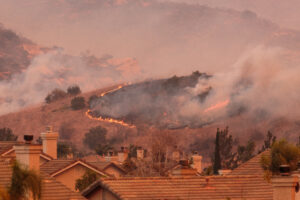
California is increasingly experiencing extreme weather, including wildfires – and the pace at which the wildfires have ignited has dramatically risen in the last two decades. Since 2017 alone, several thousand homes have been lost to wildfires and dozens of residents have been killed. In addition, the smoke from the fires is causing widespread air pollution.
While climate change is undoubtedly contributing to the increased wildfire incidence, researchers have also identified building in the ‘wildland-urban interface’ (WUI) as a critical factor. These are areas of high fire risk, and once homes have been built there it also makes it more difficult to generate low-intensity fire that’s historically a means of avoiding catastrophic wildfire.
The researchers looked at the use of the California Environmental Quality Act (CEQA), by which local authorities can mitigate developments in high fire risk areas having carried out risk assessment. In theory local authorities have considerable power to limit development but in practice they’re under pressure because of severe housing shortages and lack of affordability.
Using risk assessment
 The researchers studied three counties in California that have approved new developments in high or very high fire hazard areas. They found that in San Diego before 2018 the CEQA was little used in decisions on WUI development and that most development was in these areas. More recently it’s been implemented in somewhat reducing development in those areas. By contrast, only a small percentage of Los Angeles development was allowed in high hazard areas.
Interviewees in the study pointed to developers’ preference for sprawl, as building on former agricultural land was cheaper and more attractive to them.
More recently San Diego has somewhat reduced development in higher risk areas – but two thirds of all new units were still in these areas. Nevertheless, the schemes did undergo more stringent environmental review via the CEQA.
The researchers found that generally the fire risk assessment looked at schemes individually, not landscape-wide. Thus, the focus was on making the buildings and surroundings more resilient. Similarly, the fire protection plan tended to focus on whether the building was safer, had sprinklers, etc, and whether residents could evacuate easily.
There was little or no consideration of whether a development would increase the risk of fire in the area, the researchers said.
Several legal cases are underway alleging inadequate review via CEQA and challenging particular housing developments. The researchers suggest that a way forward to meet housing demand without increasing fire risk will be to concentrate on infill building on already developed land. They speculate that state government will have to intervene more in the planning and development process, and that regional planning and analysis for fire hazard will be needed.
Building to Burn? Permitting Exurban Housing Development in High Fire Hazard Zones
Eric Biber & Moira O’Neill