

 By Dr Mahmoud Alsaeed, Research Associate, Cambridge Centre for Housing and Planning Research, University of Cambridge, and Professor Gemma Burgess, Director, Cambridge Centre for Housing and Planning Research, University of Cambridge.
Across the social housing sector, under-occupancy and overcrowding are often treated as separate issues, with one framed as inefficiency and the other as acute need. However, our study at the Cambridge Centre for Housing and Planning Research, conducted in collaboration with Places for People, shows that both conditions are interconnected outcomes of a single systemic imbalance. They arise from a persistent mismatch between household needs and the size, type and distribution of housing stock. The issue is therefore not just about space, but about how effectively the system aligns people and homes across the life course.
The imbalance beneath the numbers
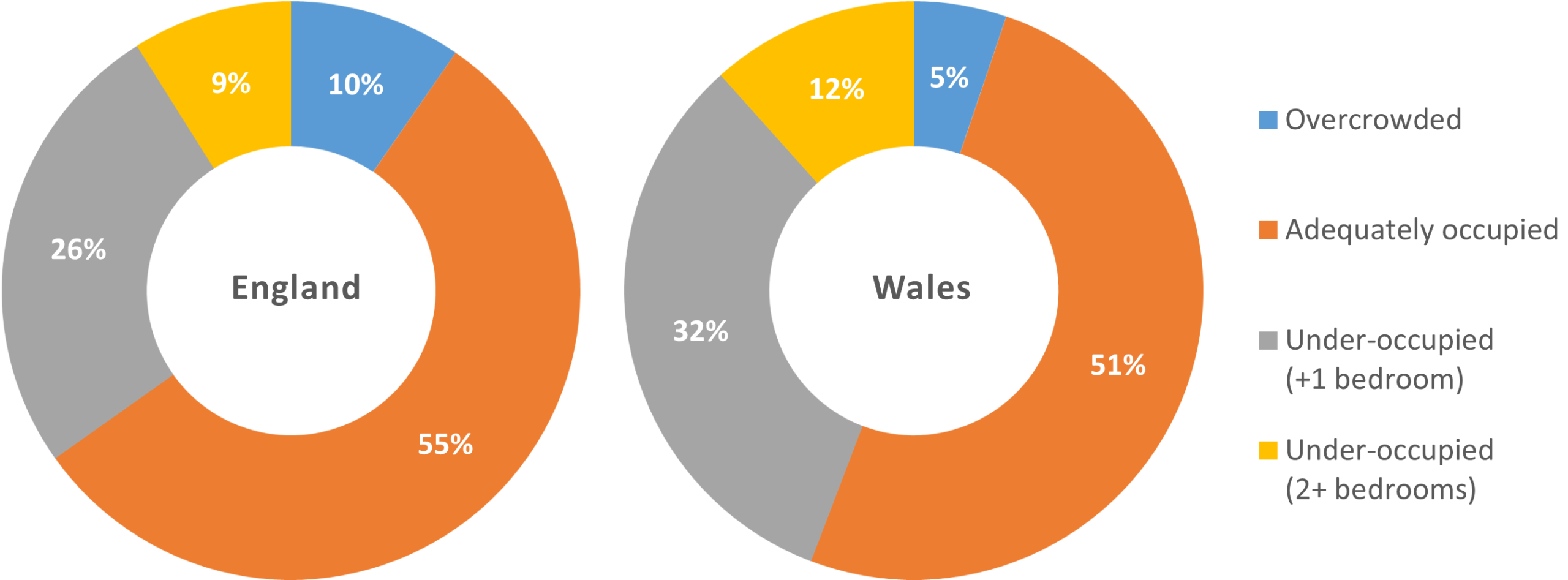
Current occupancy patterns expose a clear structural tension. Family-sized homes, defined by the number of bedrooms available, are frequently under-occupied, while demand for appropriately sized housing continues to grow. The 2021 Census and the ONS 2023 datasets show that more than 397,000 households in England and Wales were living in overcrowded homes, compared to over 1.4 million under-occupied homes. Notably, these under-occupied homes alone account for nearly one-third of the 4.2 million units in the social housing stock (Figure 1).
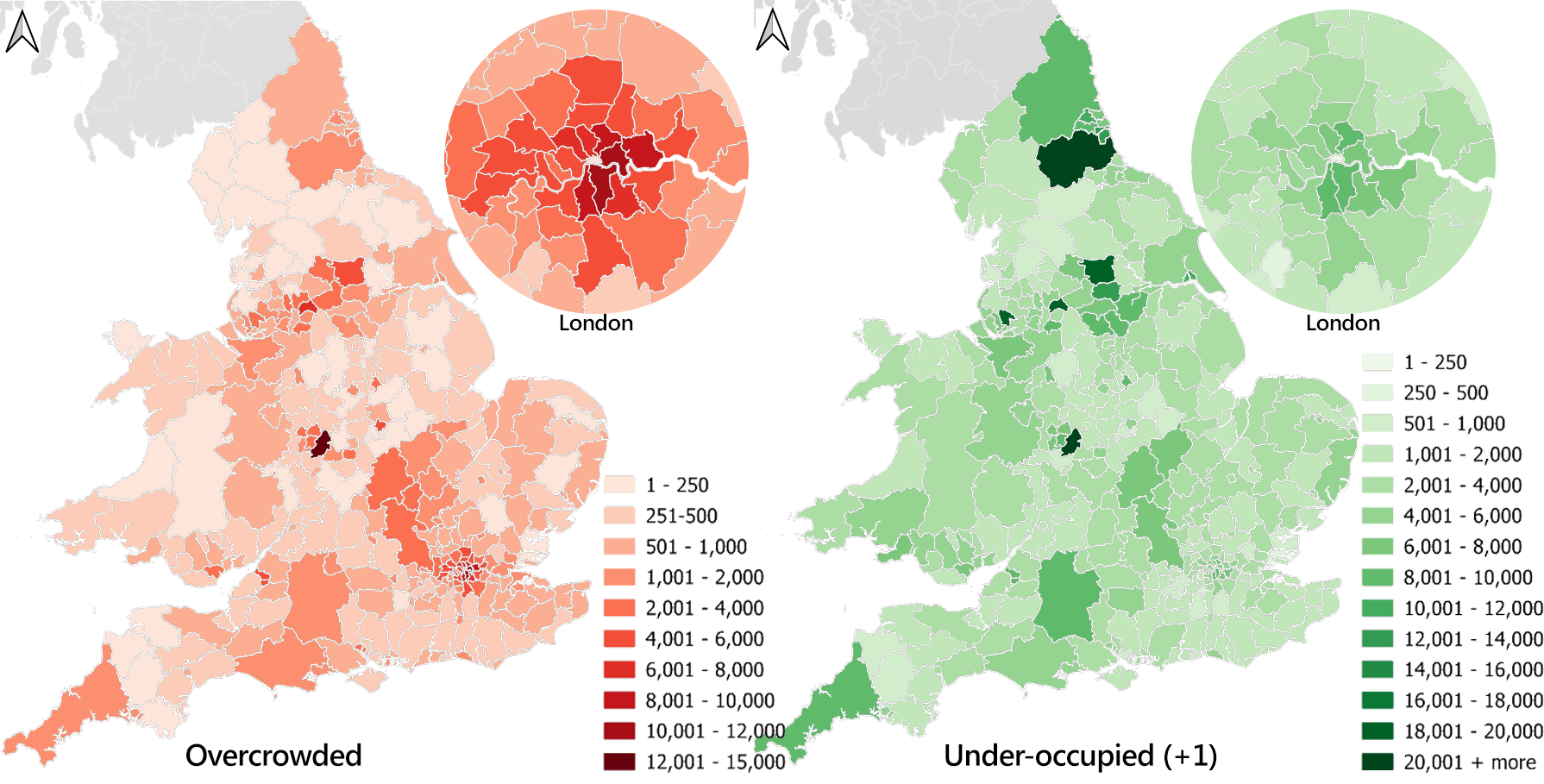
At the local authority level, this imbalance isn’t confined to London, where overcrowding is most acute. Across areas such as Birmingham, St Helens, County Durham, Sheffield, and Manchester, both conditions coexist at scale. This suggests not simply a shortage of homes, but limited mobility within the existing housing portfolio to match households to appropriately sized homes (Figure 2).
The consequences are significant. Waiting lists in some areas extend to 25 years, while reliance on temporary accommodation continues to rise. By 2025, over 131,000 households were in temporary accommodation, including 22,700 in emergency provision, such as bed-and-breakfast accommodation. Nearly 170,000 children are currently living in temporary accommodation in England, highlighting the human cost of this imbalance (Ministry of Housing Community and Local Government, 2025).
Inside the system: What practitioners know
Through a round table discussion, stakeholders across the sector consistently emphasised that neither condition could be understood through metrics alone. Practitioners, housing providers and community organisations point to a deeper structural misalignment between housing stock and household needs.
For many households, particularly older residents, remaining in a larger home isn’t simply a matter of choice. What policy defines as under-occupation is often experienced as an appropriate and necessary use of space. Spare rooms are used for storage, hosting family or adapting to changing needs, revealing a clear disconnect between technical definitions and lived experience.
At the same time, overcrowding reflects constrained access rather than preference. Households are navigating affordability pressures, limited housing supply and restricted mobility pathways within the system.
There’s a strong agreement that rightsizing must be reframed. Rather than a policy tool focused on downsizing, it should be understood as a supported and voluntary process, grounded in trust, personalised engagement and sensitivity to life-course transitions.
The frictions in the system
The study also identified a set of interconnected barriers that constrain households’ ability and willingness to rightsize:
- Mismatch between policy definitions and lived experience, where additional rooms are seen as necessary rather than surplus
- Affordability and financial risks, including higher costs associated with moving
- Emotional attachment, social ties, health, accessibility and care considerations, especially for vulnerable households
- Limited supply of suitable homes, restricting viable relocation options
- Data, funding and engagement challenges, which constrain implementation and delivery.
Together, these barriers highlight that rightsizing isn’t a behavioural issue, but a systemic one.
The limits of a simplistic narrative
While the data reveal clear system-level imbalances, there’s a risk in treating rightsizing as a uniform solution. Housing typologies, demographic characteristics, data accuracy and availability, and allocation policies all shape how these patterns emerge locally. Without recognising this complexity, interventions risk overlooking the lived realities of households and the uneven distribution of need.
From downsizing to rightsizing
Addressing under-occupancy and overcrowding requires a shift from reactive interventions towards a coordinated, rightsizing-centred approach. This means optimising existing stock through supported mobility and chain lettings pathways that are voluntary, personalised and grounded in trust. It also requires stronger data systems to match households and homes better, incentives aligned with real financial and social costs, and consistent definitions and monitoring practices across the sector. Crucially, rightsizing shouldn’t be framed as a loss, but as an enabling process, supported by high-quality housing options and community-based approaches.