
 By Dr Michael Marshall, Research Associate in Quantitative Analysis and Geographic Information Systems, School of Geography and Planning, University of Sheffield.
Improving the quality of England’s rental homes is an important societal objective. Poor-quality and cold housing is a major health risk, associated with accidents in the home, increased blood pressure and asthma. A key legislative mechanism to improve conditions for renters is the Decent Homes Standard. The standard specifies mandatory minimum conditions in the social rented sector, including that homes are in a reasonable state of repair, are free from serious health and safety hazards, and have effective insulation and heating. In 2025, the government committed to extending the standard to the private rented sector (PRS) – the tenure with the highest percentage of Decent Homes failures – by passing the Renters’ Rights Act. The government also has plans to update the standard as it was last updated in 2006. More stringent standards in relation to energy efficiency and the presence of damp and mould will come into effect, in both rental sectors, by 2035.
The scale of the challenge to improve conditions for renters is significant. Estimates suggest that 45% of social rented homes, and 48% of PRS homes, would currently fail the updated standard. But it’s important to remember that the first standard was ultimately in service to a Decent Homes programme that sought to address underinvestment in social housing. Between 2001 and 2008, local authority landlords installed 810,000 new kitchens, 610,000 new bathrooms, and over 1 million new central heating systems. The standard helped direct action, but the success of the programme was contingent upon the extent to which social landlords effectively coordinated stakeholders, managed contractors and communicated with tenants.
The importance of translating a legislative standard into action might seem obvious. But it highlights how challenging implementation of the Decent Homes Standard will be in the PRS. The majority of PRS landlords own only one to a handful of properties. Research suggests many PRS landlords are unclear over their legislative obligations while adopting an ad hoc approach to maintenance. And these issues are compounded by a lack of reliable, granular data on the condition of PRS properties. As such, extending the Decent Homes Standard to the PRS requires coordinating and communicating with a disparate group of stakeholders, while working with limited information.
It’s in this context that, over the past year, a research project at the University of Sheffield has sought to improve the quality and transparency of data on conditions in the PRS. The output of the research is the Non-Decent Index (NDI) – a freely available dataset that identifies areas where a high proportion of homes are expected to fail the (current) Decent Homes Standard. The NDI will be published in May 2026.
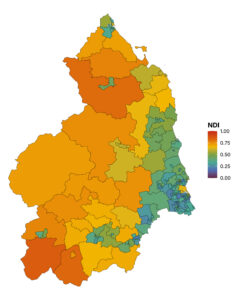
Constructing the NDI involved two stages. Firstly, using national datasets the research identified the factors associated with Decent Homes failure. Risk factors include housing type, energy efficiency rating, heating source, property age and tenure. Areas where there’s a concentration of key risk factors were subsequently identified as potential hotspots of non-decency. This stage of the research demonstrated that non-decent homes come in multiple forms. It’s common for poorer quality PRS housing to be concentrated in urban areas. But there are also significant numbers of rural properties expected to fail the Decent Homes Standard – for instance, where they are off the gas grid (see map of Northumberland).
The second research stage was to validate the NDI. This involved working with local authority PRS enforcement teams to ensure the NDI agreed with their local knowledge. Local authorities provided data from their inspections of PRS housing and qualitative feedback on the NDI. The validation stage found the NDI was highly effective in identifying concentrated areas of Decent Homes failure. In one area identified as a potential hotspot of non-decency by the NDI, local authority inspections found that 85% of PRS properties weren’t legally compliant with housing standards.
Participants in the research suggested several potential uses of the NDI. These included targeting communications to landlords and tenants, directing inspections activity, and identifying areas where landlords will be required by the local authority to acquire a license. The NDI, therefore, has the potential to be a strategic tool for allocating resources and targeting interventions as England’s rental housing is brought up to modern standards of decency.
For more information on the NDI, please contact [email protected].