
How data-driven, explainable AI is enabling housing providers to move from broad assumptions to targeted, evidence-based retrofit strategies.


 By Dr Shamaila Iram, Senior Lecturer in Computer Science, Prof. Phil Brown, Professor of Housing and Communities, and Dr Claire McCamley, Research Fellow in Healthy Housing.
Artificial intelligence (AI) is moving into mainstream use across the housing sector. Some providers are actively experimenting with new tools, while others remain cautious about cost, capability and risk. Alongside this, there’s growing recognition that AI can support more effective service delivery, particularly where large volumes of data already exist but remain underused. Retrofit planning is one such area, where the challenge is no longer data availability but how to translate it into clear, defensible decisions.
The housing sector faces a growing challenge: improving energy efficiency, reducing carbon emissions and delivering better outcomes for residents, often with limited resources. While large volumes of housing data now exist, many providers still struggle to translate that data into clear, actionable decisions.
Traditional approaches to retrofit planning rely heavily on averages, such as energy savings, EPC improvements and standardised interventions applied across housing stock. In practice, properties vary significantly in age, design, condition and use, and many organisations have found that one-size-fits-all strategies rarely deliver optimal outcomes.
Our recent analysis of over 2,400 UK homes with pre- and post-retrofit data highlights this challenge. Some interventions, such as solar photovoltaic systems with battery storage, deliver strong improvements in energy performance, while others produce more modest gains. The effectiveness of any measure depends heavily on the specific characteristics of the property, reinforcing the need to understand performance at property and portfolio level rather than relying on aggregated assumptions.
Moving from data to decisions
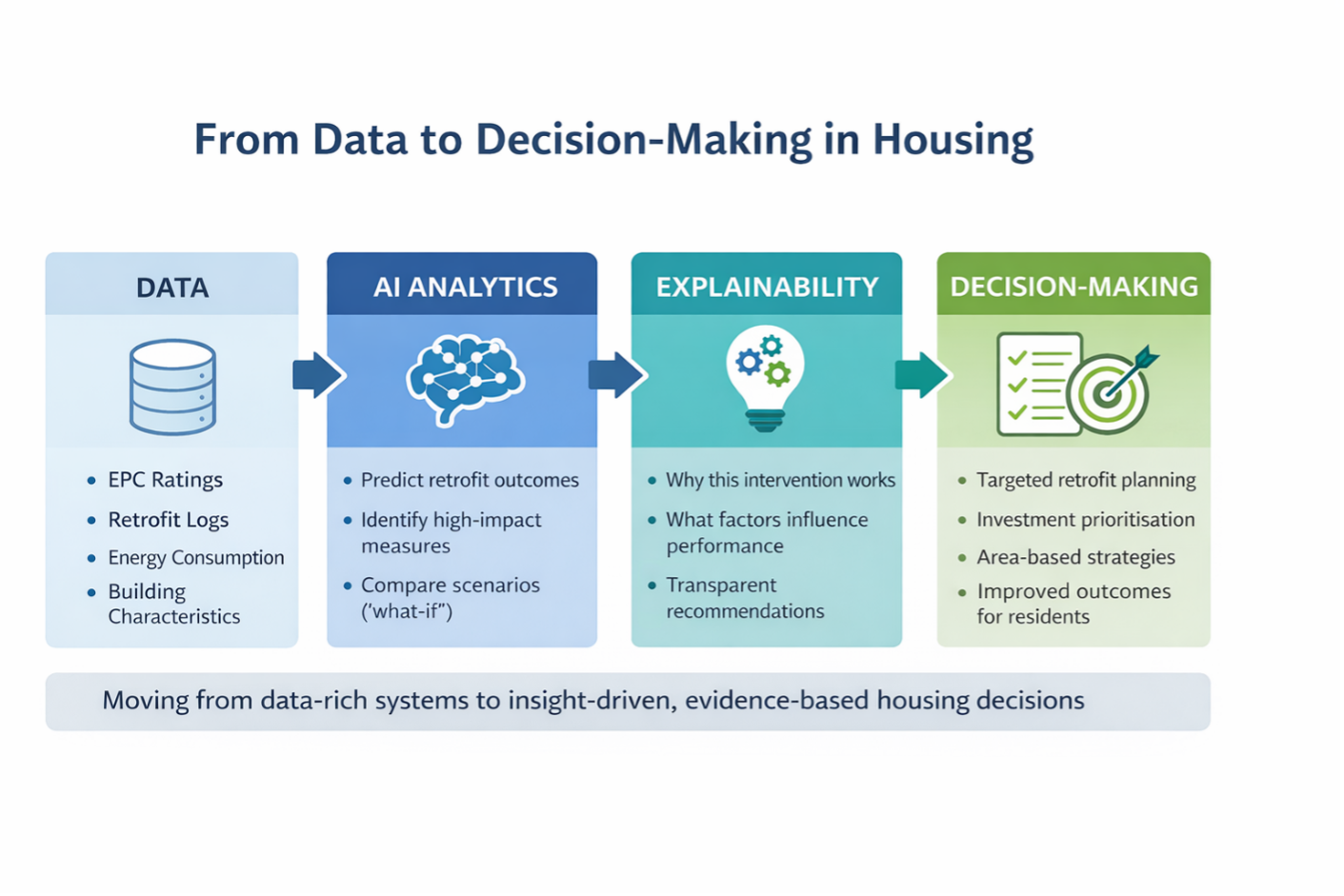
AI is increasingly being used to address this gap by identifying patterns across large datasets and supporting more informed choices.
This means moving beyond static reports towards interactive decision-support platforms that combine housing data, predictive modelling and visual analytics. High-priority properties can be identified with greater precision and intervention strategies compared with before implementation, and ‘what-if’ scenarios tested prior to committing investment. Data shifts from a reporting function to a tool that actively shapes strategy.
A hidden challenge: Data quality
One of the most important findings from our recent work is the importance of data quality. In several cases, properties appeared to perform worse after retrofit. Deeper analysis showed that around 74% of these cases were due to inaccurate baseline data rather than actual performance issues.
This has significant implications, as poor data quality can lead to misinterpretation of outcomes, the undervaluing of successful interventions and ineffective investment decisions. For housing providers, this points to a more fundamental shift: data must be treated as critical infrastructure that underpins decision-making, assurance and investment. This requires attention to baseline accuracy, consistent data standards and the capability to interrogate anomalies.
From insight to action
To respond to these challenges, AI-driven platforms are emerging that integrate data, analytics and user interaction into a single decision-making environment. These tools enable housing professionals to filter properties by age, type and energy profile, identify where specific measures are most effective, detect underperformance, and plan interventions at property and community scales. In practice, this supports more targeted approaches and more efficient area-based retrofit strategies. The evidence also points to the value of combining measures, with the strongest performance gains seen where fabric improvements are integrated with low-carbon technologies.
Building trust through explainability
Building trust remains a central challenge in the adoption of AI within housing, particularly where decisions carry direct implications for investment, asset performance and residents’ lived experience. Transparency sits at the core of this. Explainable AI addresses this by making the logic of decisions visible, showing how conclusions are reached and enabling users to understand and interrogate the reasoning behind recommendations. This stands in contrast to ‘black-box’ systems, where the basis of decisions is not readily accessible. In practice, this enables housing professionals to assess proposed interventions, weigh trade-offs between cost, carbon and comfort, and maintain oversight of decision-making processes. Over time, this supports stronger confidence in data-driven approaches and more accountable and defensible investment decisions.
What are the implications for housing providers?
For housing providers, the shift towards AI-driven decision support has clear implications. Investment can be targeted more precisely, directing resources to where they deliver the greatest impact. Decision-making becomes more robust, with data actively shaping strategy. Delivery can also be scaled more effectively, allowing organisations to move from isolated retrofit projects to coordinated, portfolio-wide planning.
Conclusion
The future of housing retrofit will be shaped by how effectively data is structured, validated and used in practice. Combining AI, visual analytics and explainability allows housing providers to target interventions where they will have the greatest effect, supporting more efficient use of resources, stronger outcomes for residents and a credible pathway towards low-carbon housing at scale. The most effective strategies will connect technical intelligence with people-centred delivery, helping providers decarbonise at scale while maintaining resident trust and improving outcomes.