
Three years on from its announcement in the Social Housing White Paper, the review of the Decent Homes Standard continues to drag on despite it being a priority for secretary of state Michael Gove. So, what’s going on? Neil Merrick investigates.
To start with, it was mostly about kitchens and bathrooms. From the mid-2000s onwards, social landlords spent billions upgrading flats and houses, with special attention paid to the most dangerous hazards.
But two decades later, what exactly constitutes a decent home? As we move further into the 2020s, residents don’t just want homes that are fit for human habitation – they want ones that are safe from the risk of fire and meet higher environmental standards. It’s also nice to have good broadband and be within walking distance of a park.
In the Social Housing White Paper, published in 2020, the government announced a review of the Decent Homes Standard (DHS). Discussions are taking place over equivalent standards in Scotland and Wales.
But in spite of the media attention generated by the tragic death of two-year-old Awaab Ishak in a mouldy flat in Rochdale, the review in England appears to have ground to a halt. A ‘sounding board’ made up of 18 housing bodies, which was proposing ways to improve the standard, hasn’t met since last August.
In a letter to senior coroner Joanne Kearsley in January, Michael Gove said concern over damp and mould showed the necessity of ongoing reviews of both the DHS and the housing health and safety rating system (HHSRS). So, while Gove steps up his TV appearances and threatens to use the law against errant landlords, why are things taking so long?
Gove’s appointment as housing secretary in early 2022 came after part one of the decent homes review confirmed the DHS needs updating. As the second part got underway, he announced (through the Levelling Up White Paper) that the standard should also apply to the private rented sector.
Complications
This had the effect of slowing things down. “It has created lots of complications,” says Matthew Warburton, policy adviser at the Association of Retained Council Housing and a member of the sounding board. “It’s difficult to have different standards for the PRS and social housing, so we go at the speed of the hindmost.”
By the time the Conservatives stopped changing prime ministers last autumn and Gove returned to the Department of Levelling Up, Housing and Communities (DLUHC), the review had been running for nearly two years. A second team of civil servants is now in charge.
“It’s difficult to have different standards for the PRS and social housing, so we go at the speed of the hindmost”
Matthew Warburton, Association of Retained Council Housing and member of the decent homes sounding board
But the main reason for the delay is almost certainly cost. Areas such as thermal comfort, which require buy-in from the Treasury and other government departments, have been shelved, at least for now. Instead, the board was left considering issues such as ventilation, electrical safety and home security.
Thermostatic mixer valves and refuse management also entered discussions. “We were surprised by some of the elements on the table,” says Eamon McGoldrick, managing director of the National Federation of ALMOs. “It’s like everyone was saying what they’d like to see in an ideal world.”

Beyond the DHS
This is not to doubt the desirability, or need, for a higher standard. Some housing associations and councils already go beyond the DHS for new homes, especially in relation to energy efficiency, and upgrade existing properties accordingly.
Oxfordshire-based Soha Housing has a standard, agreed with tenants and staff, that includes weathertight doors, double-glazed windows, communal areas, and fencing and footpaths. “Residents’ expectations in terms of the quality of components have risen,” says Lee Hayward, its director of property services.
Social landlords aren’t just seen as home makers, but place shapers. That means taking responsibility for the surrounding environment. “I hope the review won’t just focus on four walls but look outside the home,” Hayward adds.
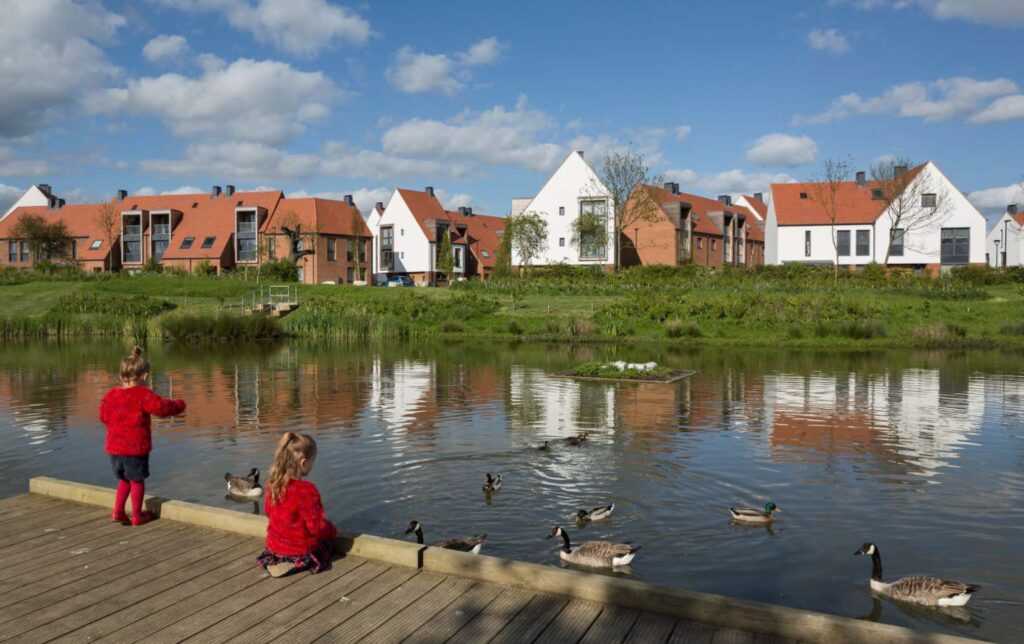
The DLUHC may be pushed towards a fuller standard by other parts of Whitehall. In January, the Department for Environment, Food and Rural Affairs published an environmental plan advocating that future homes should be within 15 minutes’ walk of green space or water. It also called for fewer leaky loos.
In Scotland, the government is a strong supporter of 20-minute neighbourhoods, allowing people to get to work and elsewhere without a car. The Scottish government is proposing a tenure-neutral quality standard with a stronger environmental focus, covering all rented housing and owner-occupied homes.
Ministers in Wales have proposed radical changes to the Welsh Housing Quality Standard, which could see landlords responsible for water efficiency, biodiversity and noise levels [see box].
But all of this comes at a cost. “It’s about how far you push the minimum,” says Louise Attwood, executive director for property at Cardiff-based Linc Cymru. “It’s about finding a balance between a great customer outcome and being able to afford everything.”
Will Jeffwitz, head of policy at the National Housing Federation, says there’s an appetite among associations to make homes more energy efficient and keep pace with tenants’ expectations. “Whatever new requirements are introduced, there should be a realistic assessment of costs and how they’re going to be met.”
In Cornwall, Coastline Housing carries out community standard inspections that cover wider concerns, including grounds maintenance. They can lead it working with local authorities over issues such as the condition of roads and waste collection.
It’s not unheard of for a parish council, or residents’ group, to take over a park or play area that was inherited by the association when stock from Kerrier Council (since abolished) was transferred in the late nineties. “People want more vibrant green space rather than just a patch of grass,” says chief executive Allister Young.
“Whatever new requirements are introduced, there should be a realistic assessment of costs and how they’re going to be met”
Will Jeffwitz, National Housing Federation
It remains to be seen whether the decent homes review concludes that social and private landlords should meet the same standard, or different ones. If the latter is the case, says Young, social landlords are likely to face a broader standard.
Alternatively, if both sectors face the same minimum standard, social landlords might be required to achieve higher outcomes through regulation. “It’s perfectly fair that our responsibilities do not end at the front door,” he adds.
The search for higher-quality benchmarks doesn’t negate the need to address basic standards. Research by the Building Research Establishment shows that about 5% of social housing in England has a ‘category 1’ hazard, such as damp and mould, with a potential cost to the NHS of £65m per year.
According to Matthew Warburton, the existing DHS is being taken more seriously in government because of what happened in Rochdale. “My feeling is we won’t stop there,” he says. “Either the Regulator of Social Housing or the DLUHC will be asking questions about other category 1 hazards.”
Ponderous progress
All of which makes the review’s ponderous progress more frustrating. No date has been set for its conclusion, but ministers have an ‘ambition’ of halving the number of non-decent homes in all rented sectors by 2030. Results of a consultation over the extension of the standard to the PRS, which ended in October, have still to appear.
In Exeter the council isn’t just building to Passivhaus standards, but retrofitting so existing homes achieve an EPC rating of A or B+. To date, about 10% of its 4,000 homes have been upgraded with solar panels and other features. “Standards need to be there,” says deputy leader Laura Wright. “When people complain about something or raise an issue, it should be responded to.”
Jenny Osborne, chief executive of Tpas, says extending the standard to the private rented sector is a “laudable ambition”, but raises major questions. “It’s difficult to see where the drive is coming from to enforce in the PRS,” she adds.
In some cases, social and private renters live on the same street, making it unlikely that ministers will plump for different quality standards in each sector. “We all want to see the PRS involved,” says Osborne.
In a statement on the current state of the decent homes review, a DLUHC spokesperson said: “Part 1 of the decent homes review concluded in autumn 2021. In March 2022 we brought together representatives from across both rented sectors to discuss what might be included in a revised DHS that applies to both sectors.
“The government has set an ambition for non-decent homes in all rented sectors to be reduced by 50% by 2030 with the biggest improvements in the lowest-performing areas.
“Part 2 of the DHS review will now consider how best to deliver on this for both social and private rented sectors.
“To ensure a logical approach to the review and prioritise developing a new standard that meets present day minimum safety and decency requirements for both the social and private rented sectors, we consulted on applying the DHS to the private rented sector as an initial step.
“Once we’ve reviewed the conclusions from that piece of work, we’ll consider how best to take forward the wider DHS review.”
What is the Decent Homes Standard?
For a property to be considered ‘decent’ under the DHS it must:
- Meet minimum standards under the housing health and safety rating system (HHSRS). Homes with a ‘category 1’ hazard are classed as non-decent
- Provide a reasonable degree of thermal comfort
- Be in a reasonable state of repair
- Have ‘reasonably modern’ facilities and services.
According to the English Housing Survey, 10% of homes in the social rented sector failed to meet the standard in 2021. This is lower than for private rented (23%) and owner-occupied (13%) homes.
4% of social housing had a ‘category 1’ hazard, also less than in the other sectors. The most serious hazards in the social rented sector are potentially dangerous stairs and damp and mould.
Where a landlord faces serious difficulty removing a ‘category 1’ hazard, government guidance says they should do their best to reduce risk and avoid placing vulnerable tenants in such properties.
Wales aims higher – but at what cost?
Since 2021 virtually all social housing in Wales has met the Welsh Housing Quality Standard (WHQS). Introduced in 2002, it exceeds the Decent Homes Standard by requiring homes are located in “an attractive and safe environment” and, where possible, meet the needs of people with disabilities.
However, a revised WHQS that could be in force by the end of this year is poised to stretch the idea of what constitutes a quality home even further.
Draft proposals for WHQS2, published by the Welsh government last year, suggest homes might be assessed for water efficiency, their impact on affordable warmth and the environment, and biodiversity.
The new standard could also cover flooring, noise nuisance and whether the home encourages active travel by, for example, providing space to store a bike.
The Welsh government received more than 200 responses to its consultation, half of which came from tenants. While tenants were generally keen on the proposals, most landlords questioned whether they’re achievable, partly due to cost.
Community Housing Cymru says it will cost associations at least £2.05bn to upgrade homes to an energy performance certificate rating of A by 2033, as proposed. The timeframe for moving to WHSQ2 is also seen as impractical.
As proposed, the revised standard will require extensive work, says Louise Attwood, executive director for property at Linc Cymru – thus could be stymied by supply chain problems and shortages of contractors.
Linc regularly installs air source heat pumps at new properties, as well as providing rear patios and garden sheds. But significant new requirements could push up service charges. “The more you add on, the more it costs,” Attwood says.
Providing a place and home for living
It’s two years since Sovereign Housing Association began assessing homes against a more ambitious science-based benchmark.
Its home and place standard is based on a wider concept of what constitutes a good home, including the immediate environment, energy sources and resident well-being. The standard, devised with residents, has four themes – customer, home, place and sustainable future.
Homes in the pipeline are given a rating of good, very good or excellent. “We use it to score every property or piece of land we’re looking to buy, to inform investment decisions,” says Jim Dyer, Sovereign’s director for built environment.
With Sovereign building about 2,000 homes per year, the standard evaluates not just whether they are affordable and promote good health, but their proximity to schools, transport and potential jobs. Are they within easy reach of green space?
A ‘very good’ rating meets revised building regulations that came into force last year. ‘Excellent’ is in line with the future homes and building standard, due to take effect in 2025. “If you’re going to make something better tomorrow, you need to know where you’re starting from today,” says Dyer.
The association’s existing stock of 60,000 homes has also been scored against the standard, but retrofitting presents a greater challenge. From 2035, all social housing in England is meant to achieve an energy performance certificate (EPC) rating of C. Sovereign wants as many homes as possible to reach EPC B or better.
In March, the association received £9.4m from the social housing decarbonisation fund that will be used to install air source heat pumps, battery storage and other low-carbon technology. But it’s outside the home that residents will eventually notice most difference.
There will, in future, be more emphasis on landscape and biodiversity, with residents encouraged to use public transport, or walk, rather than rely on cars. “If our job is to provide for those most in need and create thriving communities, we have to consider place as much as the home,” he says.