
 Community-led housing approaches have grown in global importance and prominence, writes Dr Tom Moore.
Around the world, citizens are collaborating to tackle problems of housing affordability, inequities in land ownership, and community disempowerment in decisions over land use and development. Examples include the community land trust (CLT) model, the genesis of which lies in the United States Civil Rights movement and has since been adopted in South America, East Africa, and Western Europe, as well as models of cooperative and collaborative housing.
Beginning in 2018, World Habitat’s Global Community-Led Housing (GCLH) Programme has supported the promotion and development of community-led housing internationally. There’s been a specific emphasis on facilitating the exchange of knowledge and ideas between community-led housing initiatives globally.

Evaluation
In late 2021 and early 2022, qualitative evaluation of the GCLH programme was undertaken to explore the value and impact of the transnational exchanges that it facilitated. This involved 18 interviews with communities and stakeholders representing a mix of new and emerging initiatives and more established groups and advocates.
The evaluation found that transnational exchanges are important to the development of community-led housing. It’s particularly important between groups and organisations in parts of the world where community-led housing is more established, and those in locations where it’s less developed. Peer-to-peer exchanges, facilitated by World Habitat and knowledge exchange networks that it funded (such as the CoHabitat Network), enabled communities to share experiences of policy development and lessons from stakeholder relationships. They aided understanding of how different models can be implemented in different contexts.
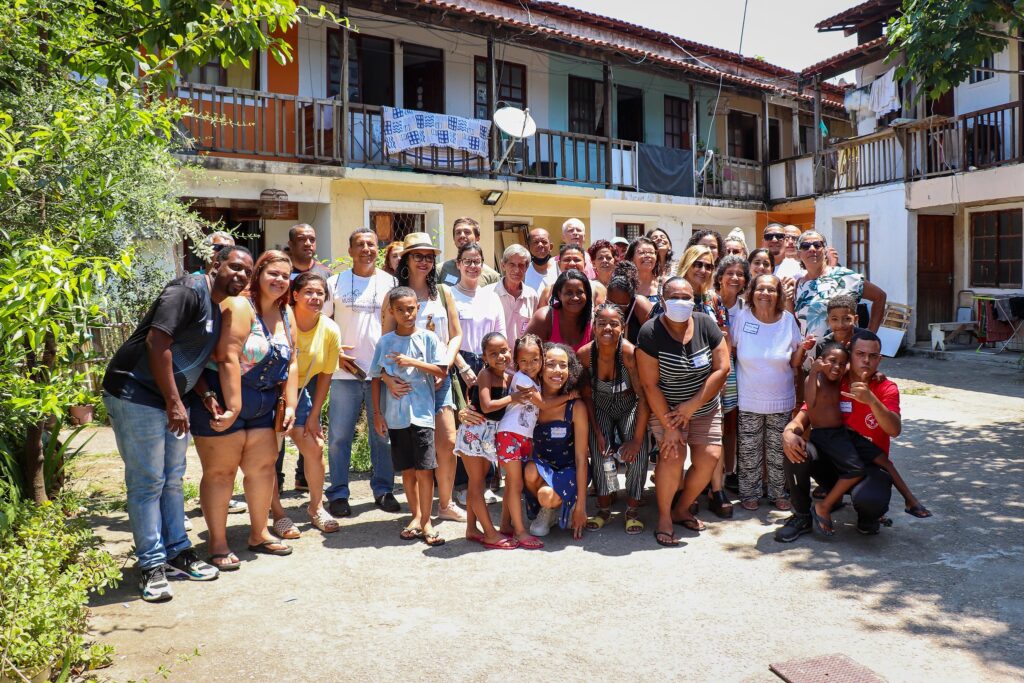
One example of this was found in exchanges between the established Caño Martín Peña CLT in Puerto Rico and Catalytic Communities in Brazil, where funding provided by World Habitat helped the Brazilian group to successfully lobby the Rio de Janeiro City Council to develop supportive policies for CLTs. Interviewees felt that peer-to-peer exchanges had been influential in their adoption and pursuit of CLT ideas.
Similarly, the GCLH programme supported and facilitated the development of the MOBA network of community-led housing groups in Central and South Eastern Europe. Here, a coalition of activists and groups from Croatia, Hungary, Czech Republic, Serbia and Slovenia have collaborated to develop new funding mechanisms.
Novel approaches
In addition to tangible impacts on policy, transnational relationships were also important in attaching legitimacy to community-led housing initiatives in areas where the concept is new, unfamiliar, or unsupported by local authorities. Global alliances such as those coordinated by World Habitat were felt to help legitimise the different and novel approaches to housing production and consumption that community-led housing models promote – particularly as they helped to showcase the scale, breadth and potential of such models globally.
While global alliances were highly valued, interviewees also highlighted that differences in social, economic and political context can limit the extent to which these alliances can have a transformative effect on local policy. The coordination of such alliances and exchanges by organisations such as World Habitat was important. But locally-specific challenges of policy development and implementation, funding for land acquisition and development, and legal frameworks often required specialist knowledge of local contexts.
Shared values
Participants were keen to emphasise that broader diffusion of community-led housing is aided by transnational networking, but that transfer of models or policy was not straightforward or predictable in different contexts. Nevertheless, the community-led projects in this evaluation shared a commitment to housing that is not driven by profit. It centres around the role of citizens and communities in the planning, management and ownership of land and housing. Participants spoke passionately about shared commitments to issues of racial inequity and injustice that are perpetuated through housing and of the need to develop climate-friendly housing solutions, providing inspiration for future global collaboration and networking.
Dr Tom Moore is Senior Lecturer in Housing and Planning at the University of Liverpool
This article was first published in 2022 following qualitative research conducted by Dr Tom Moore with individuals representing collaborators and participants in the World Habitat Community-Led Housing Programme.