
 Prof Jim Clifford OBE, Director of Sonnet Impact and Hon Professor, Sheffield Hallam University
Social housing is valuable, bringing a place to call your own to many who cannot otherwise afford it. Value is one of those things that raises further questions. How valuable, to whom, and what are the stories that underpin that? How can we be sure? How can we use that knowledge?
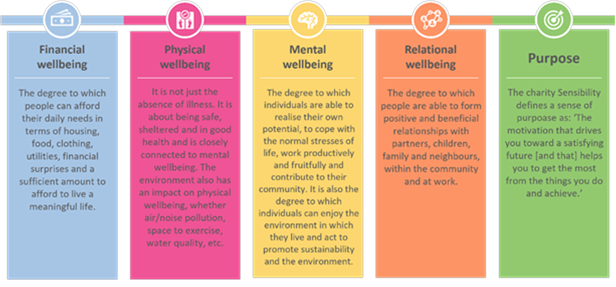
In 2017 Peter Denton, then CFO at the Hyde Group and now CEO at Homes England, and myself – then at BWBImpact, now Sonnet – pondered just those questions. We decided to pool resources to develop the answer – an answer that could inform all discussions involving housing – and The Value of a Social Tenancy (VoST) was born. The 2017-18 research, led by the Sonnet team, showed eight elements in social housing that drive the value it brings. It identified outcomes achieved from the perspectives of various stakeholders and was able to value those. It compared the researched storylines for three groups of tenants (those who are thriving, managing and struggling within supportive social tenancies) to the stories of their lives if they hadn’t gained their tenancy: in temporary accommodation, sofa-surfing and lower standard private rentals. It explored outcomes in the five pillars of wellbeing, shown in the diagram at Fig.1. The approach and the results gained considerable accolade from policymakers and others.
Since 2018, VoST has been used by Hyde for its annual reporting, and for evaluating strategy focused on impact, including regeneration programmes and local specialised support. It’s also supported Hyde’s development of partnerships with local authorities and institutional investors. Other housing associations, housing funders and housing-related providers have drawn upon and developed it, too.
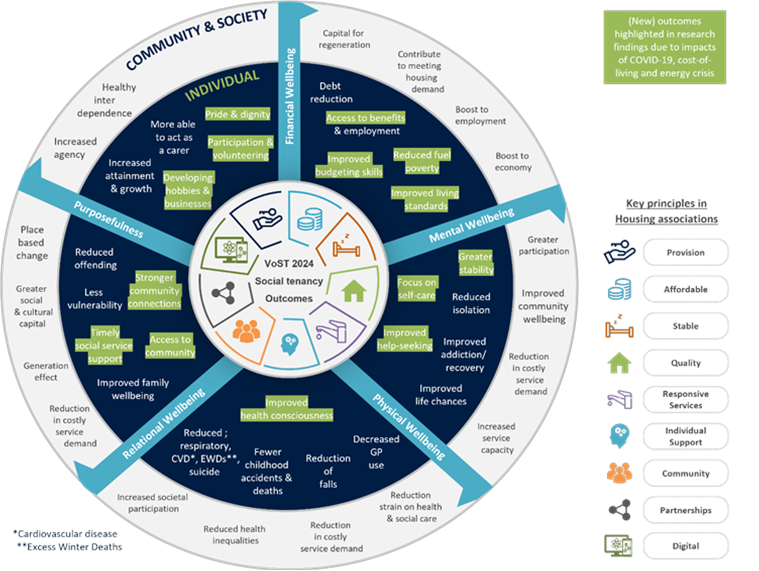
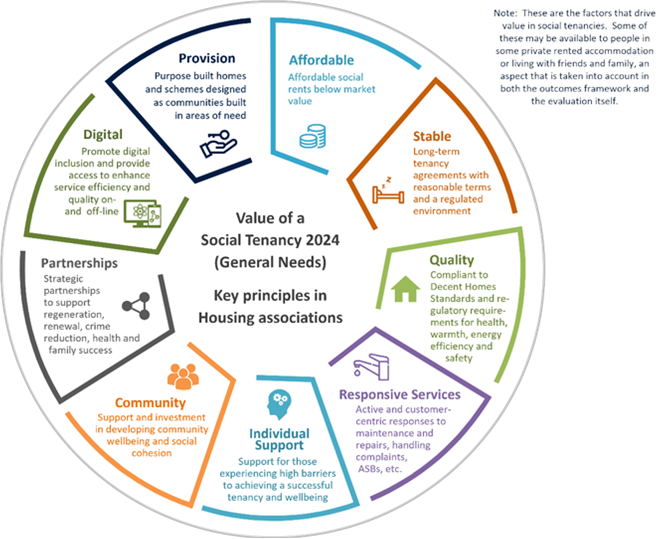
VoST brings so much insight, but is now six years old. So, in 2024, Sonnet and six HAs – A2Dominion, Guinness, Hyde, MTVH, Platform and Sovereign, with support from others – have re-explored the underpinning stories, reflecting the world post-Covid, the cost-of-living crisis, and changes in the shape of the housing market. Working through tenant and housing staff workshops, and interviews with internal and external stakeholders, it’s built a strong update to the earlier evidence. The updated view of the nine factors that drive the benefits in social housing is shown in Fig. 2. ‘Digital’ is a new element highlighting HAs’ responses to the rising importance of digital wellbeing and inclusion.
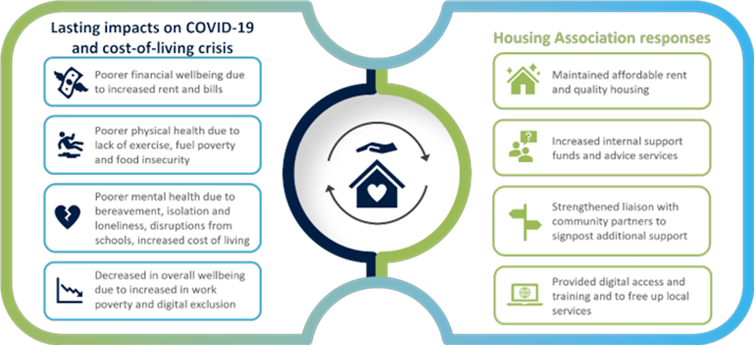
Social tenants reported negative consequences, including poorer finances due to higher cost of living, and worsened physical and mental health with the associated impacts of lockdown and the pandemic. Three major new challenges were apparent, with effects in all five of the pillars. In-work poverty among low-income households is the first. It compromises the health of working age adults, the educational attainment of children, and the mental health of the whole family. Digital wellbeing is the second concern. More aspects of our lives require digital access – communicating with services, obtaining better prices on essentials, and accessing education and work. Finally, with the rising cost of private sector rentals, key workers, such as NHS staff, teachers and social workers, are having to move away from city- and town-centre jobs, leaving capacity gaps in key public services.
HAs were able to provide a safety net for those struggling in the pandemic. Figure 3 shows how. Tenants reported being more aware of their physical and mental health needs and developing stronger community connections as positive impacts of Covid-19. With social housing, they were able to maintain stability and dignity in challenging circumstances, and develop new hobbies and businesses. These have all increased their pride for living in social housing and improved their wellbeing in the longer term.
Changes in costs and assumptions have been reflected in the re-modelling. These include temporary accommodation costs (+4.4% since 2022), increases in the amount of average debt (+24.7%), increases in GP visits (+16.7%), and a 7.2% increase in value from employment. The costs of digital exclusion weren’t explored in the study at this stage.
Outcomes for individual tenants and their families, and for communities and wider society have shown change since the 2017-18 VoST study. Fig. 4 shows the map of these, categorised by the five pillars of wellbeing, with the new ones highlighted in green.
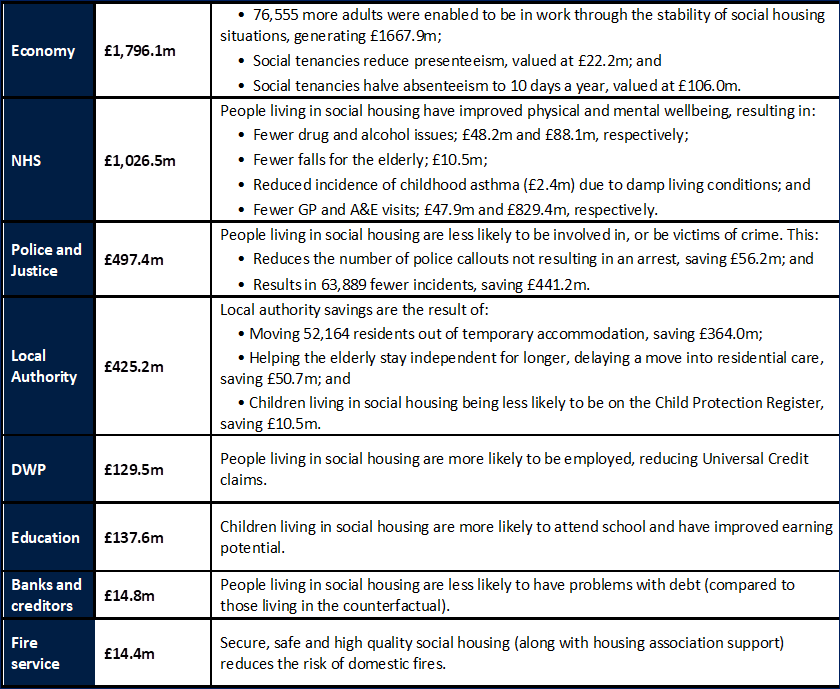
The total value of each social tenancy, averaged across the participant HAs’ combined 220,000-tenancy portfolio, is at least £23,777, of which £18,051 is the social value in tenants’ lives, and the rest is the average annual economic gain by constructing and maintaining the properties. Fig. 5 shows the social values brought to different stakeholders.
In the last two months, CEBR for NHF/Shelter(1) and the G15 group of HAs have published research on (i) redressing the shortage of social housing, and (ii) the value of social tenancies in different areas of London. The latter uses the updated VoST figure for value. The former, whilst drawing on VoST, focuses particularly on the construction and maintenance of homes, modelling the gains flowing from that, in the short and longer term. As such, it answers a different question from VoST, so produces different figures:
VoST: the (annual) value brought by maintaining and operating a social tenancy in a general social housing portfolio
CEBR: the present value of 30 years’ economic gains through building new social housing, if tenanted by employed people coming out of the private rented sector.
VoST is evidence-based and holistic in its view. It’s of wide value to HAs and others in planning, reporting, strategic refining of offerings, deep analysis of delivery for specific groups of tenants, and as a foundation for discussions with policymakers, funders and delivery partners. It’s complementary to the HACT Social Value calculator, which explores changes in wellbeing over a period for a defined group of tenants, rather than the value brought by providing the tenancy. The plan is that VoST will be made available to the sector on the HACT platform to make it easier to access.
With that in mind, the means of segmenting a portfolio between the three life stories – thriving, managing and struggling – has been refined and simplified. For general reporting it can be driven by figures for rent arrears, which correlate sufficiently with wider wellbeing measures. Where a housing provider wants more accuracy and nuance, they can use one of three other standardised segmentation approaches. Using VoST will require segmentation, and provide easily-available information about the portfolio. This approach appears straightforward but will be tested out with a wider group of HAs over the next two months.
The full report (2), contains the new evidence-based analysis of the value brought by the provision of social tenancies, and the figures are striking. It’s set to be available soon across the whole sector thorough the HACT platform.
Footnotes
1 The economic impact of building social housing (2024)