
 Anna Pagani
“[…] it’s become social work, it’s become healthcare, it’s become the community involvement […] we are stepping in and taking things that local authorities would have done but are not in the position to do. […] the bit that really worries me [is] that sense of ‘can’t do everything’ […].”
(Housing association participant, May 2023)
Social housing is essential to ensuring affordable access for all and is a cornerstone of housing justice. Yet in England, and particularly in London, the social housing stock has decreased dramatically, from 31% in 1979 to 16% in 2023. Most studies to date have addressed the causes and consequences of this loss in isolation — focusing for instance on changing housing politics, policies and standards, on tenant stigma and discrimination, or on redevelopment and gentrification. Understanding their interactions and the system they shape, however, is critical to guide interventions that maximise co-benefits and minimise unintended consequences.
With this goal, our latest study used systems thinking to visualise the complex system that underpins critical issues in the social housing sector, and to identify possible leverage points within it. We translated the content of the report The Better Social Housing Review and the book chapter The Gentrification of Social Housing by Melissa Fernández Arrigoitia into six systems maps (causal loop diagrams or CLDs), revealing the system structures that govern the dynamics we observe in the social housing sector in England. The diagrams were enriched and validated in participatory activities involving four London-based housing associations and the authors of the two studies in activities. Here, I summarise some of the key dynamics emerging from the analysis.
1. Pressures on the delivery of social homes
In England, and London specifically, social housing delivery faces multiple converging pressures – external financial pressure, austerity-driven funding cuts, changing safety and climate policies, and the increasing support needs of tenants. In response, housing associations turn to market-based solutions to grow and maintain their social housing stock (the cross-subsidy model). According to participants, as the share of market homes increases, social housing is reduced to a “specialist product”, reserved for tenants with more complex needs. This results in an increase in the demand for support services that housing associations provide to their tenants, and thus more financial pressure – a reinforcing loop. The residualisation of the sector is deepened in parallel by government policies like the right to buy, generating shortages in the most attractive larger, family-sized homes – triggering, again, more construction. The higher costs to replace larger homes and the difficulty for social renting households to afford these properties (due to the cap on their income) leads to a reduction in the size of new homes, limiting tenant mobility and reinforcing overcrowding, health issues and longstanding social inequalities.
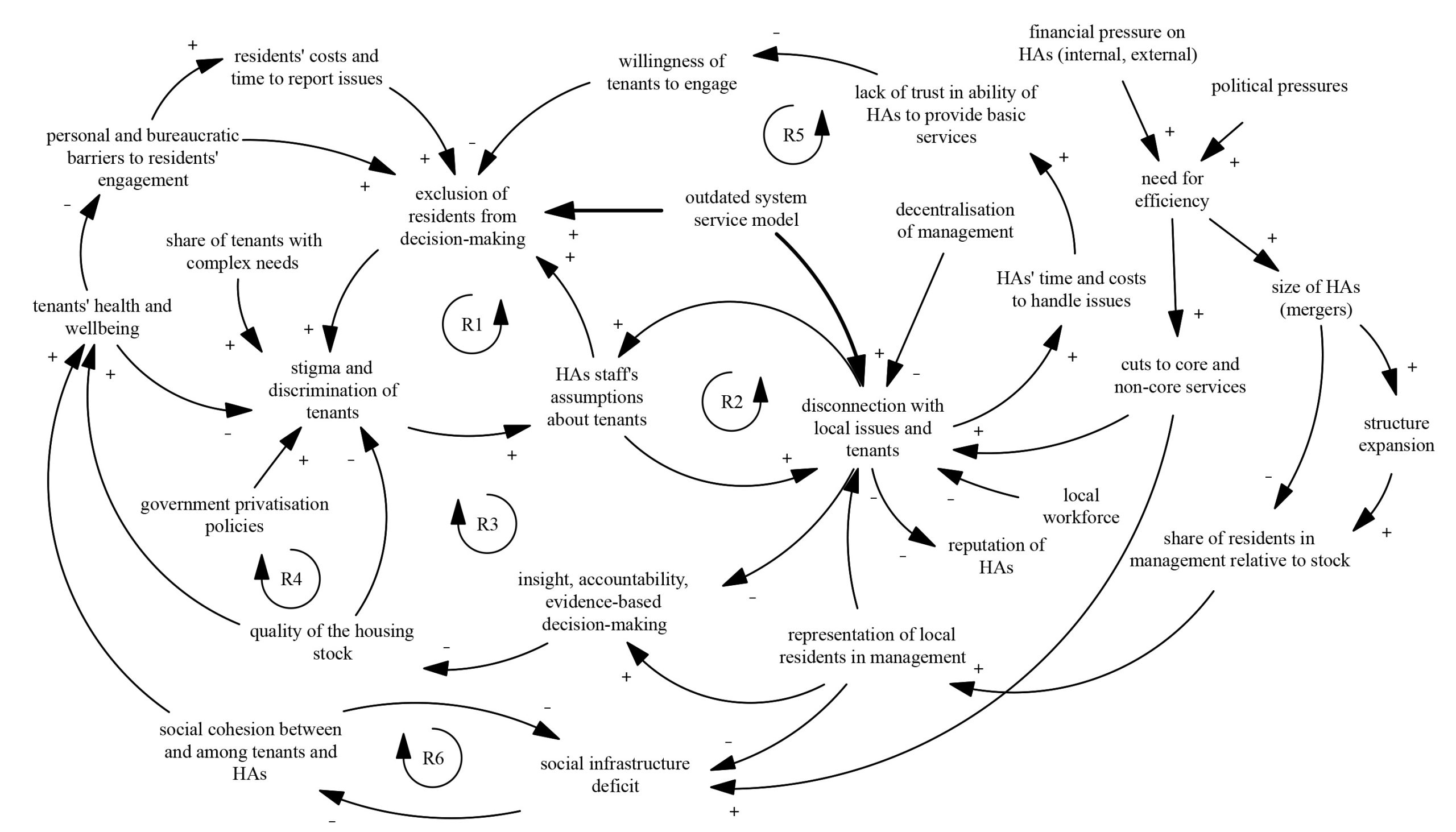
2. Disconnection between management and tenants (see figure 1)
Government-driven policies prioritising homeownership, and the associated reduction in the quality of the housing stock and tenant health and wellbeing, altogether intensify stigma and discrimination of social housing tenants. Stereotypes can lead to resident disengagement from decision-making processes, especially among racialised and minoritised communities, whose voices are too often overlooked. These system structures reinforce stigma, worsen the disconnection of staff with local issues and tenants, and undermine housing quality, health and engagement.
The CLD also shows how inefficient, outdated service models further erode trust in the ability of housing associations to address issues, worsening resident exclusion and self-exclusion. Meanwhile, tenant engagement is further undermined by the lack of funding to support social infrastructure, affecting social cohesion, stereotypes and stigma.
3. Management issues
Poor connections between housing associations and tenants not only discourage complaint reporting but also undermine accurate problem identification, resulting in delayed, reactive approaches to repairs. This reactive stance strains staff, who must handle heavy workloads amid frequent turnover, larger patch sizes and inadequate training, all of which compound their stress and reduce their capacity for proactive maintenance. In turn, under-reporting and misreporting of issues persist, eroding staff’s understanding of housing conditions and fuelling a cycle of inefficiency and frustration. Participants stressed that providing accessible, user-friendly technologies – and avoiding a ‘digital by default’ approach – could improve communication, streamline reporting, and ultimately foster more responsive and effective housing services.
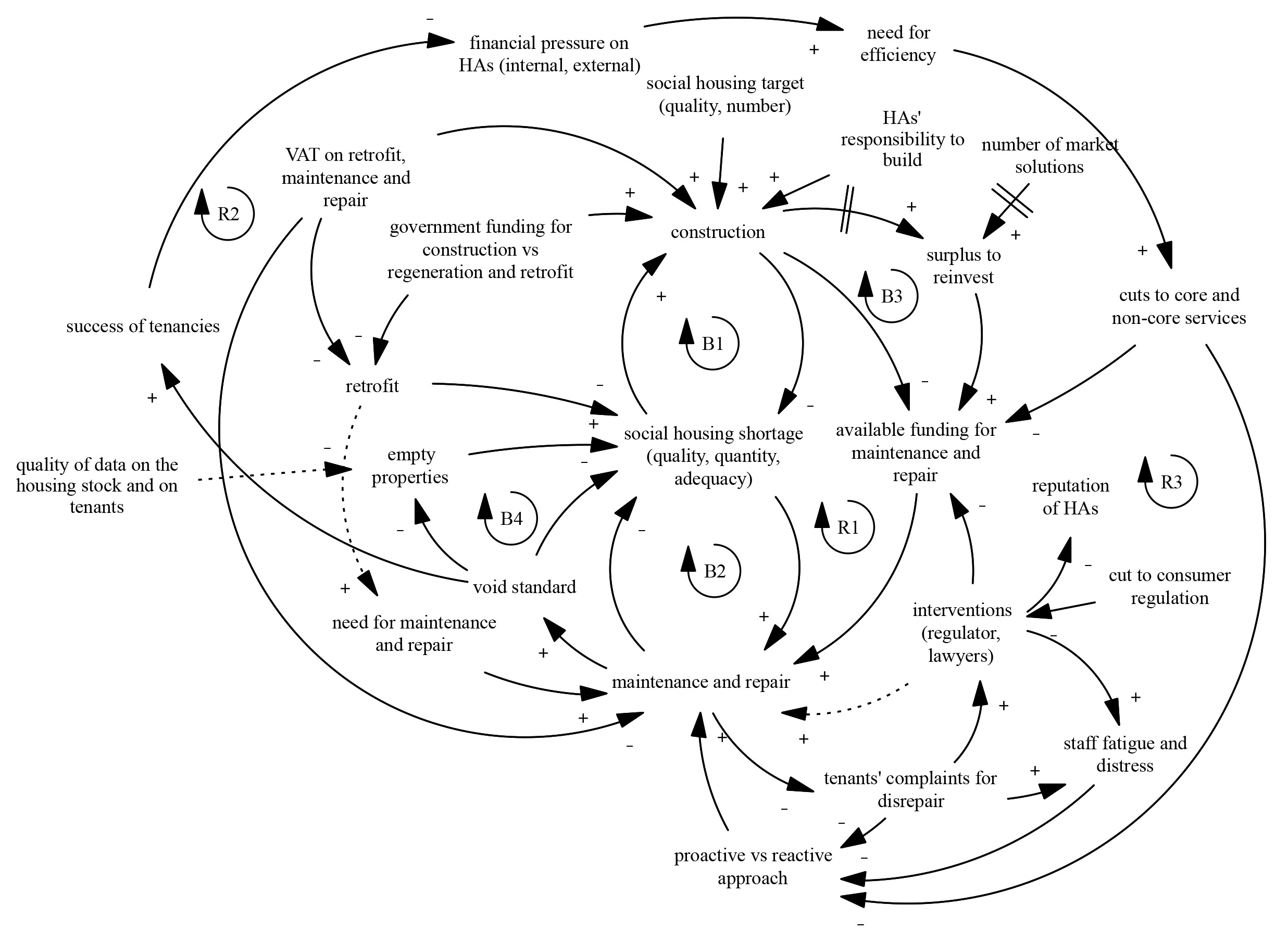
4. Resource allocation (see figure 2)
The fourth CLD highlights the tension between addressing the social housing shortage through new construction or through maintenance, repair and retrofit. Incentives such as zero VAT on construction (compared to 20% for maintenance and repair) and government funding dedicated to new build encourage housing providers to prioritise construction over proactive maintenance. Although new build is perceived as more convenient – lowering maintenance costs and meeting government-set targets, while supporting the upkeep of the existing stock – the emphasis on construction can actually draw resources away from improving existing housing stock. That results in more frequent and costly reactive repairs, staff fatigue, an erosion of trust in and reputation of the housing association, increasing empty properties and an even greater housing shortage.
5. Competing interests
Austerity-driven sell-offs, dwindling maintenance and demolition have contributed to the deterioration of social housing quality, fuelling stigma and discrimination that, in turn, justify further demolition and privatisation. While alternative models such as shared ownership are touted as solutions to create ‘mixed communities’ and meet residents’ aspirations, such approaches contribute to existing communities’ displacement, reinforcing the stigma mobilised to justify and advance privatisation policies. Redevelopment of centrally-located social housing estates is also part of a speculative mechanism encouraging the liberation of land for the construction of market homes. In contrast, social homes in cheaper, peripheral areas are dependent on the quality of the infrastructure provided. Negotiations with developers frequently focus on short-term viability and profit, undermining the long-term success of the estates. However, according to participants, when housing associations own the land and prioritise “place-enhancing” developments, they can help address local housing shortages and counteract the marginalising effects of privatisation-led regeneration.
6. Engineering communities
The concept of social mixing – often invoked to justify estate regeneration through demolition and new construction – remains deeply contested. In practice, attempts to artificially create ‘mixed communities’ can produce displacement, escalating property prices and cultural domination by wealthier incomers, ultimately reinforcing segregation, stigma and social tension. Although social mixing is perceived and presented as a path to reducing poverty concentration and encouraging aspirational attitudes, the system structures displayed by our CLD show how this approach can paradoxically exacerbate the very issues it aims to solve. Participants noted that current regeneration projects increasingly involve community-led planning and an emphasis on long-term adaptability, through masterplans designed to meet evolving resident needs. Yet, the mechanisms and lasting impacts of these strategies are still uncertain.
Places to intervene in the system
The six diagrams highlight how political and policy shifts, as well as the strategies designed to respond to them, emerge from partial understandings and competing priorities – such as financial viability, meeting housing targets or speculative interests. In this landscape, corrective policies risk being insufficient to tackle structural issues and may continue to trigger unintended consequences. Our visual representations were used to reflect on possible places to intervene in the system – ie, ‘leverage points’.
Stocks and flows: increasing the share of social homes and their affordability would require decreasing outflow (sales, demolition), while revising social tenant income caps. These strategies could help address tenant stigma and discrimination, the narrative underpinning social mixing and speculation, by aligning new construction with actual needs and minimising unnecessary redevelopment.
Ability of the system to self-organise: decentralising management and strengthening local governance and social infrastructure could build trust, empower tenants, improve reporting and enhance the resilience of housing associations.
The goal(s) of the system: reorienting the purpose of regeneration projects – from simply meeting numerical targets to protecting and sustaining existing communities – could guide systemic design interventions, establishing a backstop from gentrification. Engaging residents in defining these goals in a participatory way could foster equitable, adaptable masterplans that support healthy, liveable social housing estates.
Overall, our CLDs and the proposed interventions can help challenge long-standing assumptions about how to address critical issues in the social housing sector – such as stigma and discrimination, residualisation and financial pressure – and offer alternative, systemic approaches.
This article is a summary of the journal paper Systemic Issues of Social Housing in London: mapping interrelated challenges faced by Housing Associations (reference below), which is currently in review.
References
Baker, H., Brathwaite, J., Singha, S., Wylde, N., & Markham, T. (2022) The Better Social Housing Review. Retrieved from https://www.bettersocialhousingreview.org.uk/
Fernández Arrigoitia, M. (2018) The gentrification of social housing, in: Handbook of Gentrification Studies, pp. 262–280.
Pagani, A., Zimmermann, N., Macmillan, A., Ke, Z., Davies, M. (In review). Systemic Issues of Social Housing in London: mapping interrelated challenges faced by Housing Associations. Housing Studies. Preprint available at: https://doi.org/10.31235/osf.io/hbfwu
Anna Pagani is Senior Lecturer in Engineering at King’s College London and Honorary Research Fellow at UCL Institute for Environmental Design and Engineering. This article is based on a study conducted with Nici Zimmermann (UCL, IEDE), Alex Macmillan (University of Otago, NZ), Ke Zhou (UCL, IEDE), and Michael Davies (UCL IEDE). The study was funded by the Swiss National Science Foundation (SNSF) Postdoc. Mobility Fellowship (grant number P500PS_210875).