
An inquiry by the Housing, Communities and Local Government select committee has raised important issues about the precarity of councils’ finances and how to improve the situation.
The report comes as government pledges to reform local authority funding but has not yet said how the demand for services will be tackled.
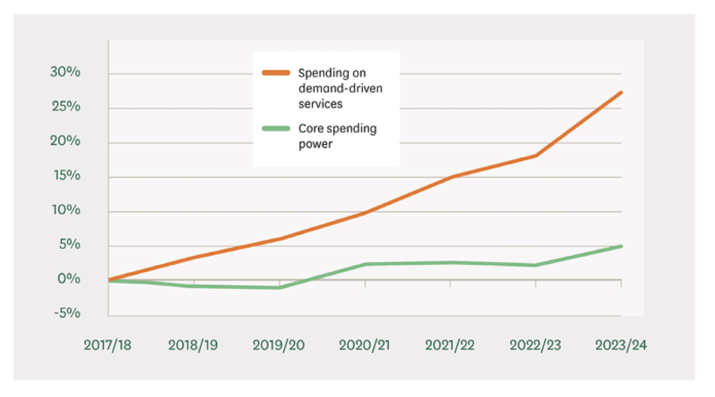
The committee found that demand-led services are the main cause of the financial crisis in local government. Principally that’s social care, special educational needs and homelessness. Local authorities spent £2.13 billion on homelessness in 2023/34, according to the National Audit Office. That’s a 105% increase since 2015/16.
That doesn’t mean that local authorities are taking on too much, however. As the LGA commented, councils want to provide essential services of high quality. The issue is resources.
Councillor Pete Marland, Leader of Milton Keynes City Council and Chair of the Economy and Resources Board of the Local Government Association (LGA), said: “Councils by their very nature are leaders of place. Should we be delivering housing? Yes. Should we be keeping children safe? Yes. Should we be making sure that children with special educational needs have the right education to make sure that they can get on in life? Yes. […] I don’t think that councils are being asked to do too much; I think councils should do more, but they need the resources to be able to do it.”
Seven councils have issued S114 ‘bankruptcy’ notices and 42 have received special funding after getting into difficulties. The current government has pledged to reform local authority funding and has begun to work towards this. A new Local Government Outcomes Framework sets out priorities and draft outcomes metrics. These cover at least three areas directly relevant to housing: homelessness and rough sleeping; decent, safe and affordable housing; and neighbourhoods. Others cover health, social care, environment, children and disadvantage. However, the objectives are broad, and questions over how they will be achieved and what form the financial changes will take remain.
The HCLG Committee draws attention to two issues. One is ringfencing and special pots of funding that limit what local authorities can do and create inefficiencies. This is part of a greater problem of over-centralised government, on which the committee points out the UK has a poor track record compared with other European countries where power is more distributed.
The current government says it’ll reduce some ringfencing. MHCLG’s Director of Value for Money told the committee: “We listed 13 separate funds that all had a connection with authorities tackling homelessness and they were across three departments. Some were allocated funding; some was funding that would be bid into. That gets very difficult if you’re a local authority trying to navigate what your budget is for tackling homelessness.”
The second issue the committee highlights is the failure of different government departments to work together and anticipate problems. Here it had strong words on how other departments’ decisions can impact on local government.
“The [MHCLG] is in regular contact with other departments and government bodies about the needs of local government, but it lacks the levers that it needs to control decisions across central government. In our view, merely discussing the issues with other departments isn’t enough. To properly reform and stabilise these vital services, clear lines of accountability between relevant departments are needed, with the responsibilities for overall delivery and for funding being held together in a single department (even if delivery in practice is managed by several).”
The committee gave an example that those affected by DWP welfare cuts such as the freezing of local housing allowance may no longer be able to afford council tax and “may even present as homeless, drastically increasing the level of support that local authorities must provide”.
The committee’s report repeatedly warns that government ambitions to refocus on prevention instead of expensively ‘curing’ problems will be hard to achieve. And success mustn’t come at the price of neglecting acute problems further, it adds.
The government says it wants reform, including multi-year financial settlements, to begin from next April. All eyes will be on the budget on 26 November to discover how far and how fast the changes may arrive.