
 Lucia Pratto, University of Exeter
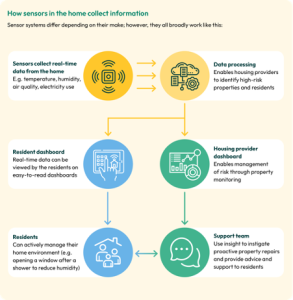
New regulations in UK social housing regarding damp and mould, such as Awaab’s Law and the Homes Act, aim to make social housing homes safer and healthier for residents. One way of detecting poor indoor environments that can threaten health is by using indoor environmental sensor systems, which monitor factors such as temperature, humidity and CO2 levels. Real-time information about a home’s indoor environment can be shared with both the resident and housing provider, facilitating remote monitoring and evidence-based decision-making.
We’ve been working on Smartline, a six-year investigation (2017-2023) in close partnership with Coastline Housing, a regional housing association, into how digital technology can support healthy homes. The project is part of the programme of our multidisciplinary team of researchers with expertise in indoor environments, housing and health at the European Centre for Environment and Human Health in Cornwall.
During Smartline, we conducted a study to investigate the feasibility of using sensor systems to help Coastline better manage their properties and support residents’ health. Sensors can help to detect damp and mould, for example, and to reach residents who might not have reported problems otherwise. In 2017, the use of sensor systems was innovative, and although their use is now more widespread and ‘off-the-shelf’ systems have been utilised in our more recent projects, SenseWell and CommunitySense (2023-2025), their full potential has yet to be realised.
Housing, health and sensor systems
Housing and the indoor environment are significant determinants of public health. Indoor temperature, air quality and humidity impact respiratory and cardiovascular systems, as well as allergic diseases and mental health. Monitoring that environment can improve health – and reduce the burden that ill health can place on healthcare services. When shared with service providers and residents, the information collected by sensor systems can enable follow-up interventions to improve the home environment. However, the feasibility of such a solution has been poorly understood. This study therefore aimed to understand the feasibility of this type of approach when utilised by a housing association.
The Smartline project
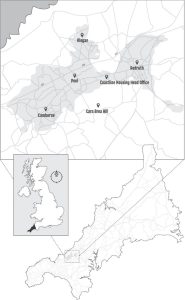
The six-year Smartline project took place in Cornwall. We recruited residents from 280 Coastline Housing homes in the Camborne, Pool, Illogan, and Redruth areas, which includes some of the most deprived areas in the UK. There are high incidences of mould, fuel poverty and long-term health issues. During this time, we installed and maintained indoor environment sensors and electricity meters in 280 homes, and conducted surveys, interviews and focus groups with residents. We co-designed two data dashboards, one for the housing association and one for residents, to display the sensor data.
Coastline Housing created a support team to monitor the sensor data and intervene in properties. We interviewed Coastline Housing staff, measured dashboard usage, and logged resident support and repairs, to understand how the system was being used. We also provided residents with tablets so they could access the dashboard and view their own data, and measured how frequently they used the dashboard. By the end of the project, over 140 homes were still engaged in the study.
Resident perspectives
In general, residents found it acceptable to have sensor systems in their homes, despite the potential concerns about privacy and security of sensor data. This attitude was strongly influenced by a high level of trust in the housing association. However, while residents were positive about the usefulness of the intervention, and had co-designed the dashboard, there was low usage of it. Additionally, while we predicted that households with high humidity or particulate matter, or those who viewed the dashboard more frequently, would consequently change their behaviour, we saw no widespread evidence of this in the data.
Housing association perspective
Despite residents tending not to access the dashboard, the housing association found the system valuable and effective in several ways:
- Identifying high-risk properties, facilitating timely maintenance and support
- Prioritising risks across housing stock to manage properties more efficiently
- Accessing data for long-term planning.
The housing association used the sensor data to identify high-risk properties and intervene when appropriate: 39 out of 144 homes were found to be high-risk and received contact, with 16 receiving direct interventions. The sensor system was valuable for the housing association to manage properties, particularly older housing stock, more efficiently. This enabled them to protect their portfolio and improve residents’ health.
The intervention was perceived to be particularly effective at reaching older residents who were less comfortable reporting maintenance issues through digital means. Staff could use the data to identify higher-risk environments and support vulnerable residents through issues that would have otherwise been unreported. These capabilities were particularly important to the housing association as they aligned with its mission and organisational values as a social landlord. Overall, the housing association found the sensor system effective and planned to scale it up for more widespread implementation across their properties.
Challenges, limitations and adaptations
 Some implementation and maintenance challenges arose throughout the study, with sensors going offline or needing maintenance. However, these issues weren’t a dealbreaker for the housing association, which decided that future implementation would involve outsourcing sensor installation and maintenance. One significant limitation was that many of the issues identified resulted from complex socio-economic circumstances, which were outside the housing association’s responsibility or capacity to address. Additionally, the housing association identified adaptations for a future implementation of the system – for example, integrating the data into existing systems and including automated notifications.
Social value
Following this study, we collaborated with AicoHomeLINK, HACT, CIH and Coastline Housing to measure the social value of sensor systems. Social value refers to the broader benefits of an activity beyond its direct financial return; for example, how innovations like sensor systems positively affect people’s health and living conditions.
We used social return on investment (SROI) methodology, which gives a financial value to the positive impact of an activity in relation to the resources invested, to measure the social value of sensor systems. For every £1 invested in home sensor systems, we found that it creates £2.68 worth of social value, giving a SROI ratio of £1: £2.68.
As housing providers across the UK work to meet regulatory demands and improve housing quality, understanding the social value of new technologies like sensor systems becomes increasingly important. We have produced a series of guides designed for housing providers to help strategic and operational teams understand the wider impacts of adopting a sensor system.
Key takeaways
This study found that indoor environmental sensor systems were useful for a housing association to identify high-risk properties and support early intervention. Although residents didn’t often engage with the data dashboard, this proved unnecessary for the housing association to utilise the data to support residents with issues such as fuel poverty and damp and mould. Overall, sensor systems are an acceptable and effective intervention for both social housing residents and providers to facilitate efficient management of housing stock, with the potential to improve resident wellbeing through healthier indoor environments.
This article is a summary of the journal article Indoor environment sensor systems for healthier homes: a feasibility study in social housing, published in Housing and Society.
Alongside the study summarised in this article, other studies in the Smartline project examined the effect of fuel poverty on health, factors impacting indoor air quality, and modelling mould growth using relative humidity and temperature.
Please get in touch if you’re interested in more about our research: [email protected]
Funding:
Smartline was funded by the European Regional Development Fund and Cornwall Council. Sensewell is funded by the UK Engineering and Physical Sciences Research Council and the National Institute for Health and Care Research. CommunitySense is funded by the UK Shared Prosperity Fund.
Lucia Pratto is part-funded by the UK government through the UK Shared Prosperity Fund. “The UK Shared Prosperity Fund is a central pillar of the UK government’s Levelling Up agenda and provided £2.6 billion of funding for local investment by March 2025. The fund aims to improve pride in place and increase life chances across the UK by investing in communities and place, supporting local business, people and skills. For more information, visit https://www.gov.uk/government/publications/uk-shared-prosperity-fund-prospectus ”
Other research in the Smartline project:
Johnes, C., Sharpe, R. A., Menneer, T., Taylor, T., & Nestel, P. (2023). Using Sensor Data to Identify Factors Affecting Internal Air Quality within 279 Lower Income Households in Cornwall, South West of England. International Journal of Environmental Research and Public Health, 20(2), 1075. https://doi.org/10.3390/ijerph20021075
Menneer, T., Mueller, M., Sharpe, R.A., & Townley, S. (2023). Modelling mould growth in domestic environments using relative humidity and temperature. Building and Environment, 208, 108583. https://doi.org/10.1016/j.buildenv.2021.108583
Tu, G., Morrissey, K., Sharpe, R.A., & Taylor, T. (2022). Combining self-reported and sensor data to explore the relationship between fuel poverty and health well-being in UK social housing. Wellbeing, Space and Society, 3, 100070. https://doi.org/10.1016/j.wss.2021.100070