
 The inquest into the death of two-year-old Awaab Ishak in a Rochdale Boroughwide Housing (RBH) property will always be remembered as the catalyst for the national damp and mould scandal that rocked the social housing sector, and the subsequent campaign to drive up living conditions.
On the eve of Awaab’s Law coming into effect, HQM caught up with Amanda Newton, RBH chief executive, to reflect on the journey the housing association has been on during the last two years, its preparations for the new legislation and what the future holds.
Jon Land (JL): What are your thoughts as Awaab’s Law comes into effect this October?
Amanda Newton (AN): As you can imagine, Awaab’s Law is very personal and important for RBH. It frames the learning that we as an organisation and much of the wider sector has gleaned through getting underneath the condition of our homes and prioritising investment.
It’s the lasting legacy to the little boy who lost his life as a result of exposure to damp and mould, and the name Awaab Ishak will stand for something important – that people living in social housing and beyond can rely on legislation in his name to keep them safe and free from harm in their homes. Meeting the requirements of this legislation can never be a tick-box exercise nor be seen as an additional burden.
For RBH, it’s a framework that aligns precisely with our core purpose: to provide safe, warm homes. The fact that the first phase focuses on damp, mould and emergency hazards is entirely right. At its most basic level, this law sets the minimum standard for ensuring dignity and respect for those living in social housing. I feel very passionately that by focusing on the purpose-driven delivery of housing that respects the people who live behind our front doors and their needs, all the regulatory requirements will be met as a result.
JL: How has RBH been preparing for its introduction?
AN: Our preparation has been fundamental to how we do things now. We were one of the first organisations to really dig into the issue of damp and mould, and it was a core part of our recovery plan. Doing this alongside getting behind front doors to understand the quality of our homes has seen us prioritise stock condition surveys.
Where we’ve identified hazards across the full HHSRS spectrum, we’ve dealt with it there and then – there was never a time we would simply create a list of things to resolve down the track, so, in many ways, we’re ready for the focus on damp and mould but we’re equally ready for the rollout of the focus on the wider hazards in the coming year.
Obviously, addressing issues with damp and mould was an early priority and right at the start of our recovery we established a dedicated damp and mould team, now 28 strong. We started in the reactive space of treating but quickly shifted into addressing root cause issues that had come about because of a significant lack of investment in our homes.
“Damp and mould recurrence in our homes is down from 48% in summer 2023 to 15% now – a statistic which tells us our focus on dealing with root cause is working”
We’ve since invested heavily in roofs, guttering and pointing. We’ve got underneath our data further and identified property archetypes which are more prone to damp and mould. In these homes we’ve installed positive ventilation systems to help with preventing the problem reoccurring.
We’re most definitely on the front foot. Damp and mould recurrence in our homes is down from 48% in summer 2023 to 15% now – a statistic which tells us our focus on dealing with root cause is working. We’ve also overhauled our property services with a project that provides a new, consistent, end-to-end diagnosis and prioritisation system for repairs. This not only ensures that our customers see the right operative at the right time, it’ll also help to ensure we can meet the necessary deadlines set out in Awaab’s Law and support our ambition to achieve upper-quartile customer satisfaction. For us, preparation means we’re ready to turn new policy into operational practice this October.
JL: You’ve just reached your second anniversary as RBH’s chief executive – how are things going? What achievements are you most proud of? What are your current challenges?
AN: From the outset I’ve been really clear that taking this organisation forward will never see an end to our improvement journey. Our ambition is to do more and do better and this will always be informed by our customers who live in our homes. We’ll also never lose sight of the next generation of customers to ensure we’re future proofing what we do.
At the start of our improvement journey we went right back to basics, reconnecting our culture with our core purpose to provide safe, warm homes in places where people can thrive. We made tough decisions to stop doing things that were getting in the way of the basics. And these were the right choices as our customers are already telling us they’re feeling the difference – our TSMs tell us overall satisfaction is now up to 77% from 72% last year so the changes we’re making are being felt behind the front door.
We’ve focused on understanding our customers and building a picture of who lives behind our front doors to enable us to better tailor what we do to meet their needs. This is more than data on protected characteristics – we’ve pushed into the space of being professionally and culturally curious and removed the fear of getting it wrong.
“[Awaab’s Law] is the lasting legacy of the little boy who lost his life as a result of exposure to damp and mould, and the name Awaab Ishak will always stand for something important – that people living in social housing can rely on legislation in his name to keep them safe and free from harm in their homes”
We’ve embraced the voices of our customers and embedded this into our governance structures. We have customers as formal members of our committees and we’re a cooperative mutual which gives our members a clear and loud voice in how we run our business. Co-creation is very important to us and a great example of this is the work we did early doors on developing a new set of organisational values which were meaningful to our customers and colleagues.
More recently, we’ve been casting our minds to the future and preparing for a return to the things we paused. This will include a return to the development of much-needed new homes and a focus on regeneration.

Leading a recovery like RBH is hard graft – it’s about rolling up your sleeves and leaning into driving a programme of deep structural and cultural change, whilst not losing sight of the needs of the people you serve. This can feel like a slow process from doing the work to seeing the results, but we’re now seeing the fruits of our labour.
This includes focusing on a purpose-driven delivery of housing that respects the dignity and uniqueness of the people who live behind our front doors and being crystal clear on the expectations of ourselves as leaders and of our people, and then holding ourselves to account to deliver.
I’m proud of so much. What I’d say is that the people who turn up to work every day in our business to do their very best for the people who rely on us inspire me and make me more proud than any personal achievement. They deal with some really challenging things daily and they take it in their stride with care, compassion and a drive to make people’s lives better. Who wouldn’t be proud to lead a bunch of exceptional people like that!
On a personal level, this was my first CEO role in an organisation which was facing what was arguably the most complex recovery in the history of the sector. When I applied for the role it was on the back of reading an inquest report into the death of a child and feeling a deep-seated sense of duty to step up and make a conscious contribution to improve things. I don’t tend to dwell on the past but in moments of reflection I’m really happy that I took the leap from a role and an organisation that I loved into RBH, which is now firmly a piece of me.
Our current challenges are mirrored across the sector when I talk to my peers. The pace and scale of change across the sector is unprecedented and we’re spinning a lot of plates to ensure we can deliver it all. The financial impact of a recovery that’s been as deep and complex as ours has been a challenge and we’re focusing on a programme of business improvement that will deliver significant efficiencies, improve services to customers and build back our operating margin.
“Achieving G2 in just over two years was a monumental achievement for every single person who works at RBH, particularly when you consider the extent of the past failures”
As a stock transfer organisation, the age of our homes in many of our communities is requiring us to take a value for money review of whether we invest or whether we regenerate. Over time, this will include us replacing some of our homes that have reached end of life with homes that will be fit into the future. This is costly and the funding regimes aren’t as clear as they might be for regeneration over normal development programmes.
In all that we do we have to make decisions for the long-term betterment of the people and communities we serve. We have to be clear that as leaders, the decisions we take today must reflect a positive legacy that we will leave for the people who follow us.
JL: Does the G2 grading feel like a vindication of your work?
AN: Vindication, which means to be free of blame, isn’t a word that I associate with the work that I have led at RBH. It has been and remains important that we own our past, and we have. But to have focused on who did or didn’t do what, would’ve simply got in the way of the positive progress we’ve made. We spent a lot of time understanding what happened and this informed what we now do differently and better.
Seeing RBH come out of recovery and being re-graded to a G2 grade was the biggest achievement for the organisation in the past year. On 25 March 2025, our return to compliance was confirmed by the Regulator of Social Housing. That was on the back of over two years of serious heavy lifting from the board, the executive and from every person across the organisation. It was a pivotal moment for RBH and one which was fundamental to restoring confidence and trust in us as a landlord. This was most definitely a moment of intense pride whilst crafting a forward-looking narrative that our foot remains on the gas to push for more.
Achieving G2 in just over two years was a monumental achievement for every single person who works at RBH, particularly when you consider the extent of the past failures. It was something that galvanised the organisation and set us up for the next stage of our change journey, which we’re absolutely not complacent about as we move forward. Our customers should expect more and we need to be part of raising aspiration. The G2 simply tells us we have the right foundations in place to continue the ascent.
JL: What’s next for RBH?
AN: RBH feels like a very different business to when I walked in the door two years ago. It’s an organisation that’s been through a lot but we’re coming out the other side stronger and more determined to be the best landlord we can. This will see a continued focus on our core business: being a great landlord, investing in our homes and preparing for a future that will see us working with partners to regenerate the places in which we work and developing new homes.
First and foremost is delivering on all the objectives of our new corporate strategy for 2025-28, with its five focus areas of customers, communities, homes, people and governance. At the same time, we’ll continue to bring our customers into the business at every opportunity, using their voices to scrutinise and shape our services.
“The financial impact of a recovery that’s been as deep and complex as ours has been a challenge and we’re focusing on a programme of business improvement that will deliver significant efficiencies, improve services to customers and build back our operating margin”
We’ve invested in building data and insight to move from backwards-looking data models to predictive analytics that enable us to plan more effectively. We’ll continue to develop this to ensure that we’re consistently joining the dots across all data points, listening to feedback, using customer engagement as a strategic tool to inform our decision-making and tailoring our services based on the needs of our customers.
We must also continue to manage our finances well and maintain the necessary investment levels in our existing stock – something that was neglected before – and keep improving our already-growing customer satisfaction with repairs. The improvement journey never ends, and our ambition to get it right is unquestionable.
Finally, we’re pushing through our regulatory improvement programme to ensure that we’re ready for inspection and that we’re able to evidence clearly positive outcomes for customers in all that we do.
JL: We’re seeing the rise of nationalism across the UK, including in places like Rochdale. Why do you think this is? What role is RBH playing in trying to promote community cohesion in the local area?
AN: RBH is an organisation that’s anchored in its communities and therefore we play a critical role in supporting community cohesion and neighbourhoods that are stronger because of their diversity. I mentioned earlier about our cultural development including a focus on cultural curiosity and removing the fear that has stopped people from all walks of life from seeking to understand and embrace difference.
There’s a lot of fear in communities across the country that’s manifesting itself in ways that can only serve to undermine cohesion.
 I was chatting to a customer a few months ago about why he loves the community where he lives and where we, as a housing provider, can do more to support the building of communities. He was really clear that no single organisation “builds” communities, they can only enable and facilitate, which is most definitely the role we play.
Our governance model is somewhat unique and we’re proud to be a cooperative mutual society. We use this to amplify the voices from across our communities, bringing customers and stakeholders together as they all have a stake in the success of RBH. We also have strong links with the voluntary sector and faith groups and will be building a new ‘community investment’ approach as part of our commitments for the coming year.
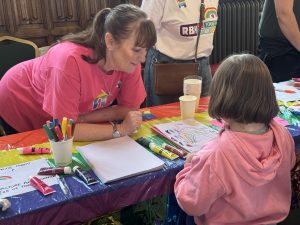
On a practical level we’re very visible in our neighbourhoods and communities and that’s seen community fun days on our estates, lots of pop-up engagement events where we take our gazebo and go to the people who live there and provide opportunities for customers to be part of reviewing what we do at a neighbourhood level. There’s nothing like being held to account when you’re face to face with your customer inspectors looking at the grass that’s been mown and assessing how well it’s been done with the people who lead those services! This brings diverse communities together, framed around a common goal.
It strengthens the bonds of community, and I believe a good landlord needs to be at the heart of that.