
In our latest case study highlighting positive practices in the social housing sector, Neil Merrick reports on a successful furniture recycling scheme in North East England that helps tenants who cannot afford to furnish their homes.
A tenant’s story
Prior to moving into a house in Stockton-on-Tees, Adam (name changed) had become used to sleeping in his car.
While pleased that he was no longer homeless, his delight at being offered a tenancy by Thirteen Housing Group was tempered by the fact he couldn’t afford furniture.
Within days, a tenancy support coordinator contacted the group’s furniture recycling scheme. This provided Adam with a table and chairs, a TV stand, a two-seater sofa, and a kitchen starter pack.
“I was grateful to have a roof over my head again, but I had very little money left to buy the essentials I needed to make my house a home,” says Adam, who has two children who mostly live with his former partner.
Adam has lived in North East England for 20 years but ran up large debts after an injury prevented him from working. “I’m slowly getting there,” he adds. “Most importantly, with shared childcare responsibilities, I have a home that my children can come to. That means a lot to me.”
Why do tenants need help with furniture?
Just 2% of homes left by social landlords are furnished when tenants move in, compared with 30% in the privately rented sector.
Some tenants cannot afford to buy furniture when they take up a tenancy for the first time and often rely on help from friends and family. They also have the option of applying for welfare assistance from their local authority but aren’t guaranteed to receive money.
Rising prices make the situation worse. According to a report on furniture poverty published last year by social enterprise Fusion 21, the cost of furniture, furnishings, and carpets increased by nearly 14% during the year to August 2022.
“Another upside is that properties are left in better condition. This has helped cut the average void cost by £500 and the average ‘key-to-key’ time from 45 days to 17”
Furniture poverty also has a downside for landlords. Tenants who cannot afford to furnish their homes are more likely to leave within a year, leading to higher turnover and more voids.
“If people can’t get furniture together and turn the property into a home, they may give up the ghost,” says Suzanne Halliwell, Thirteen’s head of care and support.
What sort of help do they receive?
Individuals and families who cannot afford furniture when they start a tenancy at Thirteen are provided with second-hand furniture by the housing association.
This generally comes from tenants who left furniture behind when they moved out of a property owned by Thirteen (or, in some cases, died). The association also accepts donations from members of the public and its own employees.
Furniture is stored and, where necessary, repaired at a warehouse and workshop at Billingham, near Middlesbrough, opened in early 2022.
Since April 2022, Thirteen has collected and distributed about 30 tonnes of furniture, helping more than 50 families. Most of this has been done since last September.
Some of the needy families were homeless prior to being housed, while others had escaped domestic abuse. “We take a common-sense approach,” says Halliwell. “We don’t make people jump through multiple hoops before they get help.”
How does the service work?
Prior to 2021, furniture left behind in homes let by Thirteen was generally discarded. The housing association, however, recognized there were sound environmental reasons, as well as social benefits, in being less wasteful and in re-using furniture wherever possible.
After reviewing its waste policy and bringing the waste collection back in-house, the association began to identify furniture that could be re-used and arrange for its collection from empty properties before it was thrown away.
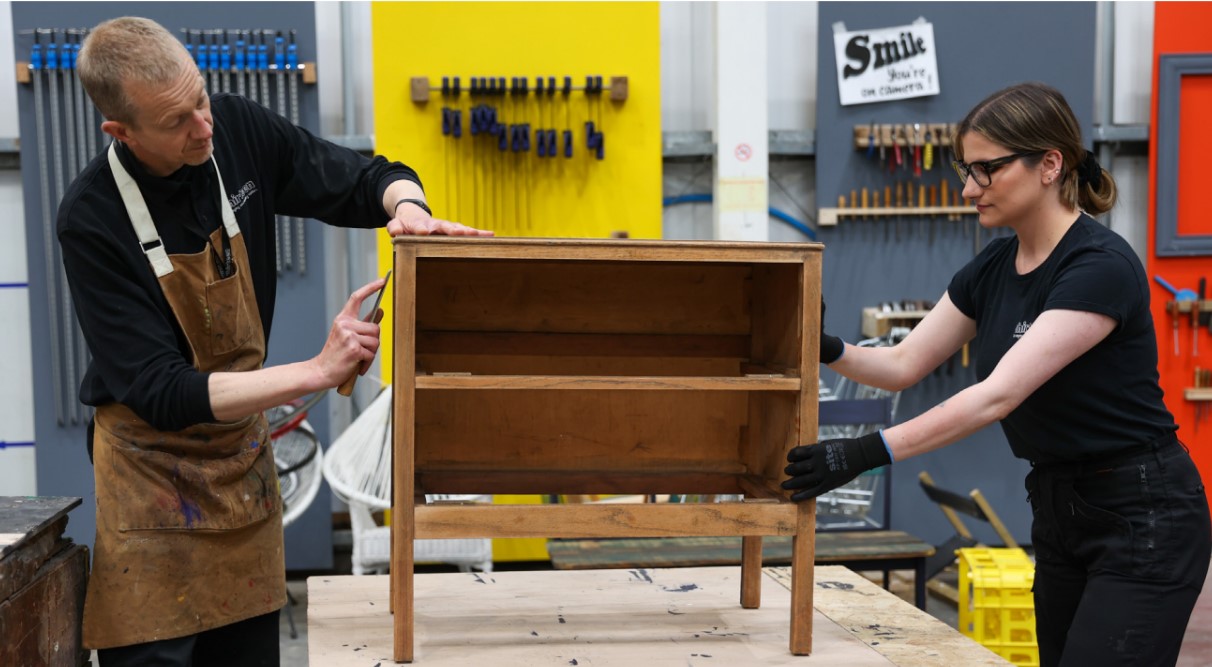
In early 2022, a small team was recruited to repair or upcycle furniture at the newly opened warehouse and workshop at Billingham. The upcycling team consists of Rhys Baker, a photography and art teacher, and Katie Forde, a graduate of the Chelsea College of Art in London.
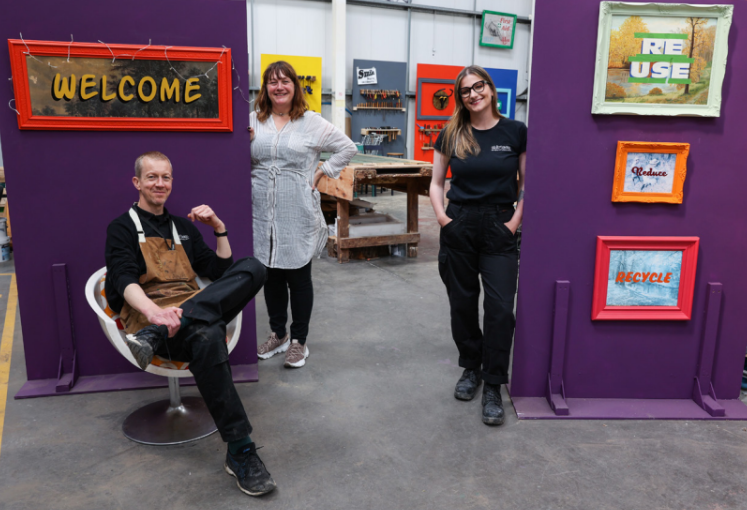
The team repair furniture as needed. Unwanted material maybe turned into curtains. “They are extremely creative,” says Helen Beaman, recycling center manager.
Thirteen put together a ‘starter pack’ of furniture and other items that are most likely to be needed by tenants when they move into a home, including tables and chairs, crockery, and cutlery.
Tenants may also receive bed frames, sofas, and wardrobes, but more personal items such as mattresses are not reused. Thirteen does not presently offer white goods but helps tenants apply for grants. In addition, employees working for the association may buy white goods left behind by tenants.
While the association has a policy governing who gets furniture, it errs on the side of generosity. In most cases, tenants who qualify are identified by tenancy support coordinators before they move in, meaning their home I furnished from day one.
Occasionally, a tenant will ask for help later, perhaps because the furniture they were promised by a friend or relative doesn’t materialise. Gas service teams and other Thirteen employees may also spot that a home lacks furniture when they carry out home visits.
As the operation has become slicker, furniture that doesn’t need repairing can be in and out of the warehouse in a few days. “We’re finding that we’re getting donations in on a Tuesday and they’re going out on a Friday,” says Beaman.
The warehouse and workshop also open their doors to local schoolchildren, so they see the value of recycling and upcycling.
Making a real difference
According to Suzanne Halliwell, tenants are “surprised and delighted” to be offered furniture at the same time as moving into a home.
Starting a tenancy can be a stressful time. “They’ve accessed accommodation but the reality is they don’t have money to buy furniture,” she says. “We alleviate a lot of pressure at that point.”
The furniture policy also helps Thirteen to reduce tenant turnover and voids and, in some instances, compete with private landlords who offer furnished homes. In North East England, private rents aren’t much higher than those of social landlords.
Another upside is that properties are left in better condition. This has helped cut the average void cost by £500 and the average ‘key-to-key’ time from 45 days to 17.
Tenants are also more satisfied. According to Thirteen, providing furniture along with flooring and decoration has led to a 10% improvement in customer satisfaction, with net promoter scores (based on customer recommendations) rising from 70% to 90%.
In the future, Thirteen may try to sell more valuable furniture and other items, especially those with retro value, to collectors. This has the potential to bring in extra income, which will be reinvested in the recycling service.
Thirteen owns about 35,000 homes in north-east England and parts of Yorkshire. Many of its residents are living in some of the most deprived areas in the UK.
There’s little doubt, particularly during the cost-of-living crisis, that tenants moving into a house or flat appreciate being offered furniture along with other support.
Recycling and upcycling furniture isn’t just good for the environment, it also means social landlords can, where necessary, compete with the private rented sector and take the stress out of starting a tenancy.
“People can’t believe how much they’re getting,” says Helen Beaman. “It makes the property a home rather than just a roof over their heads.”