
Neil Merrick reports on a housing association that’s agreeing section 106 deals ahead of builders putting spades in the ground.
The residents’ story
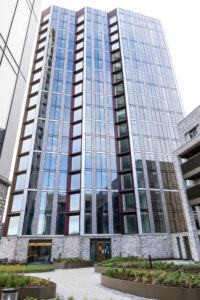
Towards the end of last year, the first shared owners began moving into homes at Victoria Riverside, a multi-million-pound development in central Manchester.
The 128 shared ownership apartments, owned by L&Q and partly funded by Homes England, make up one fifth of the 634 apartments, townhouses and maisonettes in what’s advertised as Manchester’s “emerging Red Bank neighbourhood”.
Built by international property company Far East Consortium (FEC) in conjunction with Manchester City Council, the new development will ultimately consist of three towers. It’s part of the Victoria North urban regeneration project, which is due to see 15,000 homes built over the next 20 years and was named in March as one of seven ‘next generation’ new towns.
The shared ownership apartments are in the 18-storey City View Tower, the smallest of the three blocks at Victoria Riverside, and were purchased by L&Q through a section 106 agreement reached four years ago.
Residents, says the association, are assured that any defects within the first two years are dealt with “promptly and smoothly”.
Section 106 in decline
During the past few years, the number of housing associations and other registered providers buying homes through the section 106 system has fallen dramatically.
According to the government and private builders, thousands of homes intended for social rent, shared ownership and other ‘affordable’ tenures await buyers, meaning the developments they are part of have stalled. If no association or local authority steps forward, the homes could be sold on the private market instead.
A ‘roadmap’ published in January by the Ministry of Housing, Communities and Local Government set out a range of options for tackling the problem, including change of tenure where no RP is found by early June. The government also called for earlier collaboration between developers, RPs and planning authorities, supported by a standardised template for section 106 deals.
How do housing associations see the picture?
L&Q agrees it’s better to be involved in developments from the start, ensuring affordable homes are more attractive to potential residents and avoiding the need for housebuilders to seek buyers at a later stage.
Last year, a report by L&Q for the G15 group looked at how better collaboration with housebuilders might work, preferably starting at the pre-planning or land acquisition stages.
Many associations, said the report, decline to purchase section 106 homes because of concerns over tenure, size, location and specification. “Housing associations aren’t buying them because of issues with the product and service,” says Ben Townsend, director of new business at L&Q.
“Strong strategically aligned partnerships deliver results for everyone. Developers gain certainty, housing associations take on homes with confidence, and residents get better services and value for money”
Ben Townsend, director of new business, L&Q
As well as taking joint decisions over specifications and components, affordable housing providers were urged to visit sites once construction gets underway.
The alternative, adds Townsend, is associations taking the risk of homes being built to lower standards and, consequently, residents moving into properties that need further work or repairs.
What difference does early collaboration make in practice?
For developments such as Victoria Riverside, L&Q insists upon minimum space standards and a defect liability period (DLP) of two years, as well as affordable service charges.
The shared ownership apartments at City View Tower meet the nationally described space standard, while a two-year DLP, as recommended by the National House Building Council, brings shared owners into line with homeowners.
Service charges can easily become a bone of contention with shared owners and can put off some people from buying a home on this basis, especially in dense urban developments, says Townsend.
To avoid later challenges, this means making them affordable, transparent and value for money. At Victoria Riverside, L&Q has tried to ensure the tower block was designed in a way to minimise charges, including easy-to-maintain service areas, robust external building fabric, and green areas proportionate to the number of residents.
Early collaboration doesn’t only benefit housing associations and their residents. It also provides assurances to developers, which can proceed in the knowledge they have a buyer for their section 106 homes.
“Generally speaking, we work with partners that we’ve got a good relationship with and aligned strategic objectives,” says Townsend. “It’s done at an early stage so that we can influence parts of the development.”
What difference does a joint venture make to section 106 agreements?
At Victoria Riverside, L&Q is a preferred partner to a joint venture between developer FEC and Manchester City Council.
L&Q is also involved in developments elsewhere in England that are joint ventures between the association and private builders. Here it applies the same principles to the affordable homes built under section 106 deals.
At Beaulieu on the outskirts of Chelmsford in Essex, a development that began 15 years ago as a joint venture with Countryside (now part of the Vistry Group) will eventually see about 3,600 homes built, with 27.5% for shared ownership or affordable rent.
Part of Chelmsford Garden Community, the scheme includes two new schools, parks and open spaces, and a new railway station.
About 4,000 homes are being built at Beam Park in East London, including 520 for Barking and Dagenham Council. Half those built for the council are for affordable rent, with the remainder for market rent.
According to Townsend, L&Q adopts the same approach to all section 106 deals even though, in the case of a joint venture, the association effectively buys the affordable homes from itself. “The affordable homes must be built to the correct standards and should have the right design, quality and customer service,” he says.
How do developers see the early involvement of affordable housing providers?
Kevin Delve, managing director for Vistry East London, said early engagement with L&Q over the section 106 agreement at Beam Park was critical to meeting planning and delivery goals.
“Aligning on tenure mix, quality standards and delivery approach at an early stage provided clarity and certainty, supporting a scheme that is deliverable and focused on long term outcomes for residents,” he said.
Is this a blueprint for the rest of the sector?
In effect, housing associations such as L&Q are laying down red lines when it comes to affordable homes built through section 106 agreements.
Early involvement in the development process should, in theory, make section 106 homes more attractive to shared owners and tenants, while private builders avoid the hassle of selling the homes to associations and other RPs later, possibly at lower prices.
“Strong strategically aligned partnerships deliver results for everyone,” says Townsend. “Developers gain certainty, housing associations take on homes with confidence, and residents get better services and value for money.”
Early collaboration also increases the likelihood of communities where standards are consistent across all tenures. “Every resident is treated the same and receives the same high level of service, no matter how they access their home,” he adds.
Sue Phillips, founder of Shared Ownership Resources, welcomes the approach L&Q is taking but says: “It’s hard to understand why social housing providers ever signed up to section 106 deals where they have no control, and limited influence, over costs charged onto financially vulnerable shared ownership households.
She adds: “Consequently, we welcome sector-led initiatives at the pre-planning or acquisition stage to drive down long-term costs for entrants to the shared ownership scheme.”
Wider reforms
That said, Shared Ownership Resources is calling for wider reforms of both section 106 and the way shared ownership is regulated.
“Section 106 reform shouldn’t be reliant on a piecemeal, voluntary approach. Rather, the government and the Regulator of Social Housing should widen their focus from demand and access to include requirements to improve the likelihood of good long-term affordability outcomes for shared owners,” Phillips adds.
“Such measures should include: a 24-month defects period (commencing on completion) in order that shared owners benefit from the same protections as any other new-build homebuyer; adoption of the Shared Ownership Code and, specifically, the service charge information document (SCID); new Tenant Satisfaction Measures to assess shared owners’ ongoing satisfaction with the affordability of their home; and not awarding C1 ratings where shared owner overall satisfaction rates are below a specified benchmark (say 60%).”