
In the latest in our Housing in Practice series, Neil Merrick reports on a local authority that places design at the heart of its housebuilding programme.
The tenant’s story
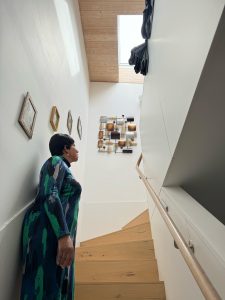
When Glenda moved into her new council home about two years ago, she vowed that she would stay there for the rest of her life.
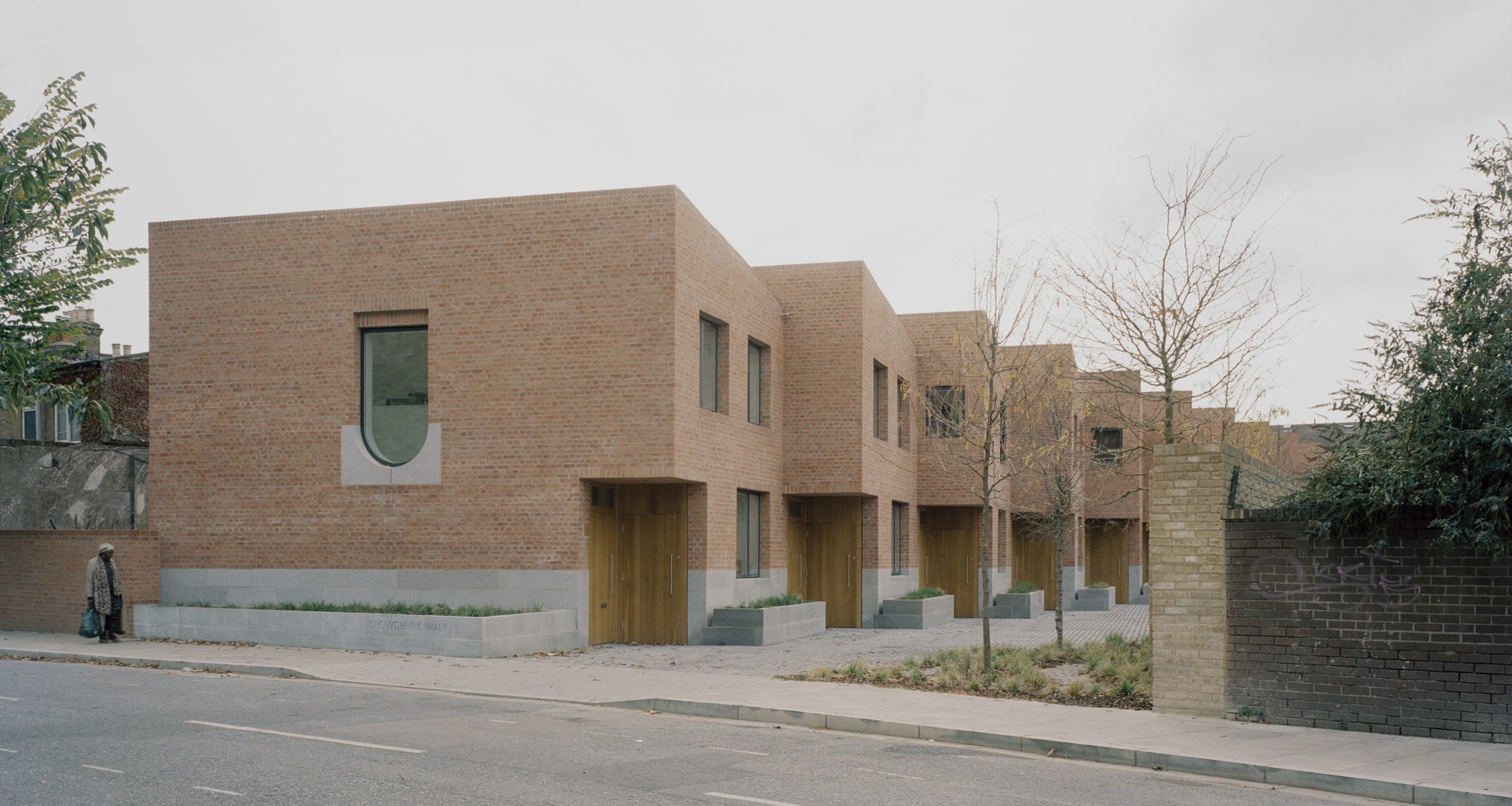
“It’s so spacious inside and so peaceful around here,” says Glenda, one of seven council tenants in Chowdhury Walk, a multi-award winning development of just 11 homes near Hackney Marshes in east London.
Having moved from a street just a short walk away, she’s particularly impressed by the community spirit. “If it was a bigger estate it wouldn’t be so inviting,” she adds.
Since being completed in late 2022, Chowdhury Walk has won or been shortlisted for a range of awards, recognising its innovative design and the comfort it provides for residents. The other four properties in the terraced street were quickly snapped up by private owners.
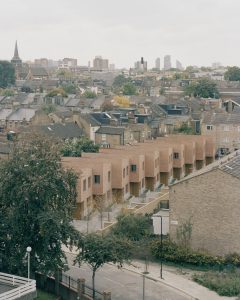
Part of its appeal stems from the fact the homes sit at an angle, avoiding the feel of a monolithic block. “I assumed the plans would be scaled back,” says Karen, who lives in a neighbouring street. “I was really happy that it was true to the plan.”
What’s so special about Chowdhury Walk?
Chowdhury Walk was built by Hackney Council in a quiet cul-de-sac that was once the site of lock-up garages.
The development is named after Abdul Mabud Chowdhury, a consultant urological surgeon who worked at nearby Homerton Hospital but died of Covid in April 2020 at the start of the pandemic.
Built from low-carbon cross laminated timber and clad in brick on the outside, the homes are well insulated with triple-glazed windows. Solar heating and their location in relation to the predominant wind also keep energy bills down, while reducing over-heating during the summer.
A new pathway in front of the homes may be used by the public as well as residents. “It’s a healthy environment to live in,” says Ken Rorrison, head of Hackney Council’s eight-strong regeneration strategic design team. “We’re using less toxic materials and they are attractive houses to look at.”
The fact the homes are ‘twisted’ and face the pathway and wider area at an angle also helps to protect the privacy of neighbouring properties. The front bedroom in each home overhangs the ground floor, creating an outside porch area. “It was a tricky site to develop,” explains Rorrison. “It’s backed by other homes and wasn’t accessible as such.”
How did the scheme come about?
Since Hackney Council began building homes again more than a decade ago, it has sought to ensure they are of a high quality.
To some extent, says Ken Rorrison, they are all special in the sense they meet the same design standards. “We follow the same aspiration in all our work,” he adds.
The council not only employs leading designers but allows them to get on with their work. “We try not to be prescriptive,” says Rorrison. “It’s just as important what the building does as what it looks like. Chowdhury Walk introduced a new route to the neighbourhood. It’s very gratifying to see school kids and other people using it day to day.”
Chowdhury Walk was designed by architects Al-Jawad Pike. “We knew whatever we put here was going to have to be modest in scale,” says founding partner Jessam Al-Jawad. “Twisting the houses broke up what would otherwise have been a long block of repetitive windows and doors.”
Richard Heath, director at structural engineers Momentum, says the ‘twist’ not only adds character to the terrace but means that most homes receive light from two directions. “It creates a corner that means you can get light coming in from the side elevations,” he explains.
The location of windows also increases security, with residents able to survey the neighbourhood from their homes. According to Heath, other London councils are looking for this type of innovation when commissioning homes, though nationally these represent the exception rather than the rule.
“With more than 8,500 households on the housing waiting list, it’s important Hackney builds wherever it can”
In many cases it’s a question of making the best use of small infill sites. Momentum is currently working with Hackney on five other schemes involving land that used to be the location of garages.
While most local authorities only started building again towards the end of the last decade, Hackney moved faster and therefore found it a little easier to recruit people with the required skills. “We slightly stole a march on others,” adds Ken Rorrison.
Initially, the design team focussed on estate regeneration, but attention has now switched to smaller-scale schemes on infill sites across the borough. “The principle of placing design at the centre of things was established early on,” he says. “We’re the professional voice with the ability to critique and review.”
How can Hackney afford schemes such as Chowdhury Walk?
Hackney owns more than 30,000 council homes. Since 2011 it’s built or supported housing associations to complete 4,100 homes, including Chowdhury Walk. A further 972 homes for social rent are in the process of being built, part of a target of 1,000 new social rented homes set by the council four years ago.
Money comes from the Mayor of London’s affordable homes programme, and cross subsidised from the sale of four of the homes in the terrace.
The council works to the same ‘standard build cost’ for all developments, says Ken Rorrison. By adopting a portfolio approach, the cost of projects with fewer homes (such as Chowdhury Walk) can partly be covered by larger developments.
With more than 8,500 households on the housing waiting list, it’s important Hackney builds wherever it can. About 30 developments are ongoing, including one for just nine houses.
“Some sites are more expensive than others,” says Rorrison. “Things have to stack up across the whole programme but the portfolio approach allows us to bring in less viable sites.”
Do schemes such as Chowdhury Walk represent the future of social housing?
It would be nice to think so. Since 2024, the development has been shortlisted for the Royal Institute of British Architects (RIBA) Stirling Prize and won both the Neave Brown Award for Housing and the Wood Awards, which celebrate timber design.
It was also among the winners at Hackney Council’s 2024 design awards, which take place every two years.
According to Ken Rorrison, councils shouldn’t only be trying to bring down waiting lists but providing homes that people are proud to live in, showing social landlords can outshine the private sector when it comes to design and construction.
An attractive, comfortable, low-carbon home brings pride to more than just residents. “Architecturally, you need to respond to the neighbourhood,” he says. “When you finish, the neighbourhood should be better than it was before.”