
Gaining access for safety checks, repairs, improvements and tenancy audits is part of the routine work of social housing providers. But there’s increasing concern about cases where access hasn’t been possible. These cases are highly problematic because they involve risk: the tenant could be in danger; their neighbours could also be at risk; the provider has legal and regulatory obligations to meet; and the cost of failed visits is very high. The risk of programme slippage is also significant.
The Association of Safety and Compliance Professionals’ (ASCP) White Paper estimates that in social renting, the cost of failed access attempts for gas servicing alone is £49-£65m a year. It believes the total cost of failed access for all reasons could reach £1bn over the next decade. That’s despite the great majority of tenants complying with landlord requests.
Our research report Opening the door: Changes to support necessary access to social tenants’ homes found that only about 40% of organisations in our survey had adopted a formal definition of ‘no access’. The most cited definition was that a case would be recorded as ‘no access’ after three attempts to gain access had failed. Most said these would be pre-booked attempts in writing (pre-arrangement is necessary to substantiate legal action). Some made calls or sent messages in addition to this.
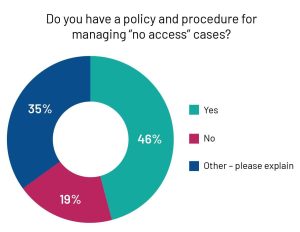
Most organisations (about four in five) did have a policy and procedure for dealing with ‘no access’ cases, or were developing one. Quite a number of landlords have either set up a specialist team to focus on complex cases, or have developed the capacity of local housing officers to deal with these cases (including, for example, by reducing patch sizes).
The organisational changes reflect a change of culture underway in the sector. Many providers have recognised that they need to get to the bottom of why a tenant might not, or might not be able to, allow access. Then they can tailor the service accordingly, giving an increased chance of a successful outcome. We found that those reporting some success had commonalities that we summarise here.
A focus on modern, effective services
A number of organisations examined their own performance, especially around appointments, and found problems:
- Appointment slots for too long a time period (all day/half day)
- Technology that made it easy to book an appointment, but not for the tenant to change or cancel
- Lack of automated reminders
- ‘Visit fatigue’: too many appointments
- Staff not knocking loudly enough or taking enough steps to make their presence known.
Tenants at a meeting for our research also reported problems:
- Failures of the landlord in organising visits – too little notice, difficult to rebook, contractors fail to attend or attend unannounced
- Too many single purpose visits
- Threatening legalistic letters from the landlord after one failed visit
- Little attention to people with disabilities, language issues, hearing impediments, etc
- People attending with no identity badges.
The remedies, therefore, could amount to making the best of technology to create more streamlined services coupled with effective communications.
- Where access is only needed for a short time (eg, 15 minutes) very short appointment slots could be offered
- Operatives should be able to give texted updates on their arrival in similar ways to delivery firms. An ALMO said one of its major contractors has an online tracking system that customers can use to see when the operative is likely to arrive.
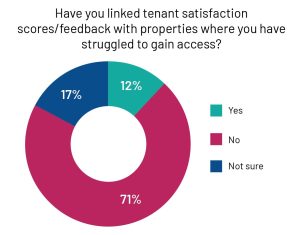
There was a growing awareness that tenants may be asked to allow access too many times, by different teams (which is only likely to grow as new legislation comes into force). Providers were trying to streamline visits, including for a single ‘home safety check’ each year. The logistics of this were proving difficult for some and there was a recognition that ‘silo working’ needed to be overcome. There are budget implications. It also requires flexibility and careful planning.
Some participants mentioned a ‘make every visit count’ approach where operatives going into a home for any reason would be asked to look out for damp or other repair issues. Some had set up easy reporting systems for operatives to feed back information. Longstanding problems of contractors working smoothly with the housing service remained but providers were paying attention to this.
In support of this type of approach, IT that works smoothly across the organisation and possibly with external contractors as well was important but difficult to achieve. This was acknowledged as an area of weakness that requires ongoing focus.
The importance of involving and asking residents was highlighted by the insights and improvements some organisations had gained as a result. One said the repairs focus group had helped shape the wording on cards put through doors. Another asked residents to comment on all of its access letters and had made adjustments. One organisation had gained insights from listening to a tenant directly affected by ‘no access’.
A focus on complex and persistent cases
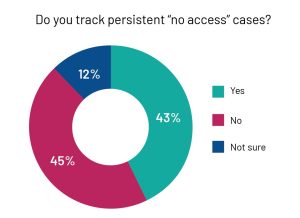
Here again we found evidence of culture change underway. Many organisations were asking housing and specialist officers to try to form an empathetic relationship with tenants. Crucially, this would involve listening to the tenant’s concerns, taking them seriously and negotiating for operatives to be allowed access.
Some reasons for not gaining access, and potential remedies, included:
- Some residents have no phone or calendar to record a scheduled visit. Multiple reminders, including a local officer calling the day before if wanted, can help
- Some residents may not be able to predict whether they or their family will be well enough to accept a future visit. Others may have a complexity of health and/or social services appointments that they understandably prioritise. Some organisations try to make it easier for the tenant to change their appointment, even at short notice
- Anecdotally many providers report more cases of hoarding behaviour, partly through increased surveys and campaigns encouraging people with problems to come forward. Providers that have successfully built personal relationships with tenants report some success in supporting people to allow access, within a wider empathetic approach that treats hoarding as a mental health issue requiring multi-disciplinary and trauma-informed support
- Housing organisations and local authorities must work within the Domestic Abuse Act 2021 and providers must comply with the RSH Neighbourhood and Community Standard requirements on domestic abuse. Some organisations have responded to sensitivities of this type by asking the tenant what arrangements they would find appropriate
- In a smaller number of cases, there’s criminal activity at the property (drugs, illegal sub-letting, etc), the tenant has undertaken unauthorised DIY or the home has been abandoned. Organisations should also be alert to possible ‘cuckooing’ of a vulnerable tenant (where someone takes control of a person’s home and uses it for criminal purposes).
Legal action
There was acute awareness that legal remedies should be a last resort when all other attempts to gain access have failed. Legal action is highly resource intensive and therefore costly. It carries risk: the outcome is not guaranteed. So, providers are doing all they can to minimise the number of cases and most take action on legal or regulatory requirements only. They must keep careful and comprehensive records, including photos/video where needed, to ensure they can evidence every action.
A large majority in our research wanted a clearer and more straightforward route to gaining access. They wanted a fast-track legal process for access on safety critical issues, and a public campaign by government to stress the importance of allowing access.
Recommendations
Our report includes 16 recommendations for providers to improve rates of necessary access to tenants’ homes. They include:
- Create a culture of support and empathy toward tenants that seeks to understand individual circumstances
- Adopt a definition of and term for ‘no access’ that’s blame-free in tone, that residents, staff and contractors alike can work to
- Create policies and procedures derived from the definition. Monitor their use in practice
- Test out and refine approaches by involving tenants at an early stage. Reflect on the reasons for failed visits and in particular any areas in systems or processes that may be causing or exacerbating the problems
- Be clear with tenants about their responsibilities to grant access and the consequences of not doing so
- Use all available technology to create a modern, fit for purpose system for booking, changing and cancelling appointments.