

Awaab’s Law (Hazards in Social Housing (Prescribed Requirements) (England) Regulations 2025) came into effect on 27 October 2025, in the first of three phases. Our research report Preparing for Awaab’s Law: Progress by housing providers provides a snapshot of how landlords were preparing for the new law, just ahead of its implementation.
We found that most organisations have stepped up to meet the challenge and deadlines on Awaab’s Law for this first year of implementation, including revamped systems and response times. Some have been highly proactive on damp and mould and haven’t waited for national legislation and regulations to come into force. Many have involved residents in the planning and run awareness campaigns.
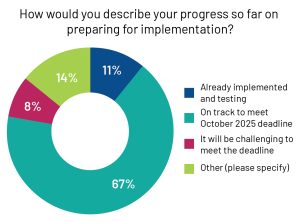
Two thirds of respondents in our survey were on track to meet the 2025 deadline, while less than 10% reported that they would struggle to meet it. Problems remain, however.
Among the difficulties are:
- Data systems, especially systems that connect across the organisation
- Resources are limited
- Staffing, particularly lack of qualified technical people such as surveyors
- Gaining access to survey or complete repairs (and see our linked report on this topic)
- Some aspects of the new law and guidance are unclear
- Achieving culture change across the organisation may be challenging
- Challenges around moving people out and finding suitable accommodation quickly.
On governance, we found organisations setting up specific reporting systems for Awaab’s Law compliance.
This includes upward reporting and escalation to governing body level, complete with metrics and KPIs. Reporting to senior staff, governing bodies and in some cases tenant panels is designed to embed reporting into the existing structures of responsibility. Some organisations specifically mentioned integrating Awaab’s Law data reporting into existing systems on risk, damp and mould and health and safety.
Responding quickly and accurately to the first report of a potential hazard under Awaab’s Law was seen as crucial. Providers were upskilling call centre staff and encouraging residents to use photos/video to enable accurate assessment. In our research, around two thirds of tenants said they were willing to do this. Triage arrangements were in place at the majority of organisations.
Many organisations reported, however, that they were struggling to recruit enough trained specialists, such as building surveyors or contractors with HHSRS experience, who could establish the severity of cases.
Ensuring compliance across a local authority was seen as a major challenge. Most organisations had reviewed their policies and most were trying to bring together housing management, asset management and other teams for seamless working – something that’s long been both a goal and a challenge.
However, the complexities multiply with other council departments. All staff who might visit tenants need to be made aware of Awaab’s Law requirements, so they can help with spotting problems and potentially supporting housing staff to gain access to the homes of tenants with particular needs. These staff and local councillors also need to know where to report any issues and to do so promptly.
Measures taken specifically to meet the new Awaab’s Law duties included:
- Staff training – eg, on HHSRS and vulnerability
- Drawing in other departments and alerting their staff to the new requirements
- Toolbox talks
- Triage arrangements – using the existing call centre or a newly formed centralised team
- More use of photos and video
- Damp and mould first aid kits made available to clean small areas
- Summary proformas
- Summary emailed (where possible) or given to tenant whilst surveyor still on site
- Ability for surveyor to book appointments to complete the work while at the tenant’s home – allows mutually convenient appointments.
Our study suggests that providers are striving to bring about a culture of respect for residents and that many are investing in training to support an approach and behaviours that foster trust. We found a distinct shift toward an approach that’s based more in understanding individual residents’ needs and wishes. This was mainly around building relationships with people who are known to have a vulnerability or who have come to the provider’s attention for a particular reason, such as complaints or not allowing access.
Most are using all their normal channels – tenant newsletters, leaflets, social media, rent accounts, etc – to alert and inform residents about Awaab’s Law. About two thirds of survey respondents had a full communications strategy. Some are taking the opportunity to do widespread consultation with residents, which can both inform them and seek their views. Some have involved resident scrutiny panels or resident groups to share progress and garner ideas. Some were engaging with tenants to develop plain English summaries of communications and advice.
Providers are moving toward a recognition that they must offer highly responsive systems that work for tenants, coupled with empathy and personal service. There’s a new willingness to seek views from residents who may not have previously reported problems, especially with DMC. Similarly, organisations were no longer assuming that problems were resolved if there was no further report: some are actively returning to ask tenants what’s happened since.
Technology was seen as crucial to delivering results, but also a key factor in problems with meeting the new demands. Many are struggling to integrate information technology (IT) systems across the whole organisation and to share appropriately with contractors. There are problems in keeping data on resident vulnerabilities up to date and appropriately shared. There were many calls for a dedicated IT system for reporting, tracking and monitoring both individual cases and the organisation’s overall compliance.
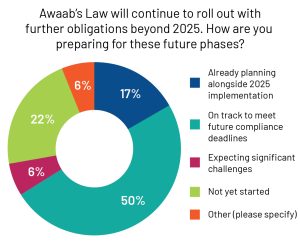
Quite a number of providers have made the link between Awaab’s Law compliance, stock condition and customer satisfaction for the longer term. Some are using the first year of implementation to embed new policies and practice, so that they will be better prepared for the next phases.
Legal and regulatory issues
Some organisations noted the lack of clarity on aspects of the detail in the government’s draft guidance, particularly over the maximum timeframes, the meaning of certain terms and any exemptions. Two terms in particular with interpretable meaning were cited: ‘emergency’ versus ‘significant’ and ‘all best endeavours’. Participants felt that this added to an already complex and sometimes unclear legal framework.
There’s considerable uncertainty simply because the legislation is new and untested. Organisations had many concerns about a potential rise in disrepair cases and ‘claims farming’. However, some had taken positive action to deal with complaints and disrepair claims quickly and thoroughly, with new protocols and timescales(1). Data recording was seen as crucial.
There was no hint of outdated attitudes around residents and ‘lifestyle’ in relation to DMC. Instead there’s a widespread concern that residents’ circumstances can exacerbate complex problems. There’s sensitivity around this, of course, but especially with damp, mould and condensation issues, providers report that people are suffering through the cost-of-living crisis, cannot afford to turn their heating on or want to keep the windows shut to conserve warmth. Others are having to live in overcrowded conditions above the design tolerance of the building, that can worsen humidity.
A number of organisations are offering support to residents, as part of a general shift towards being more empathetic and responsive. Some are trialling damp and mould or environmental sensors to help pick up problems earlier. Some are fitting ventilators and dehumidifiers. Most are signposting residents to help with maximising finance and meeting bills.
There were particular concerns around finding suitable alternative accommodation when needed, within Awaab’s Law timeframes. A few organisations planned to hold properties vacant, but given extreme demand pressures, this was likely to be difficult, especially for smaller organisations. Finding accommodation in the private rented sector at short notice could also be difficult.
Future challenges mentioned most frequently are:
- Timeframes
- Integration
- Legal and access
- Resources including specialists, contractors, admin capacity, staff knowledge
- Concerns over disrepair claims, no win no fee claims firms
- Challenges over moving people out at short notice.
Many participants in the study felt more could be done at government level to facilitate the transition to full implementation of Awaab’s Law. There were repeated calls for clarity on legal action with a clear route to gaining access, action on claims firms, increased funding and capacity, and new IT systems.
Footnotes
1 Birketts solicitors have produced a useful set of flow charts to help providers stay legally compliant in responding to Awaab’s Law