
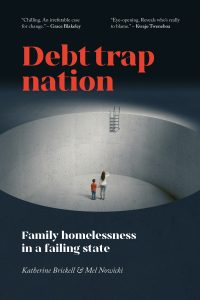
By Mel Nowicki and Katherine Brickell, authors of Debt Trap Nation: Family Homelessness in a Failing State.
It’s no secret that England is a country in housing crisis. Homelessness records are continually being broken. Last year, 1,611 homeless people died, a 9% increase from the previous year, and a record-breaking 131,141 households, including 170,000 children, are currently homeless and living in temporary accommodation – a 12% jump in just one year.
It’s also no secret that local authorities are cash-strapped and are struggling to keep up with the soaring costs of housing people in temporary accommodation, including in hotel rooms and B&Bs. Local authorities in England are spending a staggering £2.8 billion per year on temporary accommodation. In London, the epicentre of the temporary accommodation crisis, that spend is up to £5.5 million per day.
And yet, what remains under the radar are how local authorities themselves contribute to increasing numbers of families stuck living in temporary accommodation.
Our new book, Debt Trap Nation: Family Homelessness in a Failing State, tells the stories of single mothers navigating rent arrears, spiralling debt and life in temporary accommodation. In it, we pull back the curtain on some of the lesser-known policies that contribute to this trap.
Social housing allocation policies are one of the key offenders, with most councils in England barring families from bidding for social housing if they are in housing-related debt – even though these debts are usually what triggered their homelessness in the first place. This is a perverse situation where local authorities are unnecessarily extending families’ stays in temporary accommodation, extending time spent living without a secure home, or a secure future, and extending their own vast spending on unsuitable, often trauma-inducing, accommodation.
“Many of the women we met, and whose stories we tell in the book, had fallen into rent arrears and homelessness as a direct consequence of abuse”
Our research found that 88% of local authorities in England have disqualification rules linked to housing-related debt. In one month alone, FOI requests we submitted revealed that nearly 4,000 households were barred from social housing due to debt-related rules – over 1,500 of these households included children. This is likely to be a gross under-estimate, as many councils could not provide us with the data. Typical responses to our FOI requests included “We don’t hold this information” or “This will require a manual trawl” through their records which they declined to do. If councils can’t – or won’t – monitor how their own rules affect society’s most vulnerable families, how can they claim to be fair or functional?
Fewer than one in five local authorities state that they exempt domestic abuse survivors from these rules. Many of the women we met, and whose stories we tell in the book, had fallen into rent arrears and homelessness as a direct consequence of abuse. This took various forms, including their abuser lying to them about not paying rent, taking out loans in their name, and withholding access to money. Women we spoke with had fled violent partners only to enter financial destitution. They then found themselves – and their children – trapped in poor-quality temporary accommodation, which they couldn’t escape because of allocation rules that meant they were unable to bid for social housing because of the debt they were in, despite the fact that these debts had been forced upon them by their abusers.
One participant described themselves as “survived then punished” – escaping one trap, only to be immediately entangled in another.
This isn’t only immoral: it’s also potentially unlawful. We met with a top barrister in social housing and allocations law, who confirmed that if local authorities are excluding domestic abuse survivors from allocations lists on the basis of housing-related debt, and that debt is a direct consequence of domestic abuse, then that’s discriminatory and therefore unlawful under the Equality Act 2010.
We’re therefore calling on national government to change legislative guidance and regulation to ensure that all survivors of domestic abuse are exempted from these rules. This won’t produce more of the desperately needed high-quality social housing overnight, but it will at least give families, who have already been through too much, a fighting chance of eventually moving on from homelessness.
Debt Trap Nation: Family Homelessness in a Failing State is out now.