
How do you gain the trust of communities that have been let down too many times before? That’s been a central question for the Placemaking project, which HQN researchers have been working on for the last two years.
The project was commissioned by the Community Housing Industry Association (CHIA) of New South Wales, Australia, and funded by the NSW Department of Communities and Justice (DCJ). They wanted to establish practical guidance on supporting neighbourhoods in the state that had been taken on by housing associations in recent years. The housing stock is still owned by the state public authority, and was previously run by it as well.
Many of the problems facing the communities and the housing providers will be familiar to UK practitioners. Poverty, isolation, the distance between young and old residents, vandalism and a poor environment are common. Aboriginal communities in particular have suffered long-term loss and may feel alienated from service providers.
So, trust and respect are important concepts in the work of getting communities to engage with providers for mutual benefit. Our project found that very often, residents just want providers to get the basics right: day-to-day repairs done properly, rubbish cleared away, graffiti removed, grass cut. Their frustration understandably grows when they see a provider struggling even with these bread-and-butter issues.
Case study organisations in the UK, Ireland and Australia offered imaginative ideas on how to achieve buy-in from residents in these circumstances. Some held fun days, some brought in community arts projects, many stressed the importance of listening to residents’ stories about the history of the neighbourhood and its people. The aim was to build a sense of pride in place – and once a dialogue started, residents and staff could make a start together on tackling the problems.
It’s crucial to deliver on what you promise, of course. Providers will need to make an offer to residents – perhaps simply a promise to tackle roaming dogs or those botched repair jobs – but whatever it is, providers had to show they were as good as their word.
As resident engagement developed, residents would open up about other issues. Further down the line they might want young people given something positive to do, or action taken on antisocial behaviour. A key element in delivering on these issues was providing spaces for people to come together in the neighbourhood. Our research found that a community centre or meeting room placed very locally on the estate or complex was vital for people to be able to build their connections with each other. Outdoors, informal ‘bumping into’ spaces could be created, to help people get to know their neighbours and feel less isolated.
In Australia, understanding and respecting Aboriginal communities’ cultures is essential. The term ‘cultural safety’ is used to mean creating environments where Aboriginal people feel respected, valued and free from discrimination or marginalisation. It ensures that cultural identity, beliefs and practices are acknowledged and protected in the work of placemaking.
As a guide written by Emily Hale for the Placemaking project notes, placemaking for Aboriginal communities involves restoring their deep connections to land and recognising its spiritual and cultural significance. Some housing associations have begun working with Aboriginal elders to support empowerment and leadership in their communities as placemaking develops. That involves building trust by learning about the histories, values and cultural practices of the communities, and taking things at the pace the community wants.
Some organisations in the UK have been working on placemaking initiatives for many years, developing sophisticated systems along the way. Pioneer Group has been working on the Castle Vale estate in Birmingham since it became a Housing Action Trust back in the 1990s. Today the housing association works in close partnership with residents on a range of initiatives designed to support and stabilise the community. The long-established systems and practical ways of working stood them in good stead when first Covid and then the cost-of-living crisis struck.
Castle Vale’s partnership of residents, housing association and a range of other services such as police and health works to a rolling five-year neighbourhood plan. The plan is not branded as Pioneer Group because it belongs to everyone. It means that each agency is drawn into a strategy that has clear goals and requires each partner to play their role fully – at both operational and strategic level.
Drawing together the toolkit
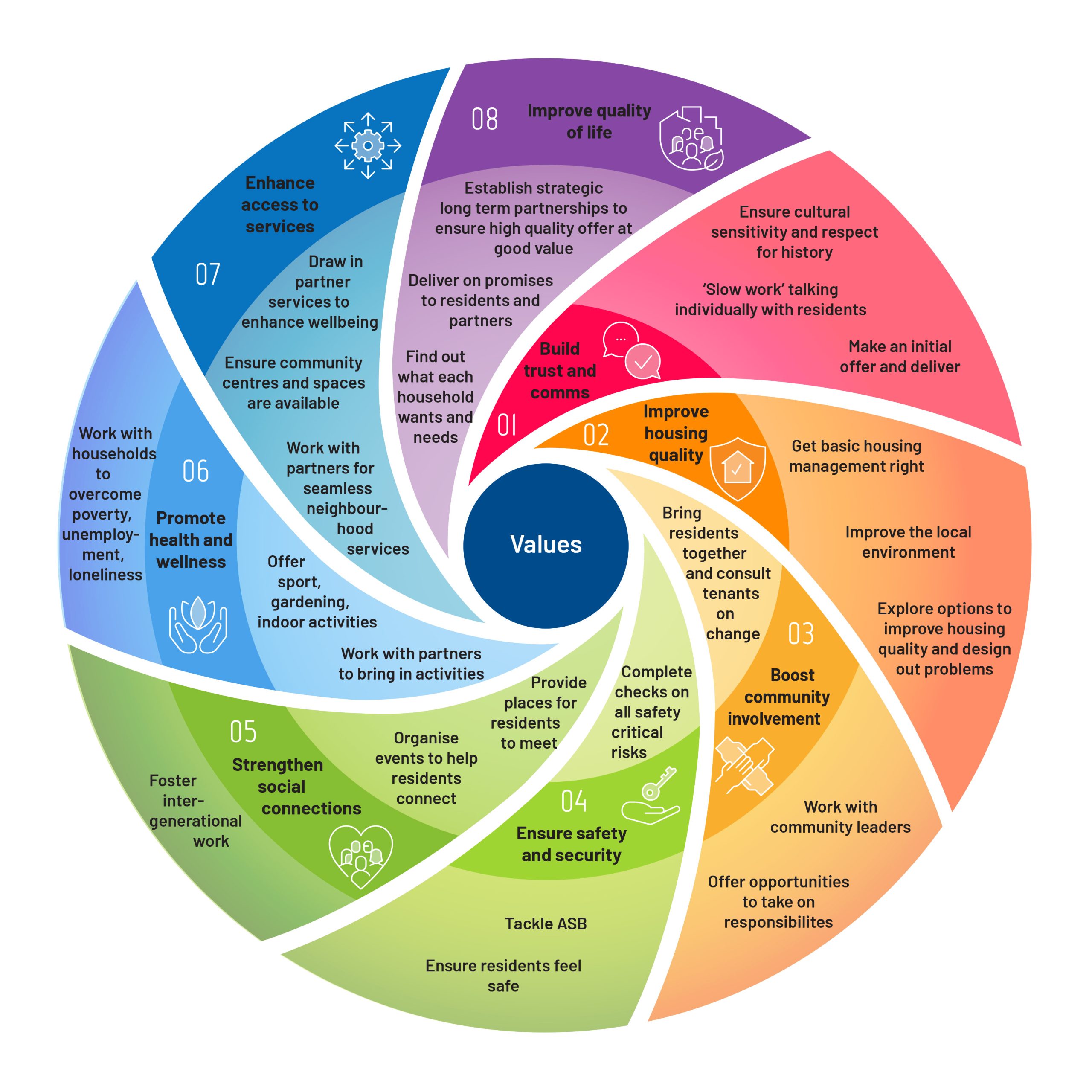
CHIA NSW asked HQN to draw up a toolkit for housing providers to undertake placemaking. Drawing on our research into the issues and successes our case studies were reporting, we set out six fundamental values that providers work to in their placemaking. Then we established eight objectives to achieve action in fulfilling those values.
Finally, we grouped practical actions that organisations can take toward achieving each of the objectives. Some, like getting the basics of housing management right, can be put into action straight away and will help establish trust. Once residents are starting to engage, they may start to lead on their own ideas for projects and to take on local responsibilities. And finally, longer-term strategic actions, drawn up in partnership with the community, can tackle the deep-seated issues such as poor health and lack of employment that are often found. Actions can be formalised into partnership plans, as at Castle Vale, to ensure everyone’s pulling in the same direction.
We represented this combination of objectives, actions and time as a spiral (see below).
By using our toolkit’s self-assessment questions, organisations can work through the different phases of action from the early objectives to the very broad outlook over time. There are lots of examples from around the world, and links to other resources. Practical ‘how to’ guides help organisations to get started with initiatives such as estate inspection, scrutiny panels and dealing better with complaints. The toolkit is designed to support organisations using shared metrics to track their progress toward fulfilling their objectives and values.
The Placemaking project is here: https://communityhousing.org.au/placemaking-improving-services-engagement-and-satisfaction-in-estate-communities/ and the toolkit will be available online soon.