

 Local authorities often get a bad press for the standard of their housing services compared to better resourced housing associations. But tenancy fraud is one area where they are streets ahead, according to our exclusive research, helping to free up thousands of social homes and generate significant savings. Keith Cooper’s investigation throws some much-needed light on an under reported area of housing and reveals some significant disparities.
How should social landlords treat tenancy fraud?
As a ‘niche’ part of housing management, just another job for the housing officer but one with little reward? Or is it something in need of more serious attention, requiring dedicated full-time fraud-busting staff, an endeavour with the potential to save millions of pounds and free thousands of homes?
To find out, Housing Quality Magazine has analysed data obtained under the Freedom of Information Act from 114 local authorities in England.
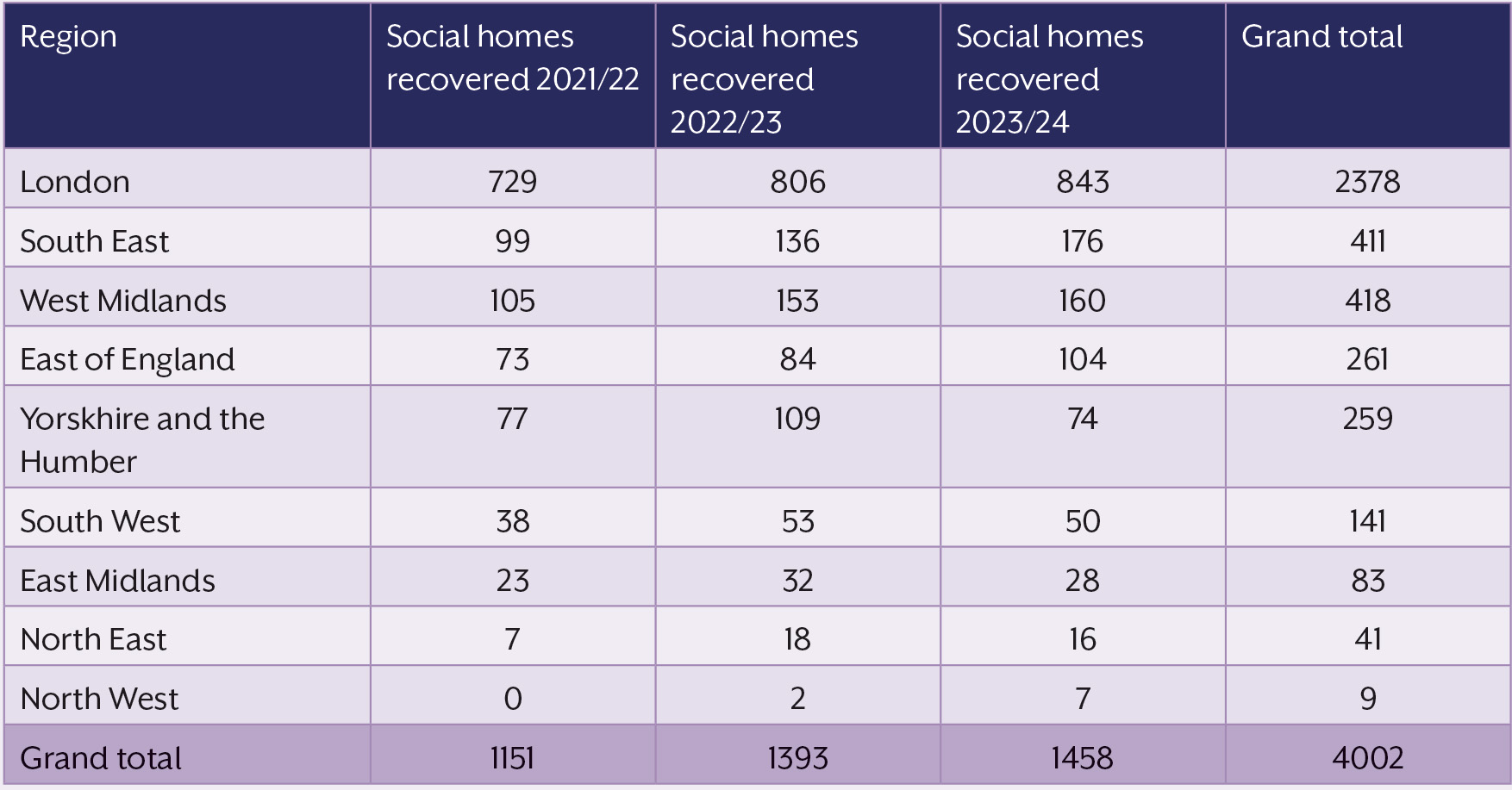
This analysis reveals a chasm-like divide in the way councils treat tenancy fraud. While 90 of the councils in the analysis recovered more than 4,000 social homes in the three years from 2021/22 to 2023/24, the other 24 authorities freed up none.
Three London boroughs with dedicated fraud teams recovered the most. Lewisham, Hillingdon, and Lambeth each freed up more than 200 homes over the three-year period. The most homes recovered by a council without dedicated fraud busters was 24 over three years by Great Yarmouth.
While the lion’s share of the 4,002 recoveries were in London, hundreds of social homes were also freed up in the south east, the east of England, the West Midlands, and Yorkshire and Humber (see box). Only 50 social homes were recovered from fraudsters in the ten local authorities in the north east and north west which responded to the FoI request.
Big financial impact
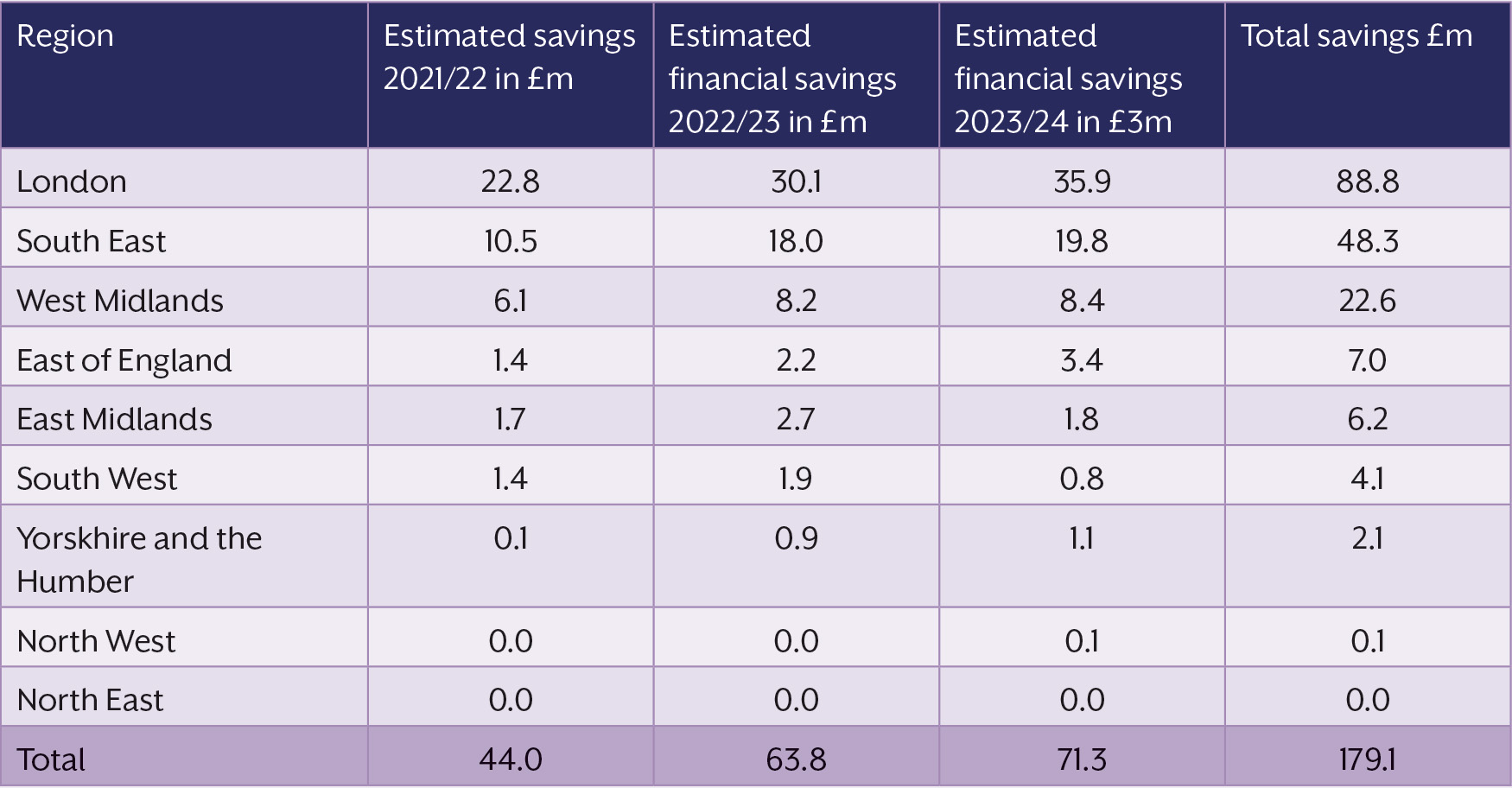
The analysis also shows that the number of homes recovered alongside the savings made by council fraud-busting teams has risen year-on-year. In 2021/22, councils freed up 1,151 homes, saving an estimated £44.0m. By 2023/24, the number of recoveries had risen 27% to 1,458 homes, as savings jumped 62% to £71.3m (see tables below).
Lewisham Council’s cabinet member for better homes, neighbourhoods and homelessness, Will Cooper, said tenancy fraud blocked people in need from accessing secure housing and had a “big financial impact” by increasing its reliance on expensive temporary accommodation.
“It’s therefore doubly important that we tackle it as rigorously as we can, and we have a dedicated team to do so. This means we make around 100 additional homes per year available to families on our housing register,” he said.
Cllr Cooper explained that not all of the frauds the authority uncovered were “deliberate” but that the impact was the same. “The majority of our cases are abandoned tenancies, where the tenant is no longer occupying the property, but hasn’t returned it to us under the terms of the tenancy agreement,” he added.
Lewisham’s FoI response shows it spent £995,000 on counter fraud measures, saved £2.7m, and recovered 290 homes over the three years covered by the analysis.
“The costs associated with the [tenancy fraud] team are low in comparison with the money saved by removing families from temporary accommodation and placing them in permanent council accommodation”
Danny Adilypour, Lambeth Council deputy leader and cabinet member for housing
Lambeth Council’s deputy leader and cabinet member for housing, Danny Adilypour, said the council’s counter fraud efforts were driven by the thousands of households on its waiting lists and the 4,700 homeless families in “expensive and often poor quality” temporary accommodation.
“For these reasons the council funds a tenancy fraud team to tackle all types of tenancy fraud and recover properties to help reduce the waiting list and to help cut the costs of temporary accommodation,” Cllr Adilypour added. “The costs associated with the team are low in comparison with the money saved by removing families from temporary accommodation and placing them in permanent council accommodation.”
Lambeth’s FoI response shows that over the three years it spent £1.6m on counter tenancy fraud, made £9m in savings, and recovered 246 homes.
Hillingdon Council said it had built its counter-fraud services to “robustly detect and prevent fraud against the public purse. The team’s outstanding achievements in tenancy fraud can be attributed to its effective detection and recovery processes through the shrewd use of intelligence and data, along with the creation of an effective counter fraud culture internally and strong stakeholder relationships,” a spokesperson said.
Hillingdon Council recovered 229 social homes over the three years. It was unable to provide figures on how much it spent but had saved £12.8m, its FoI responses shows.
‘Bouncing back’
Alan Bryce, a non-executive director at the Tenancy Fraud Forum, said the figures showed council fraud-busting work was “bouncing back” but was still “significantly below” the levels he saw as head of counter fraud at the Audit Commission before it closed in 2015.
According to one of the commission’s last reports on tenancy fraud, Protecting the Public Purse, published in 2014, councils recovered 3,030 social homes in that single year. This is more than double the number recovered by councils in 2023/24, according to our analysis.
“These figures suggest a stark difference between what local authorities and housing associations are doing. It raises questions as to why so many housing associations report nil returns to the regulator for tenancy frauds”
Paul Roberts, board member, Rochdale Boroughwide Housing
Following that peak year for recoveries, councils lost much of their fraud-busting staff to the Single Fraud Investigations Service, which was set up by the then government in 2014, according to Mr Bryce. “As a result, councils’ capability and capacity to tackle tenancy fraud fell away and they have had less funding and less focus on it,” he said. “This bouncing back is encouraging but we’re still significantly below what we saw ten years ago.”
Mr Bryce said the housing crisis is now prompting some councils to reinvest in counter fraud measures as a far cheaper means of increasing access to social rental homes than new development. “This data shows what’s achievable if you invest in counter-tenancy fraud in a professional fashion,” he added. “Some councils in London use £500,000 per unit to build new housing. For that amount of money, you could probably recover 40 or 50 properties. From their perspective of getting families out of bed and breakfasts and into social housing, it’s a no-brainer.”
Our analysis shows that councils spent £14.3m on counter fraud work in the three years between 2021/22 and 2023/24, while saving £179.1m over the same period. The figure for savings and expenditure are likely to be an underestimation as some councils didn’t provide them. Savings figures may also not include cash clawed back from fraudsters using unlawful profit orders. Camden Council told HQM it had recovered £15.1m with this legal measure in 2022-23 alone.
‘Dropped the ball’
Arun Chauhan, fraud specialist at Tenet Law, said the HQM analysis showed that while councils were “going in the right direction” it also highlighted how housing associations had “dropped the ball” on tenancy fraud.
“Fraud is a massive compliance issue in the banking sector but it isn’t in the housing association sector, which is focused on damp, mould and repairs,” he added. “But as in any business it’s important not to drop the ball in areas on which you’re not regulated.”
As our previous investigation revealed, most housing associations reported zero tenancy frauds to the Regulator of Social Housing in 2022/23. According to figures obtained under a previous freedom of information request, only 204 tenancy frauds were officially logged by associations that year, resulting in a financial loss of £127,433. In contrast, councils’ fraud busting teams that year recovered 1,393 social homes, saving their authorities £64m, according to this latest analysis.
Paul Roberts, a former finance director at The Guinness Partnership, said: “These figures suggest a stark difference between what local authorities and housing associations are doing. It raises questions as to why so many housing associations report nil returns to the regulator for tenancy frauds.”
“Some councils in London use £500,000 per unit to build new housing. For that amount of money, you could probably recover 40 or 50 properties. From their perspective of getting families out of bed and breakfasts and into social housing, it’s a no-brainer”
Alan Bryce, non-executive director, Tenancy Fraud Forum
Mr Roberts says fraud busting had been rendered the “poor relation” of housing management in associations by government-imposed rent cuts stretching back to 2016. “This forced housing associations to reassess counter tenancy fraud activity and to reorganise their housing management departments which inevitably had an adverse impact on tenancy fraud detection,” he added. “But tenancy fraud hasn’t gone away and these figures show that there are recoveries and financial returns to be made.”
Mr Chauhan pointed to the figures for London which showed hundreds of homes recovered each year. “The chances are that, in cities like London, tenancy fraud is as prevalent in housing association homes as it is for local authorities’ housing stock. Why is it assumed that fraudsters aren’t also targeting housing association stock? They just have to invest in detection,” he added. “When they go looking for it, they will find it, get results, make savings and free up affordable homes.”
As HQM has previously reported, some housing associations have recently increased their focus on tenancy fraud. L&Q created a new fraud-busting team in 2022 after its previous one was closed down. In 2024/24, this team recovered 67 homes, saving £2.8m for the taxpayer, it announced in November. West Midlands-based Bromford, Peabody and Riverside have also created dedicated counter fraud posts.
The role of regulation
Mr Roberts, who’s also a board member of Rochdale Boroughwide Housing, said the Regulator of Social Housing’s new set of consumer standards should also increase associations’ focus on tenancy fraud. “Associations should know who’s living in their homes and respond to customers’ concerns,” he says. “A lot of our customers get the message about the housing crisis. People feel that tenancy fraud is wrong and want something done about it. If we’re trying to build trust with customers but are then not listening to them, make it difficult to report tenancy fraud, and then fail to tackle it when they tell us about it, then that’s not good for trust.”
The Regulator of Social Housing told HQM that tenancy fraud was an “important issue”. “We’re clear that social landlords must take action to detect and address it, in line with the requirements in our standards,” a spokeswoman added. “Tackling cases of tenancy fraud remains a landlord responsibility. They must understand who’s living in the homes they provide and use this information to identify tenancy fraud and prevent it from happening in the first place.”
“Fraud is a massive compliance issue in the banking sector but it isn’t in the housing association sector, which is focused on damp, mould and repairs. But as in any business it’s important not to drop the ball in areas on which you’re not regulated”
Arun Chauhan, fraud specialist, Tenet Law
Social landlords with 1,000 homes or more are expected to report any losses from frauds to their regulator. But tenancy fraud doesn’t always lead to a loss for associations, as the rent on properties is often still paid by the fraudster. The financial cost is instead most likely to fall on local authorities, which have seen bills for costly temporary accommodation hit £2.3bn in 2023/24 as they struggle to find free social housing for homeless households.
With associations facing huge bills to fix dangerous cladding and rid their homes of damp and mould, many will claim they lack the financial capacity to tackle tenancy fraud, according to Mr Roberts. “But we’ve got to stop people thinking that people can get away with tenancy fraud because we haven’t got the resources to detect it. Some of this is just about joining the dots,” he added. “We’ve already got eyes and ears on the ground with customer-facing colleagues who go into people’s homes to do repairs and safety checks. Let’s make sure they have clear routes to provide valuable intelligence, data is used effectively and action taken.”
From the chief executive and chair at the top, to the housing officer on the estate, people in housing are there to help with the housing crisis, Mr Roberts explained. “A lot of people in housing management do see their role as more than just a day-to-day job,” he added. “They really want to improve people’s lives, are concerned about the housing crisis, and want to contribute directly towards solving it. Tackling tenancy fraud can be part of that.”
Social homes recovered from counter housing fraud work
Estimated savings from counter housing fraud work












One Response
We would agree that this is an area that needs significantly more serious attention. The savings are likely to run into the 10s of millions and free up thousands of homes, yet there is very little coverage and in some organisations positive resistance to tackling housing tenancy fraud. HTFI was set up specifically to meet the need of this problem. We started investigating housing tenancy fraud in 2012 with the aim of freeing up misused housing for people in need.
We employed 6 specialist housing experts and we work in a geographic area between the Midlands, London, the South East and South West. We only work with housing associations and investigate 3-400 new cases a year. As a small to medium enterprise (SME) we have an incredibly low cost base. We don’t have offices because our investigators hot desk from the housing associations. All of our investigators work with housing associations on a part time basis providing specialist expertise where it counts, often two or three days a week.
Housing officers are increasingly overstretched and whilst they don’t have the time or the specialist skills to carry out investigations and case preparation they can assist and reduce the amount of time a specialist investigator is required. We try to recruit investigators who live locally to the cases they’re investigating. Investigating tenancy fraud can involve multiple visits to the property at unsociable hours (while the sub-tenants at home) and in order to minimise travel time we prefer local specialists. The result is that the average cost of a housing tenancy fraud investigation is £517 and the average investigation cost to recover a property is £2,096, this is about 1/3 of the cost of a local authority investigation (Lewisham (£995k/290= £3,431 and Lambeth (£1.6M/ 246=£6,504).
It’s our understanding that the majority of housing associations do not report housing tenancy fraud to the regulator. This could be the reason for the disparity between local authorities and housing associations. I don’t know if the regulator publish the raw data (Last time I checked they didn’t) or if the data is available from via freedom of Information request. Clearly this data should be published and greater efforts made to collect the data. Once published and publicised housing associations will be spurred into more effectively managing their stock by tackling housing tenancy fraud and some who already investigate but don’t report to the regulator will start to report.
Over the last 10 years at least two managers in separate housing associations have told me that sub-tenants pay the rent and therefore there is no incentive for a housing association to investigate and evict the tenant who are committing housing tenancy fraud. Housing associations don’t see themselves as the victims of the fraud because they don’t suffer a financial loss. Clearly this brings into question the affective and responsible management of the stock over which their guardians, not to mention the risk to the other residents of having an unknown person living next door and further questions about the insurance of the block if the housing association know properties are sublet and have failed to act. We agree with Alan Bryce that in the immediate term it’s significantly cheaper to identify someone sub-letting then building a new build property.
The victim is of course the taxpayer, you and I who are paying hundreds of millions in a temporary social housing bill a large part of which is avoidable, Children are dying in temporary social housing (BBC 28/01/25) and thousands of people cannot settle in a permanent home whilst staying in a B&B or hotel. Central government of course are picking up the bill but as the data demonstrates they’re clearly not doing enough to incentivize the public housing sector be they councils or housing associations into tackling housing tenancy fraud.
HTFI would agree and echo Mr Roberts views. Publishing league table of housing associations and the number of investigations and recoveries they carry out a year would be good start. The regulator could be given greater powers or use existing powers in guiding housing associations in there obligation to effectively manage stock, identifying properties that are not used as main and principle home or are sublet. The way of course to do this is to collect data on the number of investigations they carry out and the number of properties recovered.
If the estimate of 10% of social housing stock (tenancy fraud forum( TFF)) is accurate any medium or large housing association can expect to see in excess of 300 investigations a year with at least half of those properties being relet to people on the temporary social housing list.
The solution is simple, unfortunately pulling the pieces of the jigsaw together is unfathomably complex.