
Neil Merrick reports on how a housing association’s tenants are helping to spread the word about energy efficiency, while enjoying lower bills.
The tenant’s story
For the past year, Alan Wright and his family have been enjoying the benefits of solar power. Since April, his monthly direct debit for electricity and gas has fallen from £200 to £150.
Along with other tenants of Raven Housing Trust, he can see how much electricity is stored in his battery via a smart meter or app, and then decide the cheapest time to use appliances, such as a washing machine.
“We get most power on the sunny days. On a wet day you have to wait for the sun to come out and then it boosts the battery in the loft”, he says. “I’m a stickler for looking at my smart meter.”
Wright has lived in the semi-detached house in Tadworth, near Epsom, since 1987 with different family members. The house was retrofitted in 2024 as part of Raven’s programme of bringing all properties up to energy performance certificate (EPC) level C. Double-glazed windows and cavity wall insulation were also fitted.
Raven’s records show the house now emits 1.7 tonnes of carbon per year compared with 3.8 before. But it’s the numbers on Wright’s bank statement that impress him the most. “By saving more than £300 per year, I could afford to put Christmas on the table,” he says.
Why is Raven improving energy efficiency in its homes?
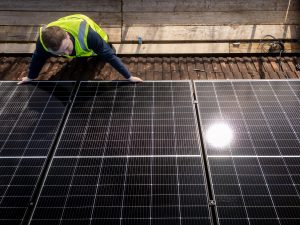 Raven Housing Trust was created in 2002 following a stock transfer from Reigate and Banstead Council.
At present, more than 5,000 of its 7,000 homes in Surrey and Sussex meet at least EPC C – equivalent to 89% of all stock and up from 79% in 2021. By 2030, all social housing in England is meant to meet EPC C.
But targets linked to achieving net zero (by 2050) were already built into the trust’s business plan. “A huge amount of carbon is emitted from housing,” says Ali Bennett, Raven’s director of homes. “We recognise that we have a role to play.”
Since 2022, the trust has upgraded more than 500 homes. Most are fitted with solar panels and battery storage systems, meaning that residents are more likely to use electricity than gas, and save money in the process.
Some properties undergo more extensive retrofitting, including modern ventilation, double-glazed windows, plus loft and wall insulation. Some homes in Epsom were fitted with ground source heat pumps, while a communal solar system was installed in nearby Ewell.
Raven says it takes a holistic approach to repairs, voids and capital works to ensure that sustainability programmes aren’t carried out in isolation, reducing disruption to tenants.
Are tenants totally behind the changes?
When it embarked on the first wave of improvements in 2022, Raven tended to tell tenants why the changes were needed rather than sell the idea to them.
Though the trust stressed how solar heating helps to tackle climate change, this wasn’t generally seen as critical to households grappling with rising energy bills and other financial pressures.
For wave 2 of the programme, which began in 2023, Raven went for more positive messaging, stressing that it wished to make homes “warmer, quieter and cheaper”, while equipping them for the future.
“Day recalls how a tenant told him how she had rung her daughter after checking the amount of energy stored in her battery, telling her daughter to come around and use her washing machine as the electricity was free of charge”
As a social landlord, Raven has no legal right to enter people’s homes. Since 2022, an average of 14% of tenants have declined to have work carried out. However, the rate of refusal fell from 23% in wave 1, which finished in 2023, to 10% in wave 2, which is ongoing.
Anthony Day, Raven’s sustainability manager, points out that, by setting a target of all social housing meeting EPC C by 2030, the government has, in effect, introduced a statutory target without any statutory back-up.
But winning over tenants is about more than simply hitting targets. By stressing how solar power can reduce electricity costs, and thermal comfort helps to reduce damp and mould, the trust is converting residents to the idea of saving energy and making a contribution to national sustainability targets.
“While people have an understanding of climate issues and what’s happening in the world, they’re more interested in the impact these things have on their day-to-day lives,” adds Ali Bennett.
Tenants with solar panels generally check how much power is stored in their battery via an app. This also tells them the best time to draw on the electricity generated, helping them to save money.
Day recalls how a tenant told him how she had rung her daughter after checking the amount of energy stored in her battery, telling her daughter to come around and use her washing machine as the electricity was free of charge.
“We have to explain how, for three or four weeks’ disruption [for a full retrofit], they will gain 20 to 25 years of economic benefits,” he says. “The app shows how much energy they’re generating and gives them more control over a significant cost in their lives.”
How do residents find out about the programme?
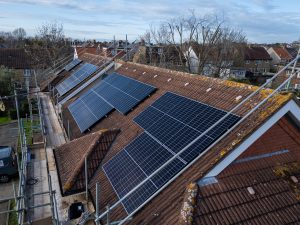 Energy efficiency and wider improvements are explained by Raven’s tenant liaison officers and contractors when they visit people’s homes.
In addition, last April, Raven turned a recently vacated home in Redhill into a sustainability hub, where the technology is explained in more detail. Some tenants may be unfamiliar with solar panels and battery storage, says Anthony Day, and require reassurance as well as practical demonstrations.
“We want to get away from the idea that we’re filling people’s homes with strange tech,” he says. “It’s important to explain what impact these measures can have on them and their homes.”
As more tenants are won over, they may tell their neighbours and assist staff in explaining the value of energy efficiency. “By our tenants becoming advocates, we get a much better response from other tenants,” says Day.
Are gas boilers being phased out?
Not for the time being. Raven says it’s keen to explore alternative technology, but doesn’t want to put all its eggs in one basket as technology evolves. Where gas boilers are installed, they’re dual fuel ‘ready’ and can be switched to other energy sources, such as hydrogen, at a later date.
How much is this costing?
To date, Raven has paid about £1.5m towards retrofitting, while receiving about £900,000 from the government’s social housing decarbonisation fund (SHDF). For wave 3 of the programme, involving 300 homes, the trust hopes to receive funding from the warm homes social housing fund, which has replaced the SHDF.
However, this may mean Raven and other social landlords receive less government money. While the SHDF contributed up to 25% of the cost of upgrading each home, the new fund will pay a maximum of £7,500 per home, well short of the £50,000 sometimes spent on a full retrofit.
How else are tenants reducing their carbon footprints?
At the same time as retrofitting homes and cutting energy bills, Raven promotes the value of a greener lifestyle. Measures include cycle paths on estates to reduce car use, along with biodiversity schemes, such as the re-wilding of green space.
“We offer guidance on reducing damp and mould and keeping homes warm, but this is not judgemental. It’s purely educational,” stresses Anthony Day.
What can other social landlords learn from Raven’s approach?
Raven’s policy on upgrading homes to EPC C is based around persuasion not preaching. To some extent, it’s in tenants’ hands whether housing is upgraded and made more energy efficient.
But thanks to the appeal of an app that shouts pounds and pence, most residents are embracing tech that goes some way towards tackling a global issue, while also helping the UK meet its net zero goals over the next 25 years.
It’s not that tenants are disinterested in climate issues, they just have other things on their plate, explains Ali Bennett. “Many of our residents don’t have the luxury of choosing an electric vehicle but still want to do something that makes a difference. As landlords, we can help them do that and put them in a stronger position to pay their rent.”