
Location type: Inner city
Landlord: Clúid Housing
Residents: Many have lived on the estate all or most of their lives, and many families for several generations. New residents are also coming in
Estate size and type: 1940s build of 80 apartments in a square with an inner courtyard. Open balconies facing inward. Total stock locally: 120.
There was a time not so long ago when even social workers were reluctant to visit St Mary’s Mansions. The estate in North Dublin had become a hotspot for ASB, drug-taking and crime. But residents saw a different picture. They were fiercely proud of their estate and its history as an example of design by the pioneering Dublin city architect Herbert Simms.
Landlord Clúid Housing decided it was essential to tap into that pride and sense of belonging to turn things around. The association is itself proud to have its main office located in the historic northern district of the capital. Clúid knew that drastic action was needed on the estate, and the choice was either total demolition or a major refurbishment. Physical regeneration wasn’t enough, though. For it to be successful, the association would need to bring residents with it on a shared journey. Resident engagement manager Steve Loveland says he noticed that existing newsletters tended to feature shiny new homes, not places like St Mary’s Mansions: “We mirrored what they felt – forgotten.”
So, it began its engagement with residents about the future by talking with them about the past – what the place meant to them. Two initiatives based in arts and history began the process. First, Clúid officers and a local artist began knocking on doors to talk with households individually. They brought with them a gift box containing a map, ‘secret scroll’, silhouettes and other materials. And as it was the time of Covid they could not go into people’s homes – so they sat on the doorsteps exploring the box contents and just talking.
With the help of the gift box from the past, residents began to respond and create their own stories of the estate. Eventually there was an exhibition of people’s memories and memorabilia. Clúid stresses the input this process requires. To get round every household, take the time to hear their stories and concerns, and keep going back again for more, took an intense amount of officer time – but the organisation regards this as an essential foundation. Stephen Lovelace comments: “Trust is the currency of engagement. So you have to acknowledge people’s history and concerns first before going for a bigger ask.”
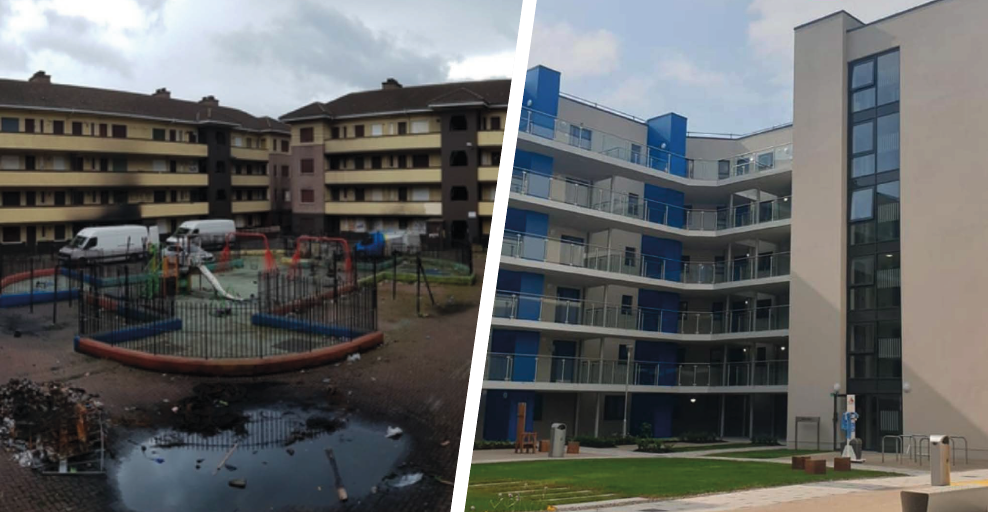
The project was aimed at helping residents to express what they wanted of their estate. By now demolition was out, and regeneration plans were taking shape with the help of major national government funding. The second initative was to begin work with students from Dublin’s School of Architecture, working up the residents’ aspirations into practical designs for the refurbished buildings. Here, residents’ voice was strongly heard as they took the role of client to the students. Although deck access blocks around the world have become unpopular, these residents wanted to keep their long balconies overlooking the private inner courtyard.
Children were invited to spend a day at the university, seeing the residents’ ideas formed into 3-D models. The idea was both to move the process forward, and to help the youngsters experience campus life, sowing a seed that perhaps they too could become students in the future.
In a similar vein, adults from the estate were invited to give an online lecture to students about social justice and life in social housing. The students then wrote essays on the topic and the residents marked them, offering a prize for the best. Now, with the regular lecture gaining popularity among residents, a group are to take a bolder step and deliver the lecture in person.
Meanwhile, plans for the refurbishment and wider resident engagement were ploughing ahead. Clúid was keen to show first that it could get the basics of management right, further building trust. When it came to the actual construction, there were glitches: for technical reasons not everything people wanted could be achieved. Nonetheless, through the relationships already built and because many features, including small details, were realised, the process was highly successful. Resident engagement staff feel that their earlier work with tenants brought them to a point where more difficult but necessary conversations could be had, without tainting the relationship.
The completely refurbished St Mary’s Mansions has now re-opened with 23 of the original families moving back in, joined by new residents. The engagement work before and during the renewal continues, and has laid the platform for a tenant association to form.
All of Clúid’s tenant engagement work is underpinned by its three-year resident engagement strategy and action plan. This both directs and informs activities aimed at inclusion, under the banner ‘We’re all Clúid’. Part of the organisation’s measures of success at placemaking includes tracking whether it’s an officer or residents leading an initiative: more resident-led activity is the goal.
The key points:
- Approach residents as individuals and households, and talk openly with them
- Put in the resources to visit individually, not just once but regularly
- Offer something to begin the process: ‘trust is the currency of engagement’
- Only later move toward a ‘bigger ask’ once trust is established
- Use history and the arts, rooted in respect for the place, to build bridges
- Allow residents into the driving seat whenever possible and whenever they’re ready.