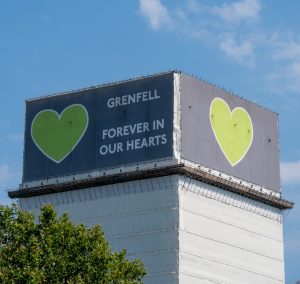
 In the aftermath of the publication of the Grenfell inquiry’s phase 2 report, Danielle Aumord talks to survivors, bereaved families and other members of the North Kensington community about where they go from here. As her reports reveals, there’s still much anger and resentment about the way they’ve been treated – before, during and after the fire.
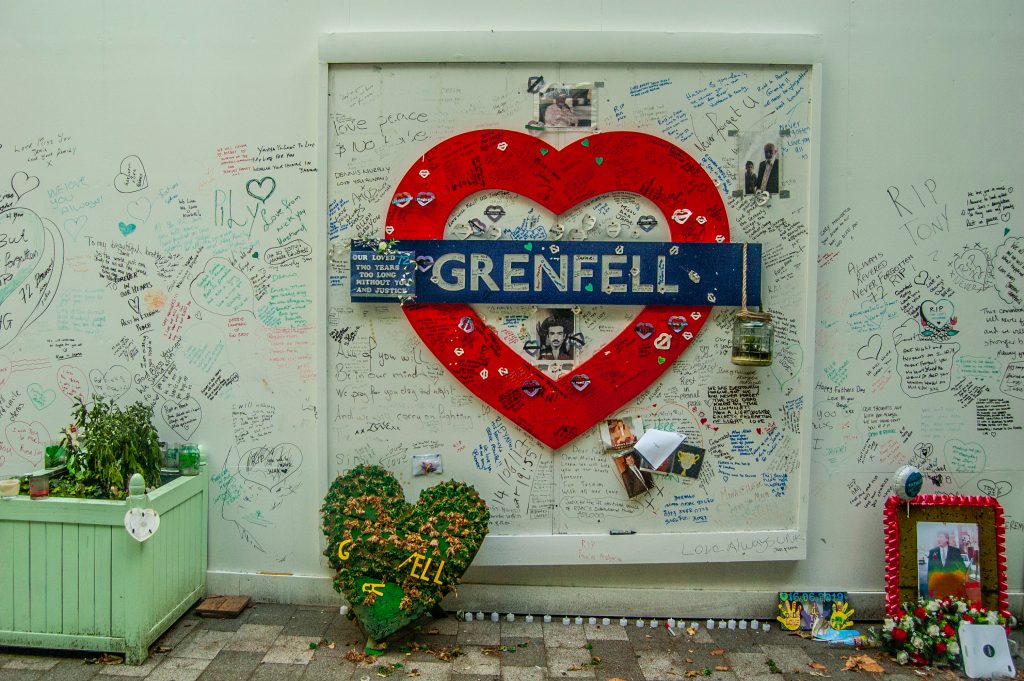
The Grenfell Tower tragedy has become a defining moment in North Kensington, where much of life is now seen through the lens of pre- and post-Grenfell.
The recently published second phase report from the public inquiry into the fire offers more than 50 recommendations. However, with many of the life-saving measures from the first phase still unimplemented five years on, the community is left asking what now?
Disillusioned
“I don’t want to go to any of their meetings,” says Nicholas Burton, a survivor of the fire who lost his wife, Maria ‘Pily’ del Pilar Burton, on that terrible night in June 2017. Burton is referring to Kensington and Chelsea Council (RBKC) and expresses disillusionment with the idea of hearing apologies from those who weren’t involved at the time.
“It’ll be all new people who didn’t work at the organisation at the time of the fire or in the lead-up to it,” he explains. “I don’t want an apology from them. They didn’t make the decisions.”
This sentiment is shared by others in the community, including Liberal Democrat councillor Linda Wade. While talking over a coffee in a bustling café on Golborne Road, she says: “It’s welcome that the borough wants to rebalance, to redress, but this needs to be throughout the organisation. Essentially, they need to listen.”
Wade recalls her time on the council’s housing and property scrutiny committee before the fire: “Without transparent information, scrutiny within the council failed to identify problems that could’ve prevented the tragedy.” She points to failures in fire safety measures, such as inadequate fire doors and door closers, which compromised compartmentalisation within the building as examples.
North Kensington Labour ward councillor Claire Simmons, meanwhile, believes the Grenfell fire hasn’t been a sufficient enough “wake-up call” for the council. “They refuse to listen and are often still downright cruel. RBKC continues to twist the knife,” she says.
“I apologise unreservedly and with my whole heart to the bereaved, survivors and residents of Grenfell for our failure to listen and to protect them…[the inquiry] shows beyond doubt that this council failed the residents of Grenfell Tower and the 72 people, including 18 children, who died”
Councillor Elizabeth Campbell, leader, Kensington and Chelsea Council
Left behind
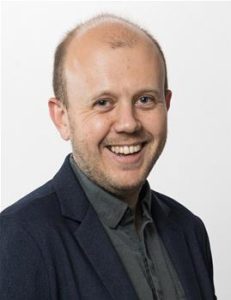
Local resident Samia Badani says she worries that those whose lives were turned upside down by the fire could become “nothing but footnotes in a forgotten report,” as she remembers how she lost consciousness when smoke from the fire at Grenfell Tower filled her home.
Badani now lives at Bramley House, just a stone’s throw away from the tower, and chairs the residents’ association there. “We were left behind, we weren’t even contacted until three weeks after the fire,” she says.
Recently elected Labour MP Joe Powell wasn’t around at the time of the Grenfell fire but is determined to deliver change on the ground in the North Kensington community – chiefly ensuring that residents are respected, treated in a humane way and have some influence in decisions that impact them.
He’s disappointed with the scope of the inquiry’s second report, particularly the fact that there are no new recommendations for social housing providers. “It’s narrow in many respects,” he says.
The Grenfell Tower fire, which claimed 72 lives, including 18 children and 15 disabled residents, was a disaster that exposed systemic failings not just at a local level but in the construction industry nationally. The cladding used in the building’s refurbishment, identified as the “principal cause of the rapid fire spread”, was found in many other buildings around the UK, leaving thousands of residents trapped in unsafe homes.
The inquiry concluded that “systematic dishonesty” from cladding and insulation companies and lack of action from central government were all factors in the fatal disaster in North Kensington. Leaseholders in homes also cladded with the same cladding as the material used within the Grenfell refurbishment, have seen their insurance costs skyrocket. They’ve also had to pay for ‘waking watch’ services as a result of the fire safety risks associated with their homes and have experienced difficulties in remortgaging the dangerous flats.
Glacial
Multiple schemes have been introduced post-Grenfell by central government to fund the remediation of the dangerous material from social and private housing over 11-metres in height. But years later, data compiled by the Ministry of Housing, Communities and Local Government has revealed that these schemes are moving at a glacial pace, with remediation work yet to begin on over half of the 4,771 residential buildings identified.
As recently as August, a fire at a block of flats in Dagenham, east London, reignited concerns about the slow pace of this work. When the fire in Dagenham broke out, remediation work was underway to remove ‘non-compliant’ cladding from the block and hadn’t yet been completed.
Alarmingly, each month more buildings are being identified as having fire safety defects, including flammable cladding on their external walls. The emotional and financial toll on Grenfell survivors, bereaved and leaseholders continues to mount.
“If Grenfell had housed a different demographic, we believe different decisions would’ve been made about the refurbishment and maintenance of the building. The fact that many of the victims were from Black and ethnic minority communities isn’t a coincidence”
Justice4Grenfell
Over at Kensington Town Hall, direct survivors of the fire and bereaved family members are attending a full council meeting to express what they’d like from the local authority, now that the inquiry’s second report has been published.
Edward Daffarn, another Grenfell survivor, remains frustrated by the lack of meaningful change and emphasised the need for RBKC to “cooperate with the criminal investigation of the fire”. He says: “We were treated as a nuisance rather than as stakeholders. The report is simply a stark reminder of the failures of the council who have made glacial progress since.”
Institutional racism
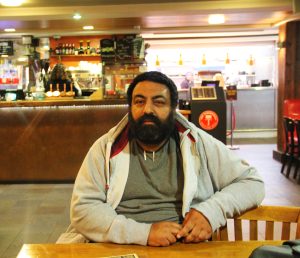
Similarly, bereaved family members like Nabil Choucair, who lost six relatives in the fire, have called for justice and expressed disappointment that the inquiry failed to address the role of institutional racism.
Choucair has pointed out that many of those affected were from Black and ethnic minority communities, whose voices and concerns were often ignored. “We were fighting to get the public inquiry to look at racism, but they didn’t,” he reflects.
The inquiry’s phase two report touched on the issue of racism, saying: “Our response to those who wanted us to investigate racial and social discrimination has always been that we would look out for it and that if we came across any evidence that racial or social prejudice might have affected any of the decisions that led, directly or indirectly, to the disaster, we would examine it thoroughly and publish our findings, as befits an inquiry seeking to uncover the truth.”
However, it was concluded that there was “no evidence that any of the decisions that resulted in the creation of a dangerous building, or the calamitous spread of fire were affected by racial or social prejudice”.
But Sir Martin Moore-Bick, a retired Court of Appeal judge who chaired the Grenfell Inquiry, said the inquiry did see “some evidence of racial discrimination” in the way survivors and bereaved family members were treated by the local authority after the fire.
For example, the inquiry found that “no regard” was shown for the cultural or religious needs of the affected Muslim residents who were observing Ramadan, a month of fasting, prayer and reflection, at the time of the tragedy.
“I don’t want to go to any of their meetings. It will be all new people who didn’t work at the organisation at the time of the fire or in the lead-up to it. I don’t want an apology from them. They didn’t make the decisions”
Nicholas Burton, Grenfell survivor
A spokesperson for the Justice4Grenfell campaign group said they have long called for a fuller investigation into the structural racism that played a role in the tragedy.
“There needs to be a systemic review of how race and inequality intersected with the decisions made about Grenfell, both before and after the fire,” the group said in a statement. “If Grenfell had housed a different demographic, we believe different decisions would’ve been made about the refurbishment and maintenance of the building. The fact that many of the victims were from Black and ethnic minority communities isn’t a coincidence. It reflects a wider pattern of how racialised communities are treated in housing and public services across the UK.”
RBKC will make its official response to the second public inquiry report next month (November). However, council leader Elizabeth Campbell has already pledged to cooperate with the police and acknowledges that the council hasn’t gone far enough.
“We acknowledge that it wasn’t us who picked up the pieces after the fire, it was the community,” she says.
Promises are not enough
But with the public inquiry now completed, the message from direct survivors of the tragedy, bereaved families and campaigners is crystal clear – promises aren’t enough. Tangible action, accountability and real, systematic change are needed to ensure that the lessons from the fire are learned, not just in Kensington but across the UK.
Burton puts it like this: “When we think about it, if the lessons from the Lakanal House fire in 2009 had been learned, the fire at Grenfell might not have happened.”
“The government hasn’t yet implemented the life-saving recommendations made within the first report from the Grenfell Tower inquiry and it’s crucial that this isn’t repeated with the phase two recommendations”
Aniesha Obuobie, Grenfell project coordinator, Inquest charity
Nationally, the failures highlighted by the Grenfell inquiry have underlined the need for greater accountability. Inquest, a charity that has closely followed the inquiry, has called for a national oversight mechanism to monitor the implementation of recommendations from public inquiries like Grenfell.
“Currently, inquiry chairs don’t have the power to monitor the progress of the implementation of recommendations after a public inquiry. This means there is no real follow up when state and corporate bodies deprioritise or fail to take action in response to recommendations,” explains Aniesha Obuobie, Grenfell Project Coordinator at Inquest.
“A national oversight mechanism would close this gap. The government hasn’t yet implemented the life-saving recommendations made within the first report from the Grenfell Tower inquiry and it’s crucial that this isn’t repeated with the phase two recommendations,” she adds.
An apology
Responding to some of the issues raised in this article, Cllr Elizabeth Campbell, leader of Kensington and Chelsea Council, said: “On behalf of the council, I apologise unreservedly and with my whole heart to the bereaved, survivors and residents of Grenfell for our failure to listen and to protect them.
“The inquiry has laid bare the chain of events that led to that night. We fully accept its findings, which are a withering critique of a system broken from top to bottom. It shows beyond doubt that this council failed the residents of Grenfell Tower and the 72 people, including 18 children, who died.
“We failed to keep people safe before and during the refurbishment and we failed to treat people with humanity and care in the aftermath.
“We’ll learn from every single criticism in the report. We’ll take time to study it further in detail, listen to the reflections from our communities, and publish a full and formal response in the autumn.”