
As part of our Housing in Practice series, Liz O’Connor, Housing Director for Horton Housing Association, discusses a project to revitalise her organisation’s involvement and engagement offer for ‘seldom heard’ residents.
At Horton Housing, we pride ourselves on a long history of working with people going through difficult times in their life.
It’s our 40-year anniversary in 2025, and over the years we’ve seen many people successfully overcome challenges, such as substance use, rough sleeping, moving to the UK as a refugee, experience of the criminal justice system and the impact of mental health conditions. Based in Bradford, Kirklees, Calderdale, and North Yorkshire, last year we supported 3,402 people.
Every housing provider will have come across a tenant who shares some of the challenges we specialise in. The sector often talks about the difficulties of engaging with people with different and additional needs, usually using the term ‘hard to reach’. We prefer the term ‘seldom heard’.
Why ‘seldom heard’?
The term ‘hard to reach’ suggests that the problem lies with the person we’re trying to engage. ‘Seldom heard’ puts the responsibility back where it should be – on us. As professionals with access to resources, shared good practice, training and a wealth of experience, it’s our responsibility to look at innovative ways of including people who are seldom heard in the engagement conversation.
Horton faces several barriers when trying to engage with people using our services. For example, a lot of the people we’re working with aren’t digitally engaged and so we cannot reach them with a simple email. We need to think of other ways to communicate with people. We use traditional methods, such as post, phone calls and posters, but we also try to be creative. Face-to-face contact usually works best and works even better in a low-pressure environment.
We use activities such as cook and eat sessions to engage differently. While we’re chopping and stirring, we’re able to have great, meaningful conversations. One tenant said that talking while doing an activity means you don’t have the pressure of being in the spotlight. You don’t have to make eye contact, and it feels like a more natural conversation.
We’re lucky because we provide support alongside housing, so it gives us the opportunity for personalised communication, with high levels of trust. However, we believe that the principles we use can be implemented in many settings.
Despite some great practice, we’re still keen to improve things. We have real strengths in engaging people, but we recognise that we’re not maximising the feedback we hear. We’re keen to use feedback in a transformative way to ensure our services get right to the heart of what people want and need.
We’re already signed up to the Together with Tenants Charter, but we want to push further. We welcome the Regulator of Social Housing’s (RSH) new Consumer Standards, as they hold us to account and encourage us to creatively implement a programme that meets the specific needs of the people we work with.
Revitalising involvement and engagement – but what’s the difference?

With this in mind, we recently started a project with Tentacles Consultancy aimed at revitalising our involvement and engagement offer. Although the RSH doesn’t make the differentiation, we think it’s crucial to look at involvement and engagement separately. Here’s how we think they’re different:
Involvement – how the views and ideas of people using services are used to change, influence or affirm the way Horton operates. True involvement is a partnership between colleagues and people using services, with an equal share of power.
Engagement – focuses on relationship building and bringing people together. Engagement usually involves activities that impact on wellbeing or personal development but aren’t about how Horton works. Engagement can be a great way to start conversations about involvement.
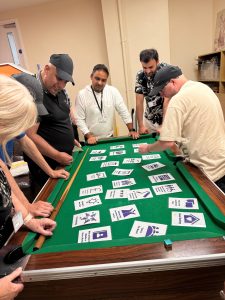
Claire from Tentacles Consultancy started the project by creating workshops to discuss involvement and engagement with people using our services. The short and interactive sessions were designed to appeal to a wide range of abilities and skills, using a simple card game. The game enabled people to find out about the possibilities for involvement, as well as exploring what they would gain from getting involved. Using stickers, people selected the top five activities they would be interested in.
At Horton, we’re very aware that people in our services have a lot on. People don’t always have the headspace for things that are additional to the challenges they have. Some find it difficult to focus or sit in one place, some have low levels of literacy, while others are still learning the basics of speaking English. With this in mind, we weren’t sure how much interest there would be. We were delighted with the results.
“As professionals with access to resources, shared good practice, training and a wealth of experience, it’s our responsibility to look at innovative ways of including people who are seldom heard in the engagement conversation”
The workshops were done for 15 services and we met with 92 people. The enthusiasm was overwhelming and almost all of them were interested in something, and not always what you’d expect.
For example, there was a lot of interest in being more involved in the workings of health and safety. There were a range of reasons people wanted to be involved, including:
- Understanding how safe their home is feels reassuring
- It’s essential knowledge for future work
- People could have a say in where to put security cameras
- Having some experience will look great on a CV
- Knowing about this stuff could save lives.
There’s a lot to be learned from this single example. We realised that people aren’t always interested in what you think they will be, so we shouldn’t make assumptions. We also learned that motivation varies and that people have aspirations beyond the short term. Getting involved can be brilliant experience and a great stepping stone.
When people become involved with our services, it’s important to be mindful that they’re giving their time, wisdom and experience to help us. We need to be sure we’re making it worthwhile. As well as providing incentives and expense costs, people need to see they’re getting more experience, confidence, skills, knowledge and change.

The workshops fed into a final report which made recommendations for the future. People’s’ expert guidance has enabled us to identify the next steps in partnership with people using our services. We’re changing things together, which means we’ll make a meaningful difference.
Some of the key recommendations are to:
- Co-produce a new strategy with people using our services
- Tailor involvement to the needs of the individual so they can get involved no matter what their situation
- Ensure that tenants lead our involvement programme rather than it be driven by organisational need
- Ensure colleagues have the right training, resources and support to deliver involvement programmes that are inclusive.
Adopting creative, sensitive and innovative ways of including seldom heard audiences in the organisation ensures that we never underestimate the expertise of people in our services. We value their lived experience and their input into our organisation. This isn’t just a ‘tick-box’ exercise but a valuable and meaningful exchange of ideas that can only strengthen our organisational development.