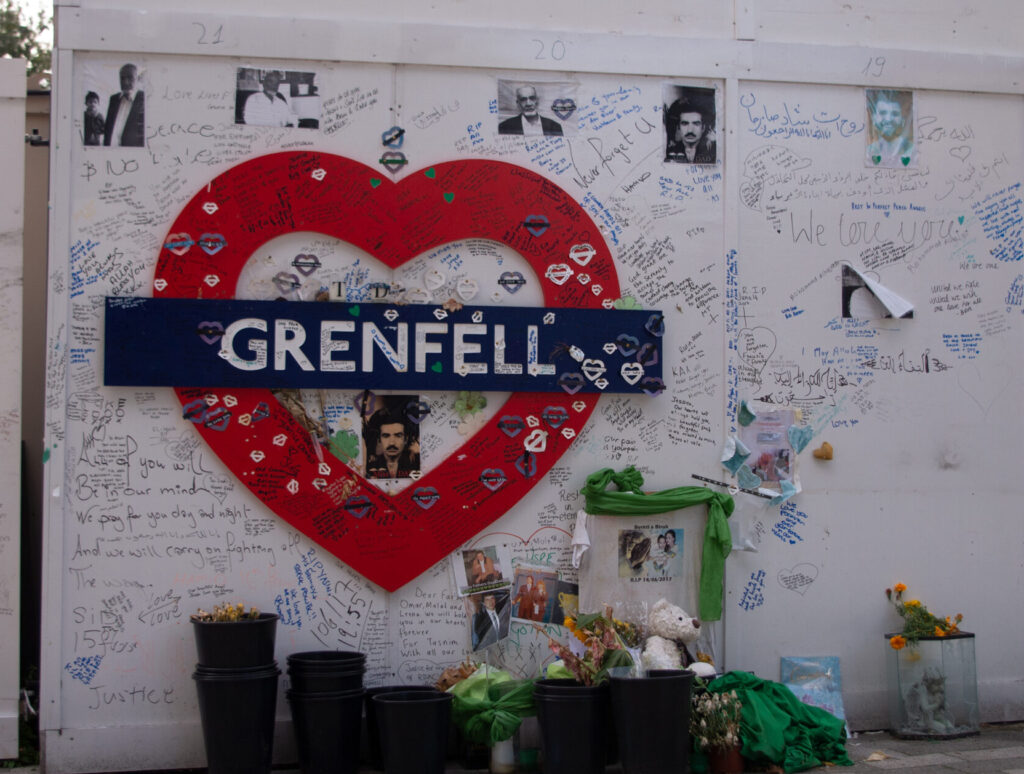

Five years on from the fire at Grenfell Tower, Danielle Aumord speaks to residents about their views on what has or, most importantly, what hasn’t been learned in that time.
The night of the Grenfell Tower fire is still crystal clear in the minds of those who escaped and those that witnessed it five years on. The fire burned for 60 hours before it was put out and the smoky smell that permeated the air in the neighbourhood lingered for weeks.
Mouna El-Ogbani, now aged 47, escaped from the fire with her husband, Youseff, a shift engineer, and their three children: Zaid, now aged 18, Hafsa, now aged 15, and Nusabah, now aged 7.
“I still hear the screams of someone as they desperately jumped from a window. And I’ll never erase the memory of opening my front door to a wall of pitch-black smoke. It was like a horror film. But this wasn’t a movie, it was really happening,” says Mouna. “I remember walking past a young girl sitting silently on the pavement, her skin badly burned.”
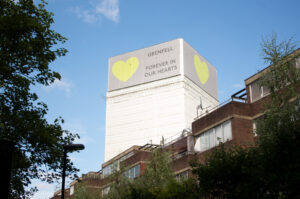
Overall, the feeling amongst residents in North Kensington – where five years on the remains of Grenfell still stand – is that not much has changed.
Residents of Lancaster West estate, which houses 826 flats, told HQM they feel left behind and that the Royal Borough of Kensington and Chelsea (RBKC) have gone back to their old ways since the fatal fire which killed 72 people.
“Attitudes need to change, nothing is going to change unless attitudes to people in social housing changes,” explains Jackie Haynes, estate resident and community advocate. “RBKC’s customer service demonstrates that they’ve gone back to their old ways. The cases that I deal with demonstrate that – rent arrears, succession appeals. The council don’t acknowledge that for the last five years this estate hasn’t been operating as normal. We’ve been living under the shadow of Grenfell and with the trauma of what happened on the night of 14 June 2017 since then and RBKC don’t make any allowances for that.”
Virginia Sang, who lives on the walkways of Lancaster West estate, even questions where the government funds of £15m for the estate refurbishment have gone: “It’s five years on now and all that’s been refurbished are the void flats on the estate.”
“Overall, the feeling amongst residents in North Kensington – where five years on the remains of Grenfell still stand – is that not much has changed”
Eighty yards from the tower is Bramley House, where Samia Badani lives. She’s the chair of the Bramley House residents association and echoes Jackie strongly: “Local residents are still being treated how Grenfell residents were treated before the fire. It’s the rolling of the eyes, the distain from council staff, like we’re not allowed to question things or challenge them even.”
But a spokesperson for DLUHC (the Department for Levelling Up, Housing and Communities) responded to say that they committed £15m to the Lancaster West Estate refurbishment in 2017, matched by RBKC, committed a further £9.9m in funding in 2019 and has supported RBKC to access other funding, including almost £20m from BEIS’s Social Housing Decarbonisation Fund.
“RBKC is responsible for the refurbishment,” he added.
An RBKC spokesperson responded to resident complaints saying that “38% of tenanted homes on Lancaster West estate have now been refurbished to the 21st-century new homes standard agreed with residents” and that it has introduced a two-stage complaints process with what they describe as “senior oversight”.
Stage one complaints are now responded to by either an assistant director or a head of service, and stage two complaints by the director of housing management.
“We had to beg for a diverse panel [at the inquiry], for people who understand our community’s experiences. But nothing’s changed”
The Grenfell Tower Public Inquiry is another sticking point with residents, with some describing it as a “whitewash”.
Yvette Williams, local resident and the co-founder of the campaign group, looks perplexed as she talks about the inquiry. “We had to beg for a diverse panel [at the inquiry], for people who understand our community’s experiences. But nothing’s changed, they staged a ‘pretend’ consultation about the terms of reference for the inquiry and then, despite the consultation, they didn’t put race and class or social housing in.
 “With the Fire Safety Bill being ping-ponged back and forth in Parliament and the public inquiry phase one recommendations being voted down and now the government decision on PEEPs (personal emergency evacuation plans), it leads you to ask: who actually benefits from these inquiries?” She adds: “From what I can see, it’s the government itself.”
“In 2019 and 2020, Thouria Istephan and Ali Akbor OBE were appointed as panel members of the inquiry to support the chairman with the investigation into the fire at Grenfell Tower on 14 June 2017,” a spokesperson for the Grenfell Tower Public Inquiry told HQM. “Panel appointments were made by the prime minister as the inquiry’s sponsoring minister.”
He went on to explain that Thouria Istephan is an architect and a registered health and safety practitioner with expertise in fire safety, buildability, accessibility and inclusive design; also that Ali Akbor served as CEO of Unity Homes, a leading housing association supporting BAME communities, for over 20 years and has extensive experience of the housing sector.
“The inquiry will investigate all the decisions that were taken in relation to the refurbishment of Grenfell Tower and, if any of them were motivated by considerations of race or social class, the panel will be sure to find out; and if they do, they will certainly make robust findings in the final report,” added the inquiry’s spokesperson.
The proposed Fire Safety Bill is intended to make sure that residents of high-rise buildings feel safer in their homes by significantly reducing fire risks.
The bill was specifically crafted as a response to the Grenfell Tower tragedy – to keep such an event from ever happening again. But it’s been in process since 2019 and frustrations are mounting both over the length of time it took to pass the bill and the government’s recent decision not to implement recommended measures – ones that would’ve ensured disabled people could safely evacuate high-rise blocks of flats in emergencies.
“The inquiry will investigate all the decisions that were taken in relation to the refurbishment of Grenfell Tower and, if any of them were motivated by considerations of race or social class, the panel will be sure to find out; and if they do, they will certainly make robust findings in the final report”
Emma O’Connor, 32, who escaped on crutches in the lift from the fire with her partner from the 20th floor, was particularly teary upon hearing the news: “I feel absolutely disgusted with this decision. It’s like saying ‘we don’t matter’, the government don’t care.”
But a DLUHC spokesperson told HQM: “We’ve made fundamental changes to strengthen building regulations and make homes safer. The Building Safety Act brings forward the biggest improvements in building safety for a generation, giving more rights and protections for residents than ever before.
“The Building Safety Act intends to achieve a major overhaul of building safety law, with new regulators that will oversee a tougher regulatory regime.”
A new Building Safety Regulator in England – overseen by the Health and Safety Executive – will enforce a new, more stringent regulatory regime on the safety and performance of high-rise buildings in scope. Also a National Regulator for Construction Products will implement stronger standards on construction manufacturers in the UK.
But Nicholas Burton, a Grenfell fire survivor, is still doubtful about the government proposals for these changes. Nick is both a direct survivor of the fire and a bereaved family member. His wife, Pily, passed away after having a stroke some months after the tragedy and was accepted as the 72nd victim of the fire.
As he recalls the horrors of that night, he shares with HQM that he feels lessons haven’t been learned from the Grenfell fire. “‘Lessons learned’ is just a get out of jail card for the government,” explains Nick. “Six people died at the Lakanal House fire in South London before the 72 died at Grenfell. Lessons haven’t been learned here because if they had of, the loopholes [within building regulations] would’ve been tightened after the Lakanal House fire and Grenfell wouldn’t have happened.”
The fatal blaze at Lakanal House in Camberwell, South London, took place in the summer of 2009. The government suppressed information about the combustibility of cladding used on Lakanal, noting the need to “avoid giving the impression that we believe all buildings of this construction [are] inherently unsafe”.
The investigation into the Lakanal House fire was then shut down by officials in a “grotesque abdication of responsibility” which “raises the spectre of a deliberate cover-up”.
After Lakanal, despite the government promising to implement the coroner’s recommendation to encourage the use of sprinklers, civil servants wrote that it was simply acting “to be able to say that [the Department for Communities and Local Government (DCLG)] is taking action” and it had prepared “a defensive line against them” [sprinklers].
“‘Lessons learned’ is just a get out of jail card for the government”
It’s worth recalling that in 2013 at the Lakanal House inquest, the coroner, Frances Kirkham, recommended to the then local government minister, Eric Pickles, in her Rule 43 letter: “It’s recommended that your department review Approved Document B… to ensure that it provides clear guidance in relation to Regulation B4 of the Building Regulations, with particular regard to the spread of fire over the external envelope [cladding] of the building and the circumstances in which attention should be paid to whether proposed work might reduce existing fire protection.”
‘Approved Document B’ is a document providing statutory guidance on building regulation in England covering fire safety matters within and around buildings.
The Lakanal House coroner’s recommendations were written plainly for all to see. A senior civil servant even warned in May 2017 – just a month before the Grenfell Tower fire – that “we, or ministers, are increasingly vulnerable to some or all of these risks becoming material and [government] being held to account for being inactive”.
But the recommendations were clearly not heeded because flammable cladding managed to find its way onto Grenfell Tower as a part of an estate regeneration scheme in 2016. And as of last month, government figures revealed 111 buildings over 18 metres on British soil are still cladded with the highly flammable aluminium composite material that burned at Grenfell.
In essence, this is what Nicholas Burton means when he says that “lessons haven’t been learned” yet – because the lessons from the Lakanal House fire weren’t heeded and eight years later Grenfell happened.