
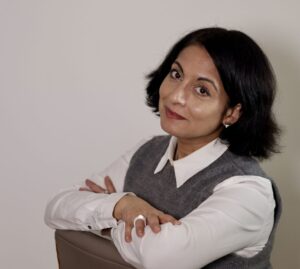
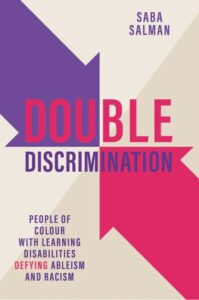
In the first of a new series of interviews for HQM, Hannah Fearn sits down with fellow social affairs journalist Saba Salman to discuss the very personal issues explored in her revealing new book, Double Discrimination.
It was during the first Covid lockdown that the author and journalist Saba Salman realised her younger sister Raana was at very high risk of an untimely death. She wasn’t physically vulnerable to the disease and carried no underlying condition such as diabetes. She wasn’t taking immunosuppressants. But Raana, back then a young woman in her early 30s, lives with a learning disability and is also of British Pakistani heritage.
Within weeks of the pandemic breaking out, a grim statistic emerged: people with learning disabilities were far more likely to perish from Covid than any other groups in society, and for learning disabled people of colour the chance of death was more than 30 times higher.
Salman, an experienced social policy journalist, started to ask searching questions about what was really happening to people like her sister. What she found was chilling: during the pandemic healthcare leaders including the British Medical Association had to put out a warning to doctors not to automatically issue a ‘do not resuscitate’ order to learning disabled patients admitted to hospital.
“What kind of civilised society thinks it’s okay to assume that if my sister goes into hospital with Covid, she won’t want to survive? It wasn’t just a threat, it was a very real danger,” she says. “To read about politicians flouting lockdown rules and people moaning about restaurants being closed… well, you cannot see that and not want to dig into it deeper.”
Personal journey
Salman’s enquiries took her on a personal journey that led to a re-evaluation of her own experiences of racism, and the compounded discrimination she realised that her sister had encountered all along. The result is her powerful new book, Double Discrimination, which explores the size of the crisis facing learning disabled people of colour but also offers profound hope for a better, more inclusive future.
The Salman family’s shared experiences frame the story of a wider social failure in a way that makes even the knottiest policy implication crystal clear. What matters, above all, is people being seen for exactly who they are. Having spent more than three decades in British newsrooms, Salman is no stranger to the ways that hidden bias can rear its head unexpectedly.
“What kind of civilised society thinks it’s okay to assume that if my sister goes into hospital with Covid, she won’t want to survive? It wasn’t just a threat, it was a very real danger”
While sitting at her desk early in her career, a white, male editor leaned over and asked her why she wanted to be an Asian journalist. “I had a split second to figure out how to reply,” she says. “So, I smiled, told my boss that I was an Asian journalist because being a Swedish one wasn’t possible and that I’d hit half my goal to be an Asian journalist simply by being born, so the rest was easy.”
It was harder for Salman, in exploring this issue, to shrug off the ways social discrimination had conditioned her own thoughts and perspectives on how to care best for her cherished sister, who has Fragile X syndrome and will need lifelong support. Until Covid, she said her family had always simply thought about her disability alone. It’d never occurred to them to think that being disabled and a person of colour made Raana particularly vulnerable.
“All of the things that reduce her life chances are massively increased because of her race and it really made me think about that aspect of our lives,” she says. “If I’ve had to deal with racism then she’s got that, which has always been going on for her, and now she’s got this [ableism] as well. What does that actually mean?”
Lack of progress
Her interrogation of the issue is timely. Not only is the country facing an insurgency of radical right wing political opinion, fuelled by hate mongers such as the Great Yarmouth MP Rupert Lowe and his breakaway Restore party (Salman labels this “racism being repackaged as patriotism”), but the lack of progress on equality for learning disabled people stands in stark contrast to progress elsewhere.
We’ve enhanced parental rights, equality for women enshrined in law (if not always exercised in practice) and better access for disabled people in general. Yet 15 years on from the Winterbourne View scandal, which exposed how profoundly neurodivergent and learning disabled people were being routinely abused, there are still 2,000 people trapped in residential accommodation without hope of escape. “This is so gripping,” Salman says. “Nothing’s done, we just keep churning out reports… just telling us what we already know.
“People are dying, and they’re dying earlier because they happen to have a learning disability and they’re not white people. They can’t get jobs, they can’t get housing to suit them and even when they do get it it’s restrictive: they’re told you’ve got to go to bed at 9pm, and they’re 45 years old. It may as well be an institution.”
Daily racism
Salman and her two sisters grew up in a prosperous area of West Sussex where, as she describes, “there weren’t many people like me”. She faced down the daily racism that every British Asian of her generation struggled with at school (“the kind of bus conductor ‘bud bud ding ding’ comments, and being told by a really nice teacher I must be good at cricket”) but excelled academically and after entering journalism focused her reporting efforts around social justice.
She spent a period as a local government correspondent at the Evening Standard before freelancing for a range of titles including The Guardian and The Independent. In the early 2010s, when she began unearthing stories that she believed deserved exposure yet couldn’t find an editor to support them – so, she created her own site, The Social Issue, to report freely.
“I think housing providers are really put upon, and I know that there are some absolutely brilliant providers of care, especially the ones that work in collaboration with the social care plan”
Her sister Raana has provided continued inspiration for her writing and reporting, including for her first book, Made Possible – a collection of inspirational essays by learning disabled people, curated and edited by Salman. Where Double Discrimination excels is in the way Salman brings to life her sister’s quirky and creative personality, humanising and bringing humour to the devastating wider story she has to tell. In one scene, Raana wittily examines a piece of fruit and declares herself to be “dancing to the tune of this orange”. Hearing her voice makes it impossible to dismiss the depth and profundity of Raana’s inner life. It’s a powerful moment.
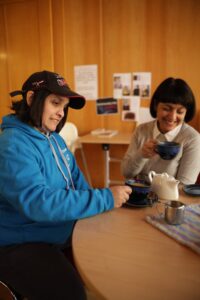
“My sister can be funny and sad within minutes, you know? She can be incredibly frustrating, but she can be really loving – just like all of us – and yet we don’t allow her to be,” she says. “We bring different rules and judgements to people like my sister, because of her skin colour and because of her disability. If you ignore these people, if you ignore these families, you’re missing out on a huge amount.”
Today, only a small fraction (around 5%) of people with learning disabilities in the UK have a job, but it hasn’t always been like this.
Salman describes how medieval communities gave every person a defined role; each had their strengths and their part to play – “it might be scaring crows, it might be taking bread to the market” – but then came industrialisation. Suddenly, there was no space for people with learning disabilities or neurodivergence or other differences, who were less efficient in a formalised economy which focused only on productivity. Separate living spaces and isolated communities were created. “There was that sense of people as a burden, a cost to us. We don’t see what they can do, we only see what they can’t. What the hell do we do with those people?” Salman writes.
“White people doing ‘good things’”
For Salman the process, the separating, is reminiscent of colonisation. “The people bringing people out of these places into [dedicated] communities were effectively white people doing ‘good things’, which is what I’m sure was the approach with a lot of areas that were colonised: we’re coming in, we’re looking at these people, they’re uncivilised, they need control, they need Jesus – the whole idea of paternalistic approach.” No wonder the discrimination is doubled.
Even within her own extended family, once Raana’s diagnosis was first confirmed her parents and siblings were encouraged to “keep it quiet”. “That was the phrase, but she’s possibly one of the loudest, quietest people I know. She makes her presence known. She’s such a character, and yet she’s also a woman of very few words. How can you keep that quiet?”
Today, the legacy of a less inclusive era lives on. Within Double Discrimination, through a series of moving interviews, Salman describes the small acts of violence meted out upon the families supporting learning disabled people of colour. In one conversation, a father admits that he always dresses more smartly when attending a meeting about his daughter’s care, specifically because he’s a person of colour. “So many of the family carers I spoke to said the same thing, which is ‘I am fighting for the rights of my loved one to get the right support but I’m the victim of parent blame’. Legally they’re entitled to [support], it’s actually their human right, but you’re dismissed and ignored, and not taken seriously.”
She recognises this from her own experience of supporting her mother to organise Raana’s care. When the family chose a specialist school during her teen years, the SEND worker tasked with organising the placement questioned whether it would be right for them because it was a Christian institution. “She’d made an assumption that my family is Muslim and therefore we couldn’t possibly have my sister going into a community that wasn’t,” she remembers. “And that woman was lovely; she was really nice and she obviously thought ‘I’m being culturally aware’, but she made an assumption.” Salman says there’s a difference between cultural awareness and cultural competence, which shows genuine curiosity about other people and their needs.
Supported housing
There’s an aspiration for better quality services for all learning disabled people, and most supported housing providers aren’t there yet. Scandals such as Winterbourne View happen (and could happen again) because we still simply don’t have enough quality housing provision for people who are learning disabled. “It’s a revolving door because there isn’t the right housing and support in people’s [local] areas. I think housing providers are really put upon, and I know that there are some absolutely brilliant providers of care, especially the ones that work in collaboration with the social care plan,” Salman says.
But there are lessons on better practice from her careful inquiry into this complex form of compounded discrimination. There are questions that housing organisations can ensure they’re asking of their own work: is the whole family involved with a learning disabled person’s care? Are residents’ own personal desires being asked about and then acted upon? Are we really doing enough to share what’s working when things are going well for your learning disabled residents?
Salman says there’s a dearth of positive stories from this part of the sector, which means nobody is learning from the best. “You hear about the bad stuff: the housing failures; the providers going bust; the contracts being returned. Housing officers are doing their damndest and still not being able to meet those people’s needs,” she says. “What you don’t hear about is the guys up in Bradford who had a learning disabled client who just wanted to make chapatis. The interview for the right support worker included a massive tub of atta, a traditional flour, and the people being interviewed for the job had to make a chapati.”
“It’s such a lovely, tiny thing, but for me it’s so simple,” Salman says. “Cultural humility isn’t thinking ‘here’s what we can do for you’, but starting from a different point: what would you like us to do for you? What are your preferences?”