

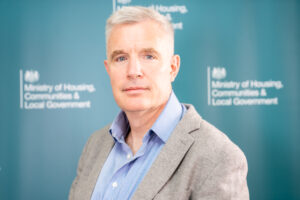
As former commissioner of the London Fire Brigade and now as chair of the Building Safety Regulator, Lord Andy Roe is continuing a personal mission to make the country’s built environment as safe as possible. As incident commander on the night of the Grenfell Tower fire, he witnessed first hand the devastating impact that years of austerity and “reckless abandonment of regulation” could have on human life. In this exclusive interview, he talks to HQM editor Jon Land about the impact of Grenfell on the London Fire Brigade, the regulation of building safety and social housing, and why there remains a “very real” risk that such a disaster can happen today.
Jon Land: We’ve just marked the 9th anniversary of Grenfell. What are your thoughts when you look back on that night and everything that has happened since?
Andy Roe: When I look back on the night itself, I think it’s the most stark example of where our country had got to at that point in time. It spoke to years of austerity. It spoke to not putting the human being or the resident at the heart of decision-making. It spoke to a complete misunderstanding around what value really means. And I see it as kind of an apex failure in the post-war history of the UK. Because everyone failed. It was the private sector in the form of the constructors and the renovators and the manufacturers and the contractors. It was the public sector in the form of the emergency services and my own beloved London Fire Brigade (LFB). As an institution, we had let the community down. It was government in its reckless abandonment of regulation. It was the local authority and, importantly for this audience, it was the tenant management organisation who had badly let their residents down and put cost saving above the quality of their lives. It showed massive disrespect to this fantastic community of people who happen to live in social housing.
On Grenfell: “…It’s the most stark example of where our country had got to at that point in time. It spoke to years of austerity. It spoke to not putting the human being or the resident at the heart of decision making. It spoke to a complete misunderstanding around what value really means”
JL: Where do you think we are today in terms of progress? Has the pace of change been rapid enough?
AR: So, I think the progress has been too slow. There has been some demonstrative change in some places. I’m with the Building Safety Regulator now, and it’s obvious to me that change has happened. We’re seeing better designed buildings. We’re seeing the construction industry certainly shift its approach in the design and quality of builds.
So, there’s been positive change in building safety and construction. But there’s more to do in occupation. I was with young people from the estates that surround Grenfell this week, and they still speak to a lack of standards in renovation and repair and maintenance of their homes. And I hear the same story from residents in lots of places in social housing. So, I think there’s some journey to go there. Obviously, we still haven’t seen proper accountability in the form of justice, although I do think that by the 10th anniversary, there will be and should be a charging decision. In my view it must demonstrate that if you hold senior responsibility in organisations, you should accept the accountability that comes with that. That absolutely needs to happen for people to have any sense of things really progressing.
“I’m afraid to say this as someone who has run so many major incidents, but what we should be doing across the built environment is looking at where the next possible tragedy could come, because it may well not be in a high-rise”
Too often as a country we view people in social housing as second-class citizens rather than the people I know them to be, which is hard working, decent people, often with a great sense of community. And I think we need to change the conversation we have with those who live in social housing and the way we view it as a country.
JL: Can I focus on two of those sectors or areas that you’ve just mentioned – the fire service and social housing. Why did you feel change was needed at LFB? And obviously you led that transformation. What were the key areas that you felt needed to be focused on post-Grenfell?
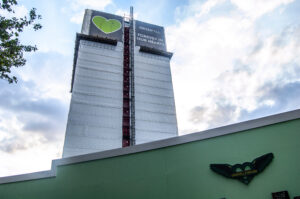
AR: It was in many ways whole scale change because we’d seen, I think, an erosion of professional standards, firstly and foremost, over many years, often as a result of placing a value on cost efficiency rather than thinking about the kind of quality and longevity of training particularly. We’d let ourselves become professionally eroded. And I don’t think we’d fully understood the changing nature of risk in the environment we served. I also think in some spaces we’d become disconnected from the people we served. This is no reflection on rank-and-file firefighters. These are excellent people, public servants, doing a really dangerous job. But our institution had become tired. It had stagnated, like many public sector organisations, across many years of austerity, actually. And I think, in the most terrible way, Grenfell exposed that. And it did so at the cost of the community and rank-and-file firefighters, both of whom deserve better. So, really, it was a process of absolute change around culture and leadership, system and operational delivery. And I want to thank on the record the men and women of the LFB for delivering that change, because it wasn’t me. I didn’t change it. They just needed the space to be able to deliver the change that they knew was necessary and I think it’s to their credit they did.
On regulation: “There’s a real role for regulators to understand that whilst they must stop the worst practices and they must hold providers to account, it’s got to be done in a way that doesn’t stop the very thing they’re seeking to support, which is more housing”
JL: We’re in a similar situation in the social housing sector where we’ve undergone major changes in regulation on the back of Grenfell. So, my question is, do you think the new era of regulation in social housing has gone far enough?
AR: In some ways, yes. For example, the regulator I lead has certainly helped improve the environment in the context of refurbishment and renovation, although I do think that regime itself needs rationalising in terms of proportionality. I think the social housing regulator has begun to extend its role beyond that for which it was created, which was really about financial conduct and the management of social housing finance, and it’s certainly pushing further into matters of quality and the lived experience of people. I’d argue that it’s not necessarily about extending regulation further, but looking at where there are gaps and rationalising, because I think to be fair to those who manage buildings and those who construct buildings, the current landscape is very fragmented. Martin Moore-Bick points to that. He speaks to the fragmented and confusing nature of regulation. So, without doubt, there’s still a job to be done which I think will be helped by the coming of the single construction regulator and the review of social housing regulation. It’ll be interesting to see where there’s alignment and where’s there’s duplication, and where we could simplify things but still regulate with the same rigour. In some ways, what’s happened is that we’ve added rather than rationalised. Martin Moore-Bick reflects clearly on that because the second phase of that report came so many years later. So, I think there’s a responsibility in government to really look at the landscape of regulation across the built environment, from product manufacture right through construction and development, and then in occupation, and see whether things can be simplified. Because I do think in the map of regulation, we don’t quite see the gaps. And there’s still plenty of people who are experiencing a lack of quality and agency in the environment they live in.

JL: Can I ask why you agreed to take on the role of chair of the Building Safety Regulator?
AR: Well, it speaks to your previous question really, which is, I think, it’s a job unfinished. I’m not sure it’s a job that ever finishes. I think regulating and enabling and supporting the built environment is a job that’s never going to end in an economy as large and as complex as the UK. And there’s a constant balance to strike between safety and actually just enabling things to be built and occupied. And that’s got to be rational and proportionate. And it’s not easy or straightforward because you’ve got to find that space where people are being kept safe, but not to such an extent that it becomes a disincentive for anyone, either private or public sector, to build. The one thing I do know from my time in LFB is that not having a house doesn’t make me safer. In fact, not having a house and living in terrible temporary accommodation in crowded, unsuitable circumstances is really, frankly, very dangerous. So, there’s a real role for regulators to understand that whilst they must stop the worst practices and they must hold providers to account, it’s got to be done in a way that doesn’t stop the very thing they’re seeking to support, which is more housing. So, that does mean you have to recognise the industry. The big housing associations are doing a very important job in society, and need to be treated with respect and seen as partners that we work with to pull standards up rather than acting as a hard stop enforcer. My experience is change only happens when the people who are going to deliver the change welcome it, inform it and drive it forwards.
“Too often as a country we view people in social housing as second-class citizens rather than the people I know them to be, which is hard working, decent people, often with a great sense of community. And I think we need to change the conversation we have with those who live in social housing and the way we view it as a country”
JL: Can you tell us a little bit about your remit with the Building Safety Regulator? What are your key aims and ambitions?
AR: I was asked to step in last year to help drive change because it was obvious that the Building Safety Act is unassailable morally and was needed. You look at many other systems across the world, in other highly developed economies, and you’ll see they have an enhanced layer of building control across more complex, larger high-rise residential schemes. So, there’s no issue with the act, nor its premise. It was more about the fact that it got set up at pace. And frankly, there were operational systems put in place that didn’t enable, but actually stopped, housing development. And in doing so, it not only didn’t make people safer, it became very difficult to navigate for everyone, whether they were residents, developers, managing agents or landlords. So, the job is really to affect very quick operational change because of the profound and negative impact the act had on the housing market in London. We promised to clear a backlog of 33,000 homes that were stuck in the planning gateway system. We did that as planned on time and with an energy. And really the whole reason for my role, I think, is to go back to that thing about organisational change. What I’m there for, with the new team we brought in, is to give the space for hundreds of top quality public servants to drive the change they know is necessary. And I think we’re seeing that. We’re seeing it in the constant improvement of approval figures and the rate at which it’s being delivered. We can see it in the standards of design being driven up. I think there’s more work to do on the occupation side and there are announcements coming on that. But really my brief was to come in and drive change.
JL: My final question and I suppose the key one: As of June 2026, do you think a tragedy like Grenfell could happen again in this country?
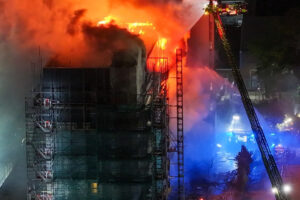
AR: I think it’s far less likely because of what’s happened in the regulation of the high-rise environment. But the risk is still there and very real. If we look at my last year and a bit in LFB, we had a terrible fire in Dagenham at the Spectrum building, which was very poorly converted from office to residential. It was extremely good fortune that we didn’t see mass casualties there. My former LFB colleagues have dealt with similarly difficult high-rise fires recently. So, although there’s been a massive change in operational procedure, certainly in London and across the country from fire services, and despite the fact we’ve done an awful lot to change the way we regulate and construct high-rise buildings, there are still thousands of un-remediated buildings out there in the high-rise and medium-rise environment. Until they’re cleared, that risk still endures. I’m afraid to say this as someone who has run so many major incidents, but what we should be doing across the built environment is looking at where the next possible tragedy could come, because it may well not be in a high-rise. It could be in a completely different environment and equally tragic. There’s a responsibility to learn from tragedies like Grenfell – you don’t just look back to learn the lessons; you should also be looking forward to see where there might be emerging risk.
“I was with young people from the estates that surround Grenfell this week, and they still speak to a lack of standards in renovation and repair and maintenance of their homes. And I hear the same story from residents in lots of places in social housing”
Lord Roe – fact file
Andy Roe is the former commissioner of London Fire Brigade (LFB) (2020-2025), where, in the aftermath of the Grenfell Tower tragedy and a highly critical statutory inspection, he led one of the world’s largest emergency services through a period of unprecedented transformation.
He currently holds a number of national board appointments, including Chair of the Building Safety Regulator, and sits as a Labour Peer in the House of Lords.
During his time as LFB commissioner, Andy implemented major reforms following the Grenfell inquiries, completing all 29 of the recommendations from the phase one inquiry. Alongside this, he worked to rebuild LFB’s relationship with members of the Grenfell community.
As commissioner he led the LFB through the pandemic, where firefighters took on additional roles to support the wider pandemic response. This included firefighters being seconded to the London Ambulance Service to act as drivers, and crews helping make protective personal equipment for key workers.
Following an independent review of the LFB’s culture following the death of firefighter Jaden Matthew Francois Esprit, Andy implemented many changes to improve the Brigade’s culture, which included creating the first professional standards unit for a fire and rescue service in the UK.
He was awarded the King’s Fire Service Medal in the 2024 New Year Honours and was created Baron Roe of West Wickham in January 2026.