
 Following the Grenfell Tower fire and the wider building safety crisis, governance problems associated with leasehold arrangements in multi-occupancy buildings (MOBs), such as blocks of flats and mixed-use buildings, have received increasing attention. These concerns underpin recent commonhold and leasehold reform, which seeks to promote and expand resident-led models of building governance, writes Yu-Tung Wu
However, while residents may have greater control and authority over their homes, they will also be taking on a more direct role in the management of MOBs. This necessitates working with a range of stakeholders, including resident owners, investor owners and tenants, while navigating the complexity of ownership structures and vertically integrated building forms.
Led by Dr Jenny Preece at the University of Sheffield, our research, conducted between November 2025 and April 2026, reviewed and synthesised international evidence on the governance of MOBs. The aim was to improve understanding of how commonplace resident-led governance models outside the UK operate in practice. The findings are relevant not only to homes currently or potentially operating under commonhold arrangements, but also to buildings managed by resident management companies and/or right to manage companies.
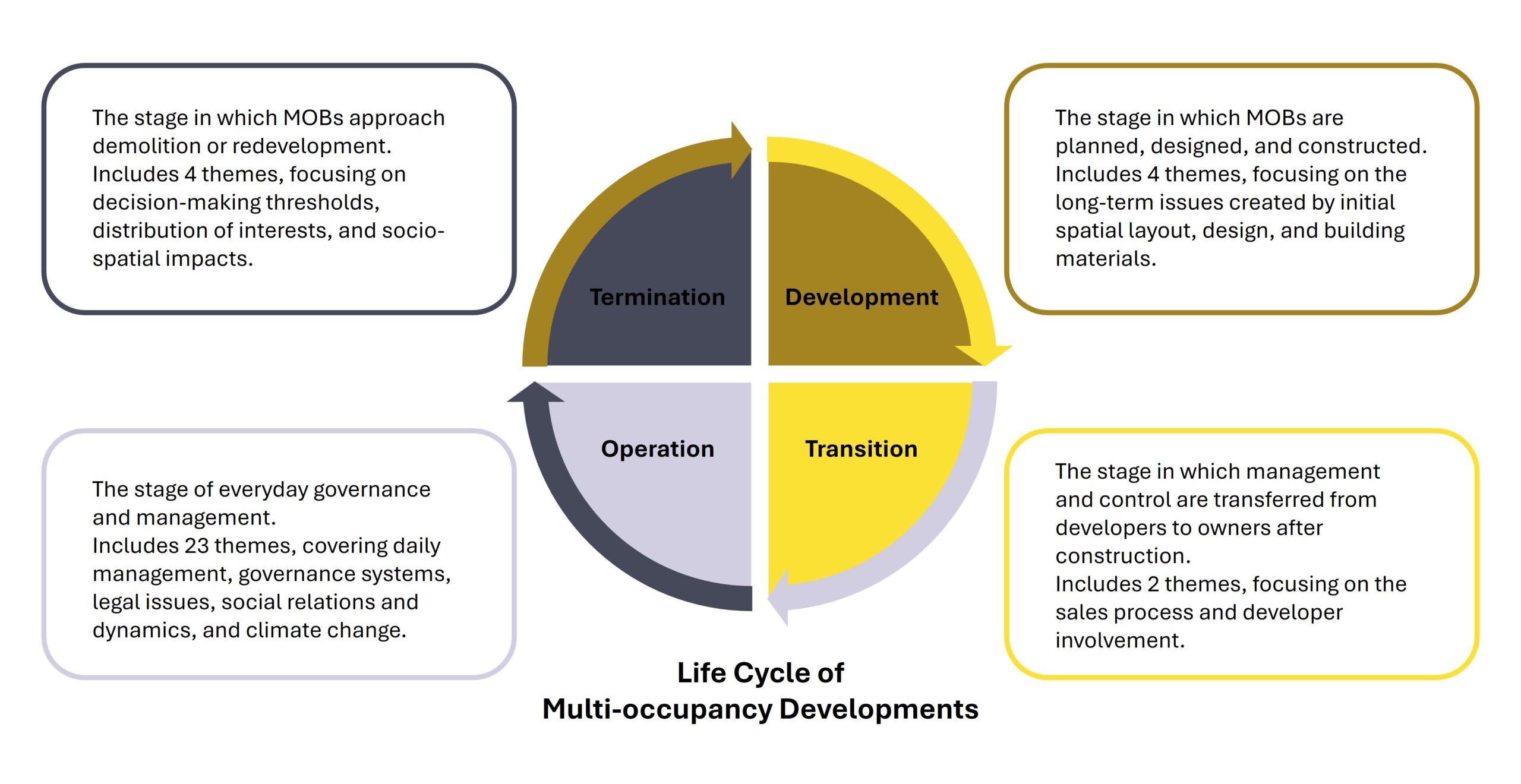
In total, we reviewed the full texts of 74 sources, covering evidence from 25 countries and regions. Inspired by Easthope and colleagues’ 2014 study, our report presents governance issues chronologically across the life cycle of multi-title developments, distinguishing four stages (Figure 1).
The key challenges associated with resident-led management systems can be summarised under the following themes:
- Shortfalls in collective funds: residents may not always be familiar with the day-to-day operation of buildings or the full range of expenditure required to maintain them. This can make it difficult to develop robust long-term financial plans. As a result, collective funds may fall short, particularly after unexpected and costly repair or maintenance works. When regular payments increase to cover these costs, some residents may struggle to afford them. Late or missed payments can then further widen the funding gap. Inadequate funding for routine maintenance may allow small problems to accumulate, resulting in larger risks and more costly repairs over time.
- Professionalisation: the everyday management of MOBs involves a wide range of complex and often highly specialised tasks, including facilities management, building services, structural maintenance, fire safety, legal matters, finance and security. These specialist and technical areas may be difficult for residents to fully understand or oversee. This contributes to reliance on outsourced professional services, such as managing agents, where residents may not have the knowledge or capacity to assess the quality of provision. The expertise, technical capacity and professional standards of managing agents can also vary considerably. When the services provided don’t match the costs paid by residents, this can lead not only to financial loss, but also to poor management decisions that may affect the long-term safety of buildings and contribute to disputes within communities.
- Juridification: the ownership and management of MOBs involves extensive legal and contractual arrangements. However, over-reliance on legal expertise can increase the influence of legal professionals in decision-making processes. International evidence suggests that this may lead to costly legal services and, in some cases, outcomes that undermine residents’ interests. This is particularly problematic where some residents form alliances with professional experts and use unequal access to specialist knowledge to influence collective decisions.
- Dispute resolution: resolving disputes can be costly and time-consuming, especially when cases proceed to tribunal. Disputes arising from everyday management can have many causes, including pets, the use of shared space, noise and disagreements over use of collective funds and decision-making and control. These disputes can disrupt the normal functioning of everyday building management. Before reaching mediation or tribunals, disputes often require the involvement of resident committees. However, committees may not always have the capacity, expertise or authority needed to achieve acceptable outcomes.
- Neglect of tenants’ needs: in resident-led governance models, participation in decision-making is often tied to property ownership. This means that tenants may find that their needs and voices are easily overlooked, even where they make up a substantive part of building occupants.
International evidence shows that residents and resident committees often lack sufficient capacity and training to identify and resolve problems arising from the complexity and professionalisation of MOB governance. Unequal access to information can hinder effective decision-making and negotiation with professional service providers. In addition, widespread apathy among residents can make it even harder to challenge poor decisions, as effective oversight often requires substantial time and effort in communication and a sufficient level of participation in collective affairs and voting.
Many governance problems also emerge before residents move in. At the physical level, these include design features, unclear boundaries, unsuitable materials and facilities that may create later management problems. Developer involvement can also be a source of longer-term issues. Before control is transferred to residents, developers may leave behind problematic by-laws and service contracts, or retain ownership of some units or spaces, giving continued influence on future decisions. Because collective action can be difficult to organise, these issues are often hard to resolve. Combined with later challenges in everyday management, they can lead to financial losses for residents and conflicts within communities. In the long term, the accumulation of these problems may create risks for building safety and residents’ wellbeing, eventually requiring further public intervention.
The international evidence is relatively silent on the challenges of resident-led governance of mixed-tenure buildings. This is likely to be a significant challenge in England and Wales, because of the ways in which affordable housing is developed in mixed tenure and pepper-potted schemes. This is less common in countries such as Australia, Canada, and the US (where most research has been carried out).
Drawing on the strategies proposed in the existing literature, we summarise the following policy recommendations:
- Government should introduce measures to encourage or require developers to disclose key information at the point of sale. This should include whole-life cost assumptions, climate change risks and adaptation, and the future operation of the building. Such information would help residents develop more effective maintenance and financial plans.
- Government should consider providing a portal that brings together developer records, including examples of good and poor practice, to reduce the cost and difficulty for residents in accessing information and making informed decisions.
- Government should strengthen regulation of the transition process from developer- to resident-control. This would help prevent problematic by-laws, service contracts and other developer-led arrangements from having lasting negative effects.
- Government should legislate to limit developer influence over resident-led governance models – for example, by restricting the period during which proxy voting rights can be exercised by developers.
- Government should establish a more comprehensive professional accreditation system for managing agents. This should set standards for professional competence and conduct, alongside mechanisms for regulation, accreditation, and the removal of accreditation where standards aren’t met.
- Government should continue to refine and clarify legal frameworks and guidance, recognising that the challenges facing MOBs, and the solutions they require, vary from building to building. Practical guidance can provide an important reference point when residents address conflicts of interest and governance problems.
- Government should provide support and training for residents and committees on the practical work of building management, including democratic procedures, conflict resolution, financial planning, maintenance planning, and guidelines on engaging tenants and other non-owner occupants.
Taken together, international experience shows that resident-led governance models require appropriate intervention and support from an early stage. Reducing the financial, emotional and time costs of resident governance is essential if democratic mechanisms are to work effectively and prevent building safety risks and wider social problems from emerging over time.
Dr Yu-Tung Wu is a Research Associate at the University of Sheffield
Funding statement: the research was funded by the UK Collaborative Centre for Housing Evidence (ESRC grant number ES/W012278/1)
Can you help us to understand how Housing Associations are preparing for Commonhold, and the challenges you face? Contact Yu-Tung Wu ([email protected]) for more information