
 By Dominic Bradley, CEO, Lenches Trust
Ageing population, rising building costs and net-zero targets are among the many challenges that aren’t just putting social housing providers under increasing pressure but exposing the limitations of traditional later living solutions. Large scale, purpose-built, purpose-managed retirement schemes have long been considered the go-to option. But for some older people, it’s been at the expense of removing the independence and ability to contribute they value the most, including being able to work.
We believe now is the time to not just look at how we can build more, but whether what we’re building has an impact – not just meeting needs but being desirable and connecting people into the nature that surrounds them. This idea around nature connectivity has led to us developing our pilot eco-pod woodland housing scheme in the heart of Birmingham.
Woodland home-from-home
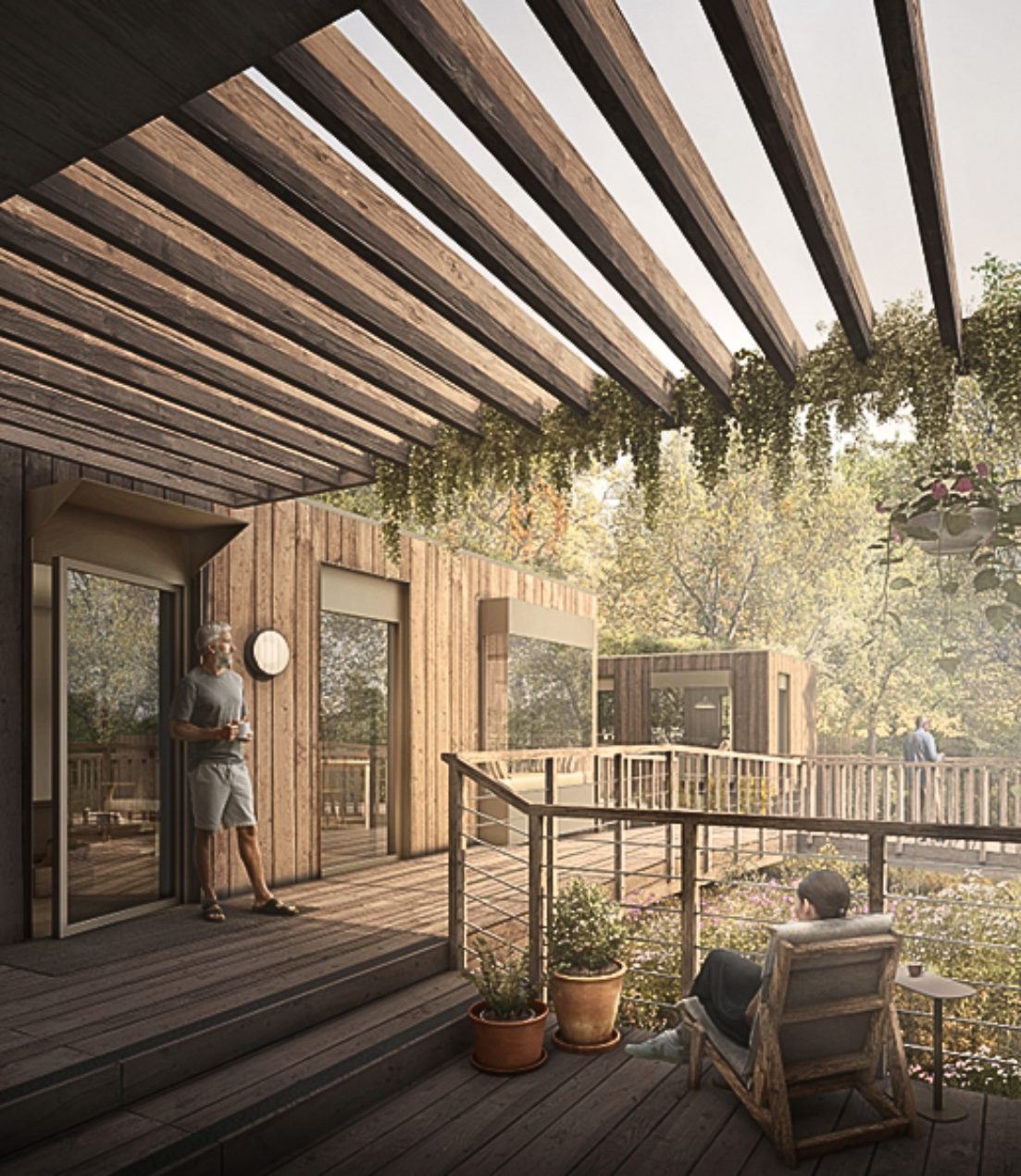
The scheme is set to take shape within just 3.5 miles from the city centre, in a hidden, self-seeded woodland in Quinton. Six single-storey residential pods, spanning 37 square metres each, will be installed within the woodland and connected to each another by a decked walkway. Each ‘woodland home’ will comprise a bedroom, wet room, open-plan kitchen, living and dining area, and a study. Prefabricated timber components will be manufactured off-site and assembled on-site as a modular system, reducing waste, construction time and environmental impact. Crucially, while each pod will be built from the same standardised parts, the orientation and site-specific placement of each unit means that no two pods will be identical, maximising natural light into the homes.
External timber cladding, green roofs, large windows that frame the canopy, and French doors opening out on to private and shared terraces will blur the boundary between the inside and out. Elevated above the woodland floor on screw-pile foundations, the pods will minimise disruption to tree roots, plant life and wildlife habitat.
Rethinking land as a social asset
One of the most significant elements of the pilot is how the space around the eco pod homes will be maintained. Residents will be invited to take collective responsibility for their shared woodland environment, participating in the stewardship of the greenery around them. In turn, this approach is designed to help tackle social isolation by building a sense of belonging and mutual care into the development. Housing that keeps older residents connected to wider community life, rather than concentrating them in age-segregated environments, is essential for enhancing their everyday wellbeing and health.
At the same time, the woodland will be given a new lease of life – a stark contrast from historic fly-tipping and drainage challenges that have plagued the site. A comprehensive drainage solution, biodiversity net gain enhancements and new ponds will be introduced. Short-lived poplar tree species will also be replaced with native oak, field maple, cherry and hornbeam to create a healthier, more resilient woodland for generations to come.
We’re under no illusion that our eco-pod concept is a solution for every site or community. What we do believe it offers, however, is an important test case – a carefully considered challenge to the assumption that later living social housing must follow a single, familiar template. Just like our residents embrace change, so should we. Lench’s has lasted 500 years for that very ambition.
Exciting times lie ahead, and we look forward to our Quinton pilot to help provide the beginning of an answer, as well as spark a much broader conversation within our sector.