



 By Dr Alice Earley, Research Associate, UK Collaborative Centre for Housing Evidence, University of Glasgow, Kenneth Gibb, Professor in Housing Economics at the University of Glasgow where he directs the UK Collaborative Centre for Housing Evidence, and Alex Marsh, Professor of Public Policy at the School for Policy Studies, University of Bristol.
This piece is a summary of a 2025 article published in the Political Quarterly, entitled The Policy and Politics of Improving Standards in the English Private Rented Sector by the above authors.
Introduction
The challenges regarding standards in the English PRS are well-established, including issues regarding inadequate renovation, maintenance and upgrading. Despite policy and legislation to improve standards, enforcement challenges remain. Our 2025 article argues for a need to think more expansively about the practical policy interventions that could help improve PRS standards, with the need to focus on more powerful leverage points associated with the design and intent of the system, to achieve transformative change towards a stronger culture of compliance with standards.
Identifying the causes
The supply and demand-side factors contributing to these challenges are well-known. On the supply-side, inadequate access to social-rented and owner-occupied homes means that many are living in the PRS who wouldn’t traditionally have done so. Further, the number of small-scale landlords in the sector means that landlords may not be well-informed about their responsibilities, and may not have business models in place to be able to easily pay for routine repairs and maintenance. Moreover, landlords may struggle to understand and follow often complex legislation. Finally, some landlords operate outside the law.
Regarding demand, tenants may be scared to exercise their rights if there’s a maintenance issue, for fear of eviction, due to insufficient security of tenure. Moreover, tenants may not know their rights to be able to exercise them in the first place. Furthermore, austerity has led to reductions in housing advice and support functions, further disadvantaging tenants. Finally, concerns have been raised about the nature, scale and administration of sanctions for landlord non-compliance.
The developing policy response
In response to these challenges, successive governments have aimed to strengthen policy and legislation to improve PRS standards. Labour’s Renters’ Rights Act aims to increase the rights and protections of renters. Key to this is the abolition of Section 21 ‘no fault’ evictions and reforming the grounds for repossession. The act also extends the Decent Homes Standard to the PRS, introduces a new ombudsman, creates a new PRS database, and strengthens local authority enforcement powers.(1)
Developing policy, seeking additional leverage
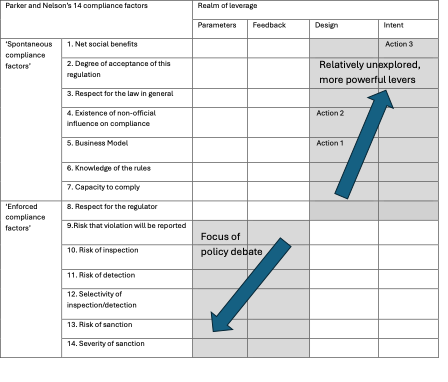
In terms of how best to regulate standards, we argue for a broader understanding of the drivers of compliance, considering the ‘spontaneous’ factors which influence landlord behaviour, as well as the ‘enforced factors’ (see Figure 1).
We argue for considering the role of ‘deeper’ leverage points, following the work of Donella Meadows, to identify policy interventions which can change system behaviour. Existing policy debate tends to focus on the relatively shallow realms of leverage, with parameters and feedback in the bottom-left quadrant of the table, whereas those realms likely to be more effective – design and intent – and associated with spontaneous compliance (in the top-right quadrant) – remain relatively unexplored. There’s a need to pay greater attention to these deeper leverage points.
The provisions introduced in the Renters’ Rights Act operate on ‘enforced’ compliance factors and information accessibility. These policies are dependent upon a strong element of consumerism: the key mechanism for remedying non-compliance is tenants asserting their rights, either directly or by raising issues with the local authority.
There’s uncertainty regarding whether these reforms are sufficient, with a question about whether adequate resources will be available for local authorities to fulfil their new responsibilities.
What policy could be doing
There’s arguably a case for focusing on the deeper leverage points that have greater potential to address the causes, rather than just symptoms, of the issues. We identify three potential areas for action:
- Professionalising business models to increase the likelihood of adequate property maintenance.
- Utilising alternative, non-official influences on compliance which can potentially alert local authorities to non-compliance.
- Identifying how we can delegitimise the provision of inadequate PRS accommodation, thus changing social norms.
Barriers to accessing deeper leverage points
We identify three key barriers to change:
- Issues of organisation and consistency of purpose, with a need for a long-term strategic approach to the housing system and issues by government.
- Challenges relating to affordability, public spending and housing supply.
- A need for greater clarity and consensus over the purpose of the PRS, with consideration of how we can shift the debate to prioritise housing as a right, over housing as a commodity.(2)
Concluding thoughts
A systems-thinking approach can offer a fruitful route forward to think more expansively about interventions. This helps bring barriers to policy change more clearly into focus, with a need for considerable thought and care regarding system redesign and shifting system intent. To access and operate these levers requires engaging with fundamental questions within housing policy, including how – and where – to embed good-quality housing as a right.
Footnotes
1 https://www.gov.uk/government/publications/the-renters-rights-act-information-sheet-2026
2 M. Pattillo, ‘Housing: commodity versus right’, Annual Review of Sociology, vol. 39, 2013, pp. 509–531; D. Rogers and C. McAuliffe, ‘Housing’s values: housing as an ethical urbanism’, Environment and Planning F, 2023.